
PTE Exam Pattern 2026: Full Format, Question Types & What Changed
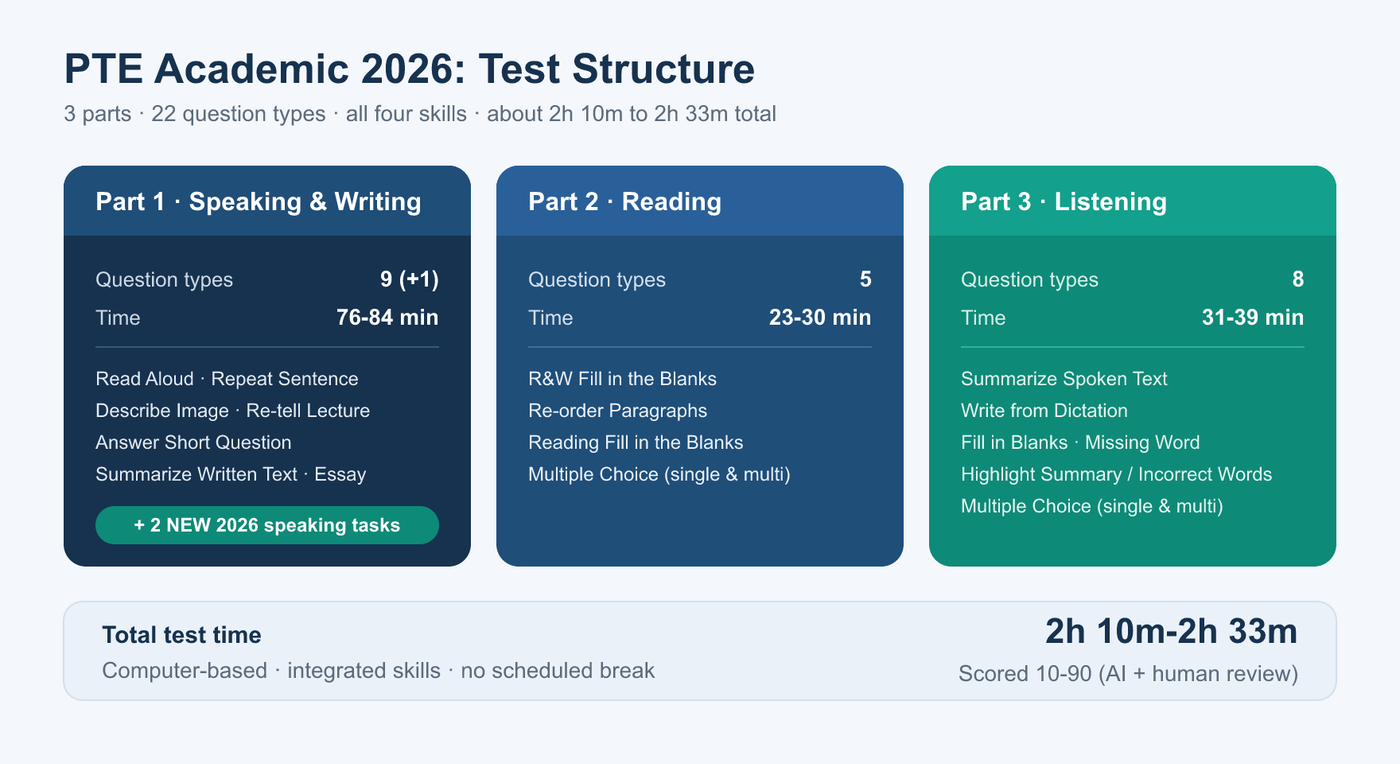
PTE Academic 2026 has three parts, Speaking and Writing, Reading, and Listening, with 22 scored question types and 65 to 75 items in total. Based on Pearson's published part timings, the test runs about 2 hours 10 minutes to 2 hours 33 minutes depending on your form. The 2026 update added two Speaking and Writing tasks (Summarize Group Discussion and Respond to a Situation) and scores you from 10 to 90 using a mix of AI and human review. This guide breaks down every section, what changed, the score you need, and exactly what to practise first.
Always confirm exact question counts and timing on the official Pearson test format page before your test day, as Pearson updates test forms periodically.
What is the PTE exam pattern in 2026?
The PTE Academic 2026 exam pattern is a single, computer based test split into three parts that together assess all four English skills: speaking, writing, reading, and listening. You sit at a computer in a test centre, speak into a headset, and type your answers, with no scheduled break between parts.
What makes PTE different from other English tests is that its tasks are integrated: many questions test two skills at once. When you read a paragraph aloud, you are scored on both reading and speaking; when you write what you hear in a dictation task, you are scored on both listening and writing. This is why your section scores can feel surprising if you only prepared one skill at a time.
Here is the full structure you will face on test day, verified against Pearson's test format pages as of 14 August 2026:
- Part 1: Speaking & Writing · 9 scored (+ 1 unscored intro) · 76-84 min
- Part 2: Reading · 5 · 23-30 min
- Part 3: Listening · 8 · 31-39 min
- Total: All four skills · 22 scored, 65-75 items · about 2h 10m-2h 33m
Pearson does not publish one official total test time. The range above comes from adding its three published part bands together, so treat "about 2 hours 15 minutes" (a number you will see on many other sites) as a rough midpoint, not an exact figure.
What changed in the PTE exam in 2026?
The biggest change in 2026 is that Pearson added two new Speaking and Writing tasks and made Part 1 longer to fit them. The test moved from around 20 question types to 22, and Part 1 grew to 76-84 minutes. The intent behind the change is clear: the new tasks test how you communicate in real, unscripted situations rather than how well you memorise templates.
The two new tasks are worth understanding before you build a study plan. Summarize Group Discussion plays you a discussion between three people and asks you to summarise it in your own words. You get about 10 seconds to prepare and around 2 minutes to speak, and simply repeating what was said, without paraphrasing, lowers your score. Respond to a Situation describes an everyday scenario, such as explaining a problem to a professor or a landlord, and asks you to give a natural spoken response. You can start practising both, prep timing and all, on the Summarize Group Discussion and Respond to a Situation practice pages.
The scoring also evolved. PTE is still mostly AI scored for speed, but in 2026 the content of certain responses is reviewed by both AI and human experts, with a second human stepping in if the two disagree. Essays, in particular, get expert review on structure, clarity, and language. The practical takeaway is that genuine, well organised answers now matter more than ever, and template only answers are easier to spot.
What is in Part 1: Speaking & Writing?
Part 1 is the longest and most heavily weighted section, combining spoken tasks and two written tasks into 76-84 minutes. It opens with an unscored Personal Introduction to warm you up, then moves through speaking tasks before finishing with writing. Because so many tasks here feed both your Speaking and Writing scores, this is the section to prioritise if you want the fastest overall gains.
The Speaking & Writing tasks you will see, with the typical number of items per form, are:
- Read Aloud (6-7 items) - read a short paragraph (up to 60 words) aloud; scored on content, fluency, and pronunciation.
- Repeat Sentence (10-12 items) - listen to a sentence and repeat it exactly.
- Describe Image (5-6 items) - describe a chart, graph, map, or picture in about 40 seconds.
- Re-tell Lecture (2-3 items) - listen to a short lecture, then re-tell it in your own words.
- Answer Short Question (5-6 items) - answer a simple question in one or a few words.
- Summarize Group Discussion (2-3 items, new 2026) - summarise a three person discussion, paraphrasing rather than repeating.
- Respond to a Situation (2-3 items, new 2026) - give a natural spoken reply to an everyday scenario.
- Summarize Written Text (2 items) - read a passage and write a single sentence summary of up to 75 words.
- Write Essay (1 item) - write a 200-300 word argumentative essay in about 20 minutes.
What is in Part 2: Reading?
Part 2 is the shortest section, with five question types in 23-30 minutes, and it tests how well you understand academic texts. Despite its name, Reading & Writing: Fill in the Blanks scores Reading only, not Writing, per Pearson's Score Guide. The section is mostly multiple choice and drag and drop, which means accuracy and vocabulary matter more than speed.
The Reading tasks are: Reading & Writing: Fill in the Blanks, dropdown (5-6 items), Multiple Choice, choose multiple answers (2-3 items), Re-order Paragraphs (2-3 items), Reading: Fill in the Blanks, drag and drop (4-5 items), and Multiple Choice, choose a single answer (2-3 items). Building academic vocabulary and learning to spot logical connectors are the two highest return things you can practise for this part.
What is in Part 3: Listening?
Part 3 tests listening through eight question types in 31-39 minutes, and several of these tasks also feed your Writing and Reading scores. The section begins with Summarize Spoken Text, where you write a 50-70 word summary of a short lecture, and ends with Write from Dictation, where you type a sentence exactly as you hear it. Write from Dictation is the single highest value task to drill, because every correct word boosts both your Listening and Writing scores.
The Listening tasks are: Summarize Spoken Text (1 item), Multiple Choice, choose multiple answers (2-3 items), Fill in the Blanks (2-3 items), Highlight Correct Summary (2-3 items), Multiple Choice, choose a single answer (2-3 items), Select Missing Word (1-2 items), Highlight Incorrect Words (2-3 items), and Write from Dictation (3-4 items). Because this section comes last, training your concentration for a sitting of over two hours is as important as the listening skill itself.
How is the PTE exam scored in 2026?
PTE Academic is scored from 10 to 90 on the Global Scale of English, and you receive an overall score plus four communicative skill scores for Speaking, Writing, Reading, and Listening. Because tasks are integrated, one task can affect several scores. Repeat Sentence lifts both Listening and Speaking, while Write from Dictation lifts both Listening and Writing. If you want the full breakdown of how the bands map to levels, see our PTE score chart, or convert any score with our PTE to IELTS score converter.
To plan your preparation, it helps to know the common target scores and what they open up:
- 79 (each): "Superior English", maximum English points for Australia (the 20 point band)
- 65 (each): "Proficient English", a common university and visa requirement
- 58 (each): "Competent / Vocational" English for many visa and registration paths
- 50 (each): Entry threshold for some courses and pathway programs
Score requirements change and differ by country and institution. This matters more than ever for the UK, where the Skilled Worker visa route raised its required English level from B1 to B2 on 8 January 2026. Always verify your target on the official immigration or university website before booking. Our PTE score requirements for Australia and the UK guide covers both markets in detail, or see the PTE for Australia and PTE for the UK pages for the current thresholds by visa route.
What should you practise first? (a starting action plan)
If you are starting from scratch, focus your first two weeks on the highest-value tasks rather than spreading yourself thin. The tasks below give the most score for the least effort because each one feeds two skills at once, so improving them lifts multiple section scores together.
Use this priority checklist for your first sessions:
- Write from Dictation - drill daily; it boosts Listening and Writing fastest.
- Repeat Sentence - chunk sentences by meaning rather than memorising word for word; boosts Listening and Speaking.
- Highlight Incorrect Words - spot where the transcript differs from the audio; boosts Listening and Reading.
- Summarize Written Text - master the one sentence formula; quick to learn, reliable marks.
- The two new 2026 tasks - practise real spoken responses, not memorised scripts.
- Take one full length, timed mock test to build stamina for a sitting of over two hours.
The fastest way to act on this list is to practise each task with instant, exam style feedback so you can see your score move. Start free PTE practice on KoorooPTE to drill these tasks with AI scoring that mirrors the real test.
Should you choose PTE in 2026?
PTE is a strong choice in 2026 if you want fast results and prefer a computer marked test over a face to face interview. Results typically arrive quickly, the test is widely accepted for study and migration in Australia, the UK, and many other countries, and the AI driven format is consistent. If you are still deciding between tests, our PTE vs IELTS comparison walks through which one fits different goals.
Frequently asked questions
What is the PTE exam pattern for 2026?
The 2026 PTE Academic exam has three parts, Speaking and Writing, Reading, and Listening, covering 22 scored question types and 65 to 75 items in total. It is fully computer based and scored from 10 to 90 by a mix of AI and human review.
What are the new PTE question types in 2026?
Two new tasks were added to the Speaking and Writing part: Summarize Group Discussion, where you summarise a three person discussion in your own words, and Respond to a Situation, where you give a natural spoken reply to an everyday scenario.
How long is the PTE exam in 2026?
Pearson does not publish one single total time. Based on the three published part bands, Speaking and Writing 76 to 84 minutes, Reading 23 to 30 minutes, and Listening 31 to 39 minutes, the test runs about 2 hours 10 minutes to 2 hours 33 minutes with no scheduled break.
How many questions are on the PTE exam in 2026?
A PTE Academic 2026 form carries 22 scored question types across roughly 9 in Speaking and Writing, 5 in Reading, and 8 in Listening, totaling 65 to 75 items. Exact counts per type vary between test forms because Pearson balances the total length of each form.
Is PTE 2026 harder than before?
PTE 2026 is not necessarily harder, but it rewards natural communication over memorised templates. The new tasks test spontaneous speaking, so candidates who practise real responses tend to do better than those relying on rote scripts.
How is PTE scored in 2026?
PTE 2026 is scored from 10 to 90 on the Global Scale of English. Most responses are scored by AI, and the content of certain answers is also reviewed by human experts, with a second human resolving any disagreement.