
PTE Score Chart Explained: What 10-90 Really Means (2026)
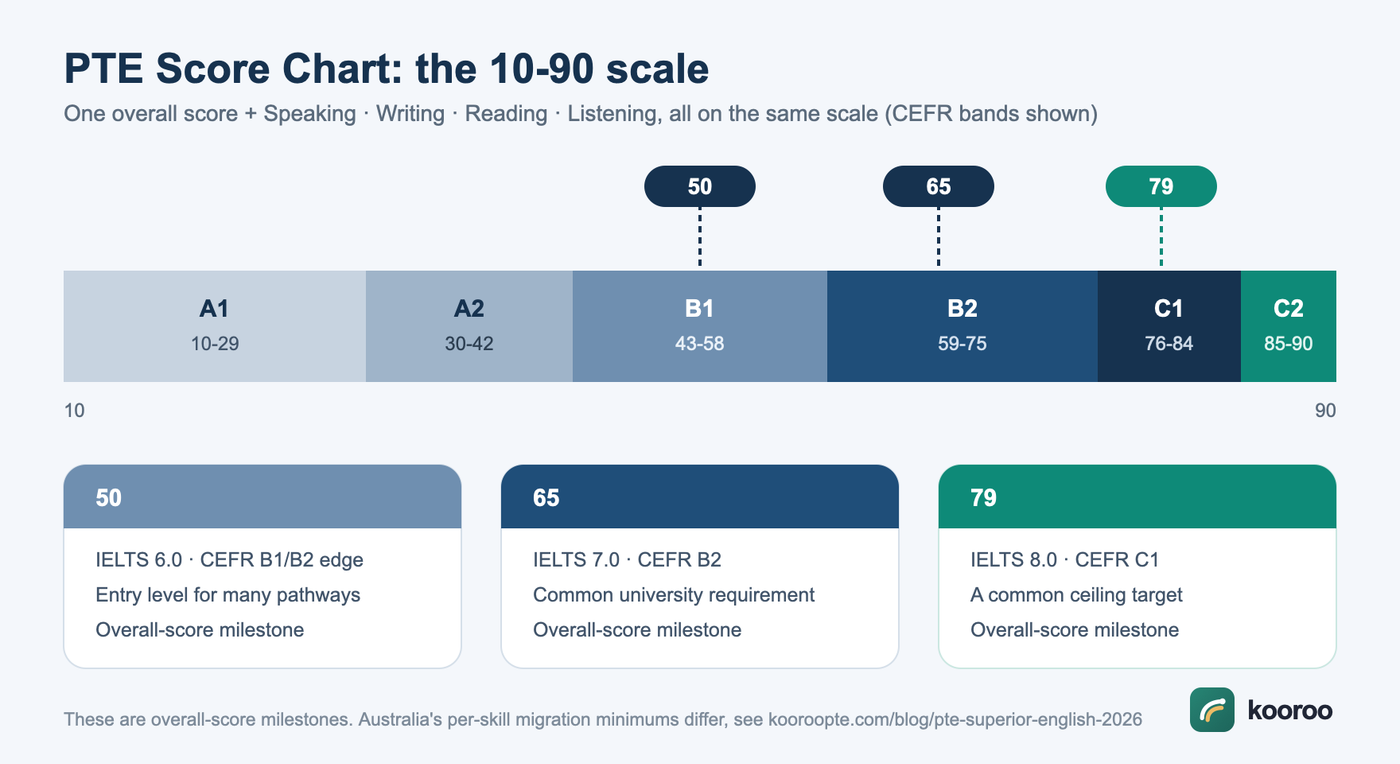
PTE Academic scores you from 10 to 90 on the Global Scale of English, with one overall score plus separate scores for Speaking, Writing, Reading, and Listening. On the score chart, 79+ maps to IELTS 8.0, 65 to IELTS 7.0, and 50 to IELTS 6.0, and the overall score is not an average of the four skills. Note for Australia-bound readers: those three numbers are Pearson's IELTS concordance milestones, not Australia's current per-skill requirements, which changed on 7 August 2025 and are covered further down. This guide shows you how to read the chart, convert your score, and pick the right target before you book.
Score requirements change and differ by country and institution. Always verify your exact target on the official Pearson scoring guide and your university or immigration authority's website before booking.
What is the PTE score chart?
The PTE score chart is the 10-90 scale Pearson uses to report every PTE Academic result, aligned to the Global Scale of English. You receive five numbers: an overall score and four communicative skill scores (Speaking, Writing, Reading, and Listening) each reported on the same 10-90 scale. There are no "bands" like IELTS; every single point from 10 to 90 is a possible score.
Pearson groups the scale into CEFR levels so institutions can read your level instantly. This is the official mapping:
- 85-90: C2 · Near-native command; understands virtually everything heard or read
- 76-84: C1 · Fluent, spontaneous English; above most undergraduate requirements
- 59-75: B2 · Confident academic English; the range most universities ask for
- 43-58: B1 · Handles familiar topics; entry level for some pathways and visas
- 30-42: A2 · Simple, routine exchanges only
- 10-29: A1 · Basic phrases and everyday expressions
Three milestone scores matter more than the rest because universities anchor to them: 50 (roughly IELTS 6.0), 65 (IELTS 7.0), and 79 (IELTS 8.0). These are overall-score milestones, not Australia's current migration thresholds; Australia moved to per-skill minimums on 7 August 2025, covered later in this guide. Deciding which milestone you need is the single most useful thing you can do before you start preparing: the PTE exam pattern 2026 guide shows what you'll face on test day.
How is the PTE overall score calculated?
The PTE overall score is calculated from your performance on every scored item in the test: it is not an average of your four skill scores. Pearson weighs all your responses across the whole test, which is why your overall score often sits a point or two away from what averaging Speaking, Writing, Reading, and Listening would give you.
Two mechanics on the scoring system catch most test-takers by surprise:
- Tasks are integrated: one answer feeds two scores. Repeat Sentence counts toward Listening and Speaking. Write from Dictation counts toward Listening and Writing. Summarize Written Text feeds Reading and Writing. Neglecting one "small" task can quietly drag down two skills at once.
- Partial credit is everywhere, and some tasks subtract. Most items award points for each correct element rather than all-or-nothing. But multiple-answer multiple-choice and Highlight Incorrect Words deduct a point for every wrong selection (never below zero on the item), so guessing extra options costs marks.
Since the 2026 format update, scoring combines AI with human review: AI scores every response for speed and consistency, and human experts also review the content of certain responses, with a second human resolving disagreements. Genuine, well-organised answers beat memorised templates under this system. Your score report also includes a Skills Profile, a breakdown of sub-skills with improvement suggestions, which replaced the old separate "enabling skills" scores.
What is the PTE to IELTS score conversion?
PTE 65 equals IELTS 7.0, PTE 79 equals IELTS 8.0, and PTE 50 equals IELTS 6.0 under Pearson's published concordance. The full conversion:
- 86+: IELTS 9.0, Expert.
- 83-85: IELTS 8.5.
- 79-82: IELTS 8.0.
- 73-78: IELTS 7.5.
- 65-72: IELTS 7.0.
- 58-64: IELTS 6.5, a common university cut-off.
- 50-57: IELTS 6.0.
- 42-49: IELTS 5.5.
- 36-41: IELTS 5.0.
- 30-35: IELTS 4.5.
These are overall-score bands from Pearson's own concordance, not Australia's per-skill migration requirements. Australia's Competent, Proficient and Superior English labels do not map cleanly onto this table any more, since each now sets a different minimum per skill rather than one overall number; see the Australia section below for the real thresholds.
Pearson publishes this concordance for overall scores; mapping individual skills the same way is a common convention but not officially endorsed, and your institution's own equivalence table is final. Use our interactive PTE to IELTS score converter to check any score both ways. Many students find the tests reward different strengths, typing skills help in PTE, face-to-face fluency in IELTS, so if you're still choosing, our PTE vs IELTS comparison breaks down which suits you.
What PTE score do you need for Australia, Canada, and the UK?
For Australia, the flat 50/65/79-in-each-skill rule you may have seen elsewhere is out of date. For a PTE Academic test sat on or after 7 August 2025, Home Affairs uses different minimums per skill: Competent English needs at least Listening 47, Reading 48, Writing 51, Speaking 54 (0 points); Proficient needs Listening 58, Reading 59, Writing 69, Speaking 76 (10 points); Superior needs Listening 69, Reading 70, Writing 85, Speaking 88 (20 points). Points are assessed on your lowest communicative skill, not your overall score, and Writing and Speaking now need noticeably more than Listening and Reading. Our PTE Superior English 2026 guide covers why the gap is so uneven and what to practise first.
For Canada, PTE Academic is not accepted for permanent residency; IRCC requires PTE Core for Express Entry, PR, and citizenship, converting scores to CLB levels skill by skill. PTE Academic remains accepted for study permits at many Canadian institutions. If Canada PR is your goal, see our PTE Core to CLB converter and the PTE for Canada page before booking anything.
For the UK, degree-level students typically need PTE Academic scores set by their university (commonly 59-67 overall with skill minimums), while work visas and below-degree study require the PTE Academic UKVI test, which has the same format but is booked as a SELT. Verify every threshold on the official immigration or university page; these numbers change without much notice.
Why is one of your skill scores lower than the rest?
One skill usually lags because the integrated tasks feeding it are underperforming, not because you're weak at that skill in isolation. Since many tasks score two skills at once, a low Listening score is often caused by weak Write from Dictation answers, and a low Reading score frequently traces back to rushed Re-order Paragraphs or Summarize Written Text attempts.
Use this decision rule to find the real culprit:
- Speaking: Read Aloud, Repeat Sentence, Describe Image: fluency and pronunciation drive it
- Writing: Write from Dictation, Summarize Written Text, Summarize Spoken Text: not just the essay
- Reading: R&W Fill in the Blanks, Re-order Paragraphs, Highlight Incorrect Words
- Listening: Write from Dictation, Summarize Spoken Text, Highlight Incorrect Words
The practical consequence: fixing one high-value task lifts two scores simultaneously. Write from Dictation is the classic example: a few weeks of daily drills typically moves both Listening and Writing.
What score should you target? (a decision plan)
Set your target one milestone above the minimum your goal requires, in every skill, not just overall. Requirements check your lowest skill, test-day nerves cost a few points, and retakes cost money and weeks. Aiming for the exact minimum is the most common planning mistake we see.
Work through this once before you book:
- Write down the exact requirement from the official university or immigration page, overall and per-skill.
- Add a buffer: target at least 3-5 points above every minimum.
- Take a scored mock test to find your current baseline for all four skills.
- Identify your lowest skill and list the integrated tasks that feed it (table above).
- Book your test date only when mocks put every skill at or above target.
The fastest way to run this plan is to practise with scoring that mirrors the real test. Take a free scored practice test on KoorooPTE to get your baseline across all four communicative skills and see exactly which tasks are holding a score down.
Frequently asked questions
What is a good PTE score?
A good PTE score depends on your goal. For most universities, 58-65 overall is competitive. For Australian permanent residency points, Proficient and Superior English now need different minimums per skill, not one overall number: Proficient is Listening 58, Reading 59, Writing 69, Speaking 76, and Superior is Listening 69, Reading 70, Writing 85, Speaking 88. Anything above 76 overall places you in the CEFR C1 band, which is more than most undergraduate courses require.
Is the PTE overall score an average of the four skills?
No. Pearson calculates the overall score from your performance on every scored item in the test, not by averaging the four communicative skill scores. Because many tasks score two skills at once, your overall score can sit above or below the simple average of Speaking, Writing, Reading, and Listening.
What is PTE 65 equal to in IELTS?
PTE 65 is equivalent to IELTS band 7.0 under Pearson's published concordance. The nearby anchors are PTE 58 for IELTS 6.5 and PTE 73 for IELTS 7.5. Institutions set their own cut-offs, so always check whether they want 65 overall only or 65 in every skill.
What PTE score is equal to IELTS 8?
PTE 79 is equivalent to IELTS band 8.0 on Pearson's overall-score concordance. Australia no longer treats a flat 79 as Superior English, though: for tests sat on or after 7 August 2025, Superior English needs Listening 69, Reading 70, Writing 85, and Speaking 88, a different minimum per skill rather than one number. Visa authorities check each communicative skill separately, so the per-skill target is what actually matters.
How long is a PTE score valid?
PTE Academic scores are valid for two years from your test date for most purposes, and institutions can see your scores online once you share them. Some visa authorities apply different validity windows (for example, skilled migration rules can accept older tests), so verify the rule for your specific application.
Is PTE Academic accepted for Canada PR?
No, Canadian permanent residency and citizenship applications require PTE Core, not PTE Academic. IRCC converts PTE Core scores to CLB levels skill by skill. PTE Academic is still accepted for Canadian study permits at many institutions. If your goal is Canada PR, book PTE Core from the start.