
Why Is My PTE Speaking Score Low? The Real Reasons (2026)
A low PTE Speaking score almost always traces back to one of three things: weak pronunciation or fluency, a Content score of 0, or practising the wrong task. Speaking is built from three scored traits across six task types, and understanding which one is actually failing is the difference between fixing the real problem and guessing. This guide breaks down exactly what feeds your Speaking score, verified against Pearson's own Score Guide, and what Pearson itself says about accent.
What actually determines your PTE Speaking score?
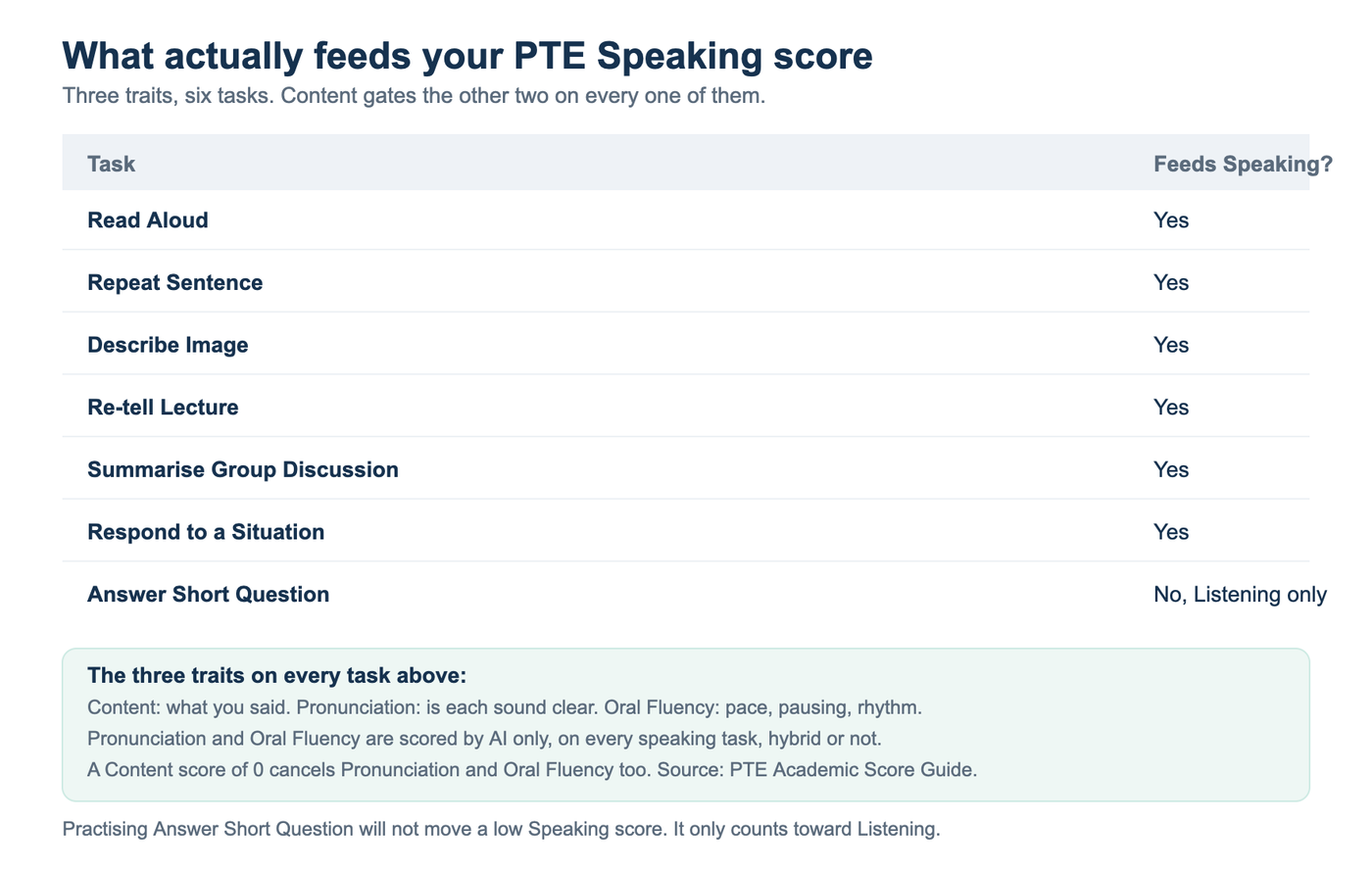
Three traits, scored on every speaking task that counts toward Speaking: Content (what you said), Pronunciation (whether each sound is clear), and Oral Fluency (your pace, pausing, and rhythm). Six task types feed these three traits into your Speaking score: Read Aloud, Repeat Sentence, Describe Image, Re-tell Lecture, Summarise Group Discussion, and Respond to a Situation.
Pronunciation and Oral Fluency are scored by AI only, on every one of those six tasks, whether or not a human also reviews the content. That matters because it means a low Pronunciation or Fluency score is not a matter of opinion or a human's bad day; it is a consistent, repeatable measurement you can actually train against.
Is weak pronunciation dragging your score down?
Pronunciation measures whether your individual sounds and words are clear enough to be understood, not how close you sound to a native speaker. If specific consonants or vowels are consistently unclear, or if you stress the wrong syllable in longer words, that shows up here on every task you speak.
The fix is targeted, not general: record yourself on Read Aloud, where the exact words are fixed, and listen back for which specific sounds you drop or blur rather than judging your speech as a whole. A sound that is unclear in isolation stays unclear across every other speaking task too, so fixing it once compounds.
Is weak fluency dragging your score down?
Oral Fluency measures pace, pausing, and rhythm, whether you speak in a smooth, connected flow or in short bursts with frequent hesitation. Long pauses, filler words, restarting a sentence mid-way, or speaking so fast that words blur together all cost marks here, independently of whether your content and pronunciation are strong.
Fluency and pronunciation are scored separately, so it is entirely possible to have clear individual sounds and still score low on Fluency because of hesitation, or the reverse: smooth pacing undermined by unclear pronunciation. Knowing which one is actually weak, rather than assuming, is what a trait-level breakdown is for.
Could your Content be scoring zero?
This is the cause most guides miss, and it is often the biggest one. Per Pearson's Score Guide, a response built from pre-prepared or memorised material is classified as an irrelevant response and scores Content 0, and once Content is 0, Pronunciation and Oral Fluency are not scored either. A single response that sounded fluent and clear to you can still contribute nothing to your Speaking average if it reads as templated.
This risk is not evenly spread across the six tasks. Describe Image, Re-tell Lecture, Summarise Group Discussion, and Respond to a Situation all carry high template risk, since a fixed opening line or a rehearsed scaffold is exactly what the Content-zero rule targets. Our do PTE templates still work in 2026 guide covers which tasks carry this risk and how to build a genuine response instead of a script; our Describe Image without a template guide covers that task specifically.
Is Read Aloud specifically the problem?
Read Aloud has no content to template, since the words are fixed for you, but it carries its own version of the same risk: rhythmic monotony. A flat, over-rehearsed delivery, the kind that comes from practising the same intonation pattern on every passage, reads to the fluency algorithm as mechanical rather than natural. The fix is the opposite of what feels safe: vary your stress and pacing to match the sentence's actual meaning, the way you would if you were explaining the idea to someone rather than reading it aloud.
Does PTE penalise your accent?
No, according to Pearson's own published position. Pearson states directly that its scoring engine looks for intelligibility and clarity of your response, not which accent you speak in, and that its technology recognises and marks everyone's speech with equal accuracy regardless of where they are from. Pronunciation and fluency are never marked by a human specifically so an accent cannot be judged, and regional or national varieties of English are recognised as long as they stay understandable to most regular speakers of the language. Source: Pearson, "How does PTE Academic mark different accents?"
If your Speaking score is low, the cause is one of the three traits above working against you, not the fact that you speak with an accent.
The task that will not move your Speaking score, no matter how much you practise it
Answer Short Question is spoken, but per Pearson's own task breakdown it counts only toward your Listening score, not Speaking. If your Speaking score is stuck and most of your practice time has gone into Answer Short Question, that is very likely why: you have been drilling a task that structurally cannot move the number you are trying to fix.
How do you find out which trait is actually the problem?
Guessing wastes practice time, since the fix for weak pronunciation, weak fluency, and a Content-zero response are three different things. Work through this order:
- Check whether you are practising the right tasks. Read Aloud, Repeat Sentence, Describe Image, Re-tell Lecture, Summarise Group Discussion, and Respond to a Situation feed Speaking; Answer Short Question does not.
- Get a trait-level breakdown, not just an overall score, so you know whether Content, Pronunciation, or Fluency is the actual weak point rather than guessing from how a response felt.
- Check your highest template-risk tasks first: Describe Image, Re-tell Lecture, Summarise Group Discussion, and Respond to a Situation. A single flagged response can be dragging your average down more than several honestly weaker ones.
- Vary your Read Aloud delivery rather than settling into one rehearsed rhythm across every passage.
- Drop any task-specific memorised script and rebuild your response around a structure you fill in fresh each time.
Practise Read Aloud on KoorooPTE and see your Content, Pronunciation, and Oral Fluency scored separately, so you know exactly which one to fix first instead of guessing.
Frequently asked questions
Why is my PTE Speaking score low even though I feel like I spoke well?
Speaking is scored on three traits, Content, Pronunciation, and Oral Fluency, and a weak result on any one of them can pull the whole score down even if the others felt fine to you. The most severe cause is a Content score of 0 from pre-prepared phrasing, which cancels Pronunciation and Oral Fluency too, so a response that sounded fluent to you can still score close to zero.
Does PTE penalise your accent?
No. Pearson states directly that its scoring engine looks for intelligibility and clarity, not which accent you speak in, and that pronunciation and fluency are marked by AI only, never a human, specifically so accent is not judged. Regional and national varieties of English are recognised as long as they are understandable to most regular speakers of the language.
What is the difference between PTE Pronunciation and Oral Fluency scores?
Pronunciation measures whether each individual sound and word is clear enough to be understood. Oral Fluency measures your pace, pausing, and rhythm, whether you speak in a smooth, natural flow rather than starting and stopping. A learner can be strong on one and weak on the other; they are scored separately on every speaking task.
Which PTE tasks actually affect my Speaking score?
Six of them: Read Aloud, Repeat Sentence, Describe Image, Re-tell Lecture, Summarise Group Discussion, and Respond to a Situation. Answer Short Question is also spoken, but it only counts toward your Listening score, not Speaking, so practising it will not move a low Speaking result.
Can a low Speaking score come from one bad task?
Yes, especially if that task's Content scored 0. Since Content gates Pronunciation and Oral Fluency on the same item, one response built from memorised or pre-prepared phrasing can drag your overall Speaking average down more than several weaker but genuine responses would.