
Do PTE Templates Still Work in 2026? What the Score Guide Actually Says
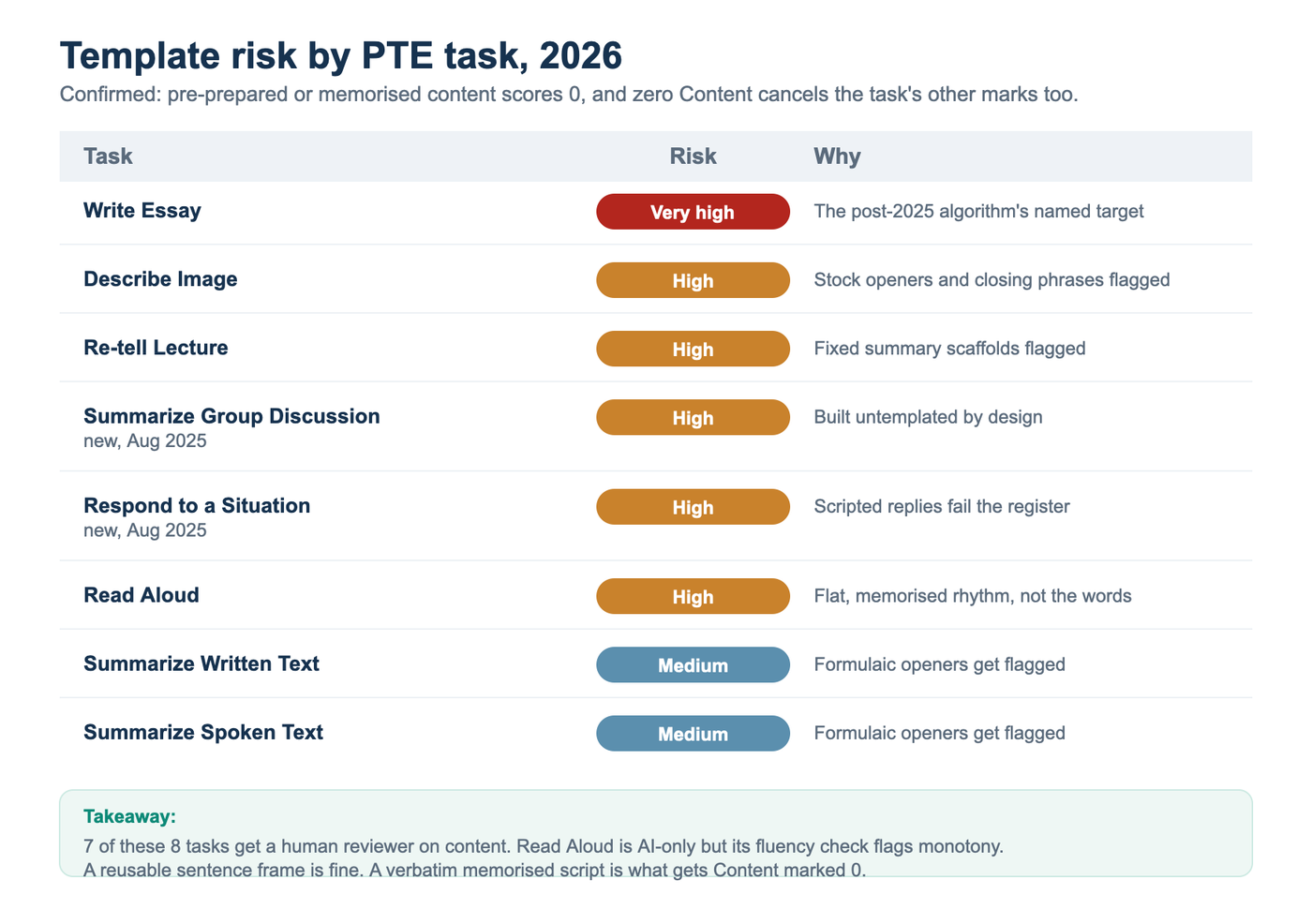
No, not on the tasks that carry the most weight. Pearson's own PTE Academic Test Taker Score Guide states that responses containing pre-prepared or memorised material are classified as irrelevant, which scores Content 0, and a Content 0 cancels every other mark on that task too. That rule alone explains why a "safe" template can cost you an entire item, not a few points. Here is exactly which tasks carry that risk, what is officially confirmed versus community-reported, and what to practise instead.
What does the PTE Score Guide actually say about templates?
Pearson's PTE Academic Test Taker Score Guide states that a response containing pre-prepared or memorised material is classified as an irrelevant response, and irrelevant responses score Content 0. This is the one part of "PTE penalises templates" that comes directly from Pearson's own published document, not from a prep company's marketing.
The part most guides skip is the cascade. Content is not one trait among several; on a speaking or writing task, it gates the rest. When Content scores 0, Pronunciation, Oral Fluency and every other trait on that task are not scored at all, so the response contributes nothing to your section score. A flagged Describe Image answer does not lose two points for a stale opening line; it can zero out the whole item, pronunciation and fluency included.
Which PTE tasks actually get scored on content by a human?
Since the August 2025 refresh, Pearson double-marks the content dimension on seven task types: a human reviewer scores content alongside the AI, with a second human resolving any disagreement. Pronunciation and Oral Fluency stay AI-only across every speaking task, hybrid or not.
- Write Essay: Very high · The task the post-2025 rubric change most directly targets
- Describe Image: High · Stock opening and closing phrases are what typically get flagged
- Re-tell Lecture: High · A fixed summary scaffold reads as memorised, not a genuine retelling
- Summarize Group Discussion (new): High · Built around a live three-person discussion, so a script rarely fits
- Respond to a Situation (new): High · A scripted reply misses the situation's register
- Summarize Written Text: Medium · Formulaic one-sentence openers are the usual flag point
- Summarize Spoken Text: Medium · Same pattern as Summarize Written Text, on a listening source
These seven are Describe Image, Re-tell Lecture, Summarize Group Discussion, Respond to a Situation, Summarize Written Text, Write Essay and Summarize Spoken Text. Read Aloud is not one of them, since it stays fully AI-scored, but it carries its own template risk, covered next.
Does Read Aloud punish templates too, even though it's AI-only?
Read Aloud has no content to template, since you are reading a fixed passage aloud, but it still carries high risk from a different angle: rhythmic monotony. A flat, memorised-sounding delivery, the kind that comes from over-rehearsing the same intonation pattern on every practice passage, reads to the fluency algorithm as mechanical rather than natural. The fix is the opposite of a template: vary your pacing and stress to match the sentence, the way you would if you were actually explaining the idea to someone.
Why are the two new 2026 tasks the hardest to template?
Summarize Group Discussion and Respond to a Situation were added in the August 2025 refresh, and both are built around a prompt that changes every time: a live three-person conversation, or a specific everyday scenario like explaining a problem to a landlord. A fixed script written in advance almost never fits what you actually heard or the situation you were given, so these two tasks reward listening and responding in the moment more than anything on the pre-2025 format. If you have not looked at either task yet, our full PTE exam pattern 2026 guide covers both, plus how they fit into the rest of the test. Practise Summarize Group Discussion and Respond to a Situation live to feel the difference for yourself.
Is Write Essay really the biggest template trap?
Yes, and it is worth treating differently from the rest. Write Essay carries very high template risk because the post-2025 scoring change is most specifically aimed at essay structure: a five-paragraph formula filled in with generic transitions reads as templated even when every sentence is grammatically correct. That does not mean you improvise from a blank page. It means your structure (introduction, position, two developed reasons, conclusion) should stay constant while every sentence inside it responds to the actual prompt. The structure is a tool; the wording is not a script.
What should you practise instead of memorising a script?
The distinction that matters is structure versus script. A structure is a reusable shape, such as "state what the image shows, then interpret the one trend that matters, then close with what it implies," that you fill differently every time. A script is the same sentence, word for word, regardless of the prompt. Structures pass; scripts get flagged.
Use this checklist when you review your own practice recordings or drafts:
- Check your opening line against three different prompts. If it is identical each time, word for word, it is a script.
- Count how much of your response is prompt-specific. A strong Describe Image or Re-tell Lecture answer names details unique to that image or lecture, not just the task category.
- Read your Write Essay draft aloud. If it sounds like it could be pasted onto any topic with two words swapped, rebuild the middle paragraphs around the actual prompt.
- Vary your delivery on Read Aloud. Stress the words that carry meaning in that specific sentence, not the same rhythm every time.
- Practise Summarize Group Discussion and Respond to a Situation cold, without a pre-written answer, so you build the habit of responding to what you actually heard.
How do you know if your own answer sounds templated before test day?
The honest answer is that Pearson does not publish its content rubric, so no prep tool, including ours, can promise an exact match to what its human reviewers see. What we can do is flag the pattern the Score Guide describes directly: on KoorooPTE, your response is checked for spans that match a pre-prepared pattern, and only the words actually present in your own answer are flagged, not a guess. High coverage triggers the same hard gate the Score Guide describes; lower coverage shows as a deduction with the flagged phrases highlighted, and you can appeal a flag once per attempt if you think it is wrong.
Practise Describe Image, Write Essay, Re-tell Lecture and the two new speaking tasks on KoorooPTE with instant feedback that shows you exactly which phrases would get flagged, before test day does it for you.
What is confirmed, and what is still just widely reported?
Worth being precise about, since a lot of PTE content blurs this line. Confirmed, direct from Pearson's Score Guide: pre-prepared or memorised material scores Content 0, and a 0 on Content cancels the task's other marks. Also confirmed, from Pearson's own August 2025 announcement: seven task types now get a human reviewer on content, and the update's stated intent is "moving beyond rote memorisation." What is not an official Pearson publication: specific claims about exactly how much an essay score drops for templated structure, or a published list ranking task-by-task severity. Those patterns are widely reported across test-taker communities and prep providers, including in the risk table above, but they are our best-effort reading of the evidence, not a number Pearson has confirmed. Treat the Content-zero rule as fact and the finer severity gradient as a strong, well-evidenced estimate.
Frequently asked questions
Do PTE templates still work in 2026?
Not on the tasks that matter most. Pearson's Score Guide says pre-prepared or memorised material is classified as an irrelevant response, which scores Content 0. That hits Write Essay, Describe Image, Re-tell Lecture, Summarize Written Text, Summarize Spoken Text and the two new speaking tasks hardest, since those are the seven tasks Pearson now double-marks for content.
What happens if my PTE answer is flagged as templated?
The Score Guide's rule is that Content scores 0 for pre-prepared or memorised responses, and once Content is 0, no other trait on that task is scored either. A flagged Read Aloud or Describe Image response does not just lose a few points; it can zero out the whole item.
Is a sentence frame the same as a template?
No. A sentence frame is a reusable structure you fill with new content each time, such as opening a Describe Image response by naming what the visual shows before you interpret it. A template is a fixed script you recite with the same words regardless of the prompt. Structure is safe; verbatim repetition is not.
Which PTE tasks are safest to answer with a template?
The tasks with no template risk are the ones with a single correct answer: all Reading items, the Listening multiple choice and fill-in-the-blank tasks, and Write from Dictation. There is nothing to memorise there, since you are matching content, not generating it.
Are the two new 2026 speaking tasks harder to template than the old ones?
Yes. Summarize Group Discussion and Respond to a Situation were built around a live, specific prompt, a three-person discussion or a described scenario, so a fixed script rarely fits what you actually heard. They reward listening and responding in the moment more than any task on the old format.