
PTE Summarize Spoken Text 2026: Notes to a Clear Summary
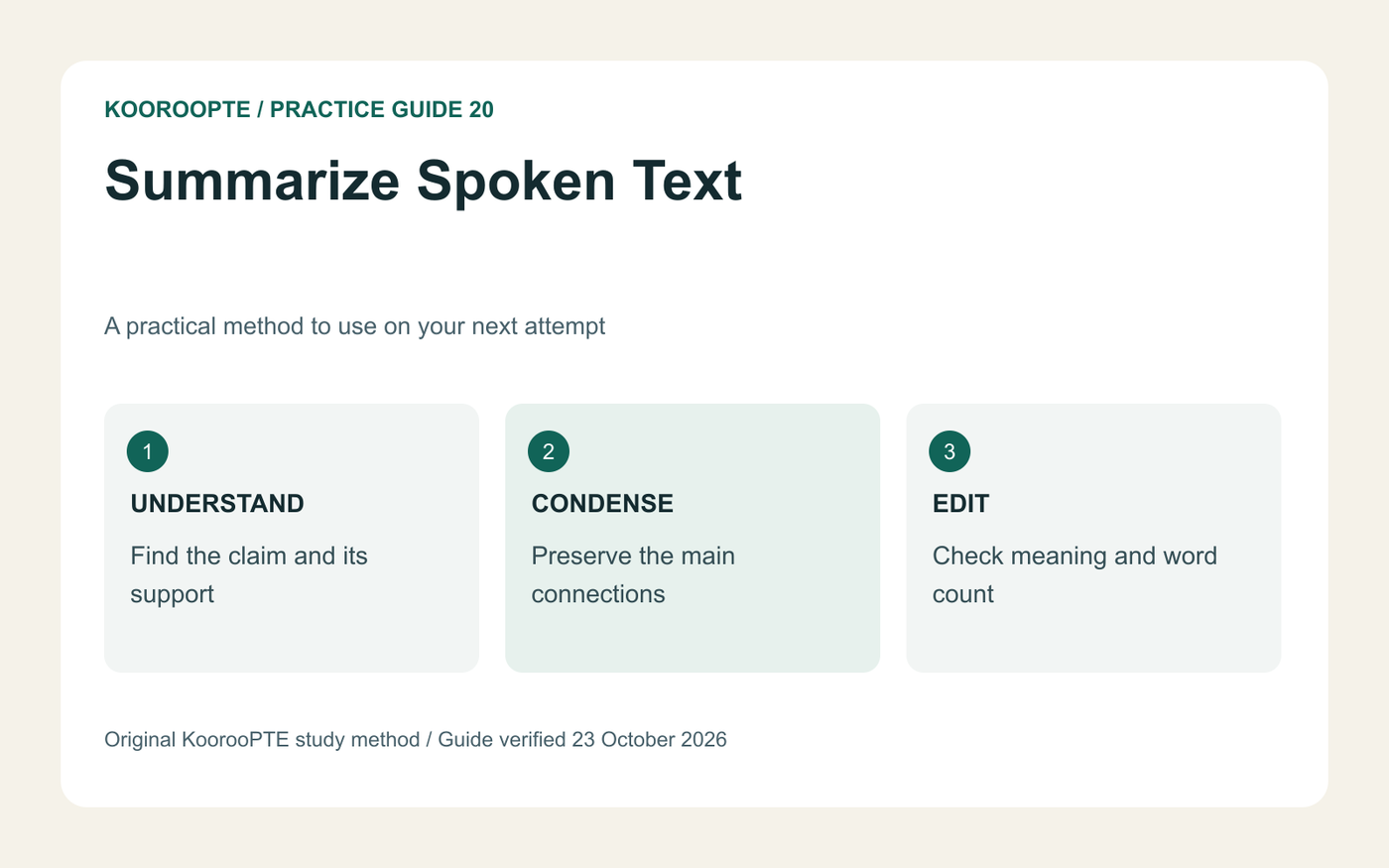
PTE Summarize Spoken Text asks you to turn a recording into a concise written account. Capture the main claim and essential supporting ideas, then connect them in accurate sentences. This guide shows the full process with an original practice passage, a model summary and a checklist for checking content before polishing language.
Written by the KoorooPTE editorial team. Last updated and fact-checked: 23 October 2026.
What does Summarize Spoken Text require?
Summarize Spoken Text asks you to write a 50-70-word summary of a recording. Pearson lists a 60-90-second audio prompt and gives ten minutes for listening and writing together. The task assesses Listening and Writing. Your response should convey the main message and essential support in your own words.
The central problem is selection. A recording may contain an example, a number, a qualification and a conclusion. Your summary needs enough of that structure to preserve the argument, but it does not need every detail in the order you heard it.
Unlike Summarize Written Text, this task does not require a single sentence. Use connected sentences when they make the summary clearer. The existing guide to the one-sentence trap explains that distinction in more detail.
Which scoring rules should you check before writing?
Pearson evaluates Content, Form, Grammar, Vocabulary and Spelling. The current guide assigns full Form credit to 50-70 words, reduced Form credit to 40-49 or 71-100, and zero Form credit below 40 or above 100. A zero in Content or Form makes the response score zero overall. These are task rules, not a target range to stretch deliberately.
Write within 50-70 words and check the on-screen counter. A small buffer from either boundary can make editing easier, but that is a practical choice rather than a separate official requirement. Content receives human review alongside AI scoring, so a fluent paragraph still needs to represent the recording accurately.
How can you organize notes without transcribing everything?
Use four short labels: topic, main claim, support, qualification. The labels help you notice the structure while leaving room to listen. Write compact meaning cues rather than full sentences.
- Identify the central question. Decide what the speaker is trying to explain or establish.
- Capture the main claim. Write a short phrase that states the answer to that question.
- Add essential support. Note the evidence or reason without copying every descriptive detail.
- Preserve limits and contrasts. Record words such as “only,” “however,” or “may” when they change the strength of the conclusion.
- Draft connected sentences. Explain how the ideas relate instead of placing keywords next to one another.
- Check content before language. Confirm that the summary is faithful, then edit word count, grammar, spelling and punctuation.
What does a complete original example look like?
The following practice script describes a fictional pilot study. It is teaching material, not a report of real research. Have someone read it while you keep the text hidden if you want to practise note-taking.
Practice script:
“A city council wanted to know whether small areas of shade could make a busy shopping street more comfortable in summer. It installed temporary fabric canopies on one section and left a nearby section unchanged. Staff measured surface temperatures and asked pedestrians how comfortable they felt. On sunny afternoons, the shaded section had cooler surfaces, and more pedestrians said they were comfortable there. However, the council did not measure every factor that could affect comfort. Wind conditions varied, and the two sections did not always have the same number of visitors. The pilot therefore offered encouraging evidence, rather than proof that canopies would have the same effect everywhere. The council proposed testing the design on several more streets before making a permanent investment. It also wanted to compare the cost of maintaining canopies with other options, including trees. The main lesson was that a simple intervention could help, but wider testing was needed before the city adopted it as a general solution.”
Useful notes: shade pilot; canopy versus unchanged street; cooler surfaces and reported comfort; wind and visitor differences; more testing before investment.
Model summary:
“A council pilot found that temporary street canopies were associated with cooler surfaces and greater pedestrian comfort on sunny afternoons. However, differences in wind and visitor numbers limited the findings. The council therefore proposed wider testing and comparison with alternatives before investing permanently, treating the results as promising evidence rather than proof of a universal solution.”
The model preserves the intervention, the observed result, the limitations and the proposed next step. “Associated with” avoids turning an imperfect comparison into a stronger causal claim. The summary also excludes a minor administrative detail without changing the lecture’s message.
How should you edit a weak first draft?
Repair the meaning before replacing words with more impressive vocabulary. A simple accurate sentence is more useful than a sophisticated sentence that changes the argument.
Weak draft: “The lecture discussed canopies, trees, shopping streets, temperatures, wind and visitors, and it proved that canopies solve heat problems in all cities.”
The list does not explain the relationship between the ideas. “Proved” and “all cities” also contradict the source’s caution. First replace the unsupported conclusion with the pilot’s limited finding. Then add why the council wanted more testing. Only after that should you adjust phrasing and length.
Use this reusable check: main claim present; essential support included; limitation preserved; no invented conclusion; word count checked; sentences complete. Read it as a meaning check, not merely a formatting checklist.
What practice routine builds useful habits?
Practise the whole process on fresh recordings and review which stage caused each error. If your notes missed the conclusion, more grammar practice will not fix that particular attempt. If the notes were accurate but the paragraph changed the meaning, work on sentence construction and paraphrasing.
Try one complete attempt, then compare your notes, draft and final version. Underline each source-supported claim. Circle any detail you introduced yourself. Finally, write one sentence explaining what you will change in the next attempt, such as “record the speaker’s qualification before drafting.”
For the next session, choose a different topic. Rewriting the same summary can teach editing, but a fresh recording tests whether the note-taking method transfers. Open Summarize Spoken Text practice and use the PTE question-type guide to balance this extended task with other Listening work.
Which sources were checked for this guide?
The exam facts were checked against Pearson's current listening task descriptions and the Test Taker Score Guide (pages 8, 15, 41-43) on 23 October 2026. The worked examples, model responses and practice routines are original KoorooPTE teaching material, not official Pearson questions or awarded scores.
Frequently asked questions
Can I write more than one sentence in Summarize Spoken Text?
Yes. Use a small number of connected sentences when that expresses the recording clearly. Do not import the single-sentence rule from Summarize Written Text. During editing, check that each sentence contributes a main idea or essential support, and remove repeated introductions that consume space without explaining the recording.
Should I include every number from the recording?
Include a number when it is central to the speaker’s argument or necessary to explain the result. Otherwise, use the space for the relationship between ideas. Never guess a figure you missed. An accurate general statement is preferable to a precise-looking detail that changes what the speaker actually said.
Can I use the same summary template for every recording?
Use a planning structure to remember what to listen for, but write sentences that fit the particular recording. A fixed paragraph can leave little room for its real message. Check that each sentence can be traced to the source and that you have not invented a conclusion to complete a template.