
PTE Summarize Written Text 2026: How Scoring Really Works (and How to Fix It)
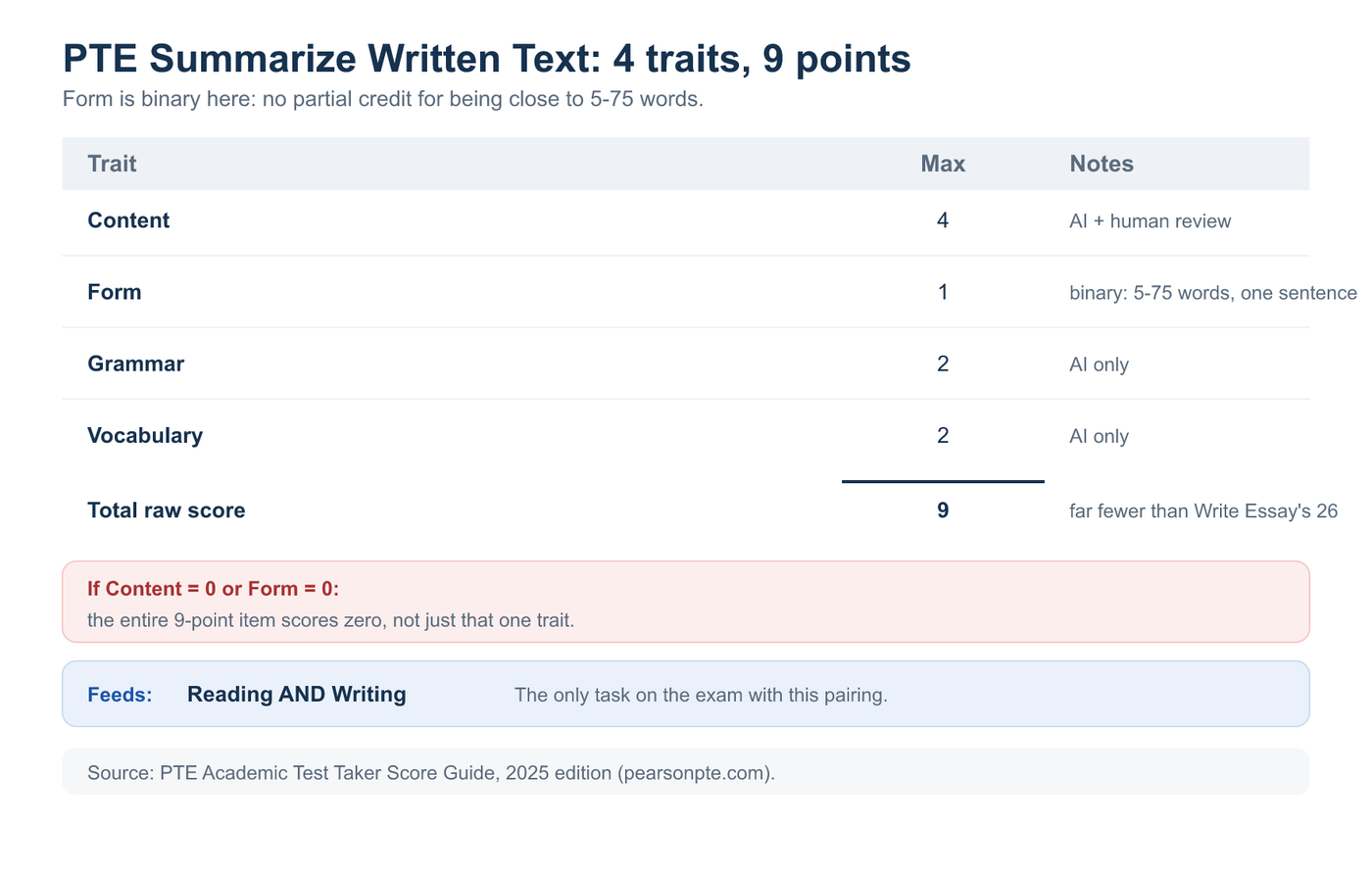
PTE Summarize Written Text gives you 10 minutes to read a passage of up to 300 words and compress it into exactly one sentence, between 5 and 75 words. It is scored on four traits worth 9 raw points total, far fewer scoring dimensions than Write Essay, and a single formatting slip, writing two sentences instead of one, or missing the word range, can zero the entire item regardless of how good your content is. This guide covers exactly how each trait is scored, the one rule that matters more than any other on this task, and a worked example.
What is PTE Summarize Written Text and why does it matter?
Summarize Written Text, usually shortened to SWT, asks you to read an academic passage of up to 300 words, then write a single sentence that captures its main ideas in your own words. There are 2 items per test form, each with a 10 minute time limit that covers both reading and writing. Unlike Write Essay, there is no argument to build, only a source text to genuinely understand and compress, which makes it a different skill from essay writing even though both are scored writing tasks.
What is the format and timing?
- Source passage length: Up to 300 words
- Time allowed: 10 minutes
- Required summary length: 5-75 words
- Required format: One single, complete sentence
- Items per test form: 2
There is no separate reading time and writing time; the 10 minutes covers reading the passage, planning, writing, and checking your word count, all in one window. Source: Pearson's official PTE Academic and UKVI test format page.
How is PTE Summarize Written Text scored?
SWT is scored on four traits worth 9 raw points, notably fewer scoring dimensions and fewer total points than Write Essay's 26, since it is a narrower, more mechanical task once you know the rules.
- Content: 4 · Reviewed by both AI and a human
- Form: 1 · Binary: 1 or 0, no partial credit band
- Grammar: 2 · AI only
- Vocabulary: 2 · AI only
Content (0-4) measures how comprehensively and accurately you captured the source text's main ideas, in your own words rather than copied excerpts. A 4 means the summary demonstrates full comprehension, removes extraneous detail, and synthesizes the main ideas coherently with effective paraphrasing. A 2 means the response leans heavily on repeating excerpts from the source text without actually reformulating them, a common trap when you are running low on time. A 0 means the response is too limited to demonstrate any comprehension of the source text at all.
Form is the trait most guides underexplain, and it is worth the most attention here. Per Pearson's Score Guide, Form scores 1 if your response is written in one, single, complete sentence, and 0 if it is not written as one sentence, contains fewer than 5 or more than 75 words, or is written entirely in capital letters. Unlike Write Essay, which gives partial Form credit for being close to the target word count, SWT's Form is binary: there is no partial-credit zone between 5 and 75 words, so a response at exactly 4 words scores the same 0 on Form as a response at 200 words.
Grammar (0-2) and Vocabulary (0-2) are scored the same as they are on Summarize Spoken Text: a 2 means correct grammatical structure or appropriate word choice, a 1 means errors that do not hinder communication, and a 0 means errors serious enough to hinder it. Neither is human-reviewed; both stay AI-only.
Content is one of the seven question types Pearson double-marks, so a human expert checks it alongside the AI, with a second human resolving any disagreement. Per the general scoring rule that applies to every Content- or Form-scored Writing question, when either Content or Form scores 0, no score points are given for the response at all, meaning the entire 9-point item, including Grammar and Vocabulary, is lost, not just the one trait that triggered it. That total then contributes to two communicative skill scores: Reading and Writing. Per the Score Guide, eight task types across the exam feed two communicative skills from a single response, and SWT is the only one of the eight that pairs Reading with Writing; the other seven pair Listening with Speaking (Repeat Sentence, Re-tell Lecture, Summarize Group Discussion), with Reading (Highlight Correct Summary, Highlight Incorrect Words), or with Writing (Write from Dictation, Summarize Spoken Text). Read Aloud, despite a common assumption, is not one of the eight; it is Speaking-only.
How do you do PTE Summarize Written Text? (step by step)
- Read for structure first, not detail. Identify the passage's main claim and its two or three supporting points before you start planning a sentence; the details you drop are as important as the ones you keep.
- Draft your sentence with a subordinate clause structure. A pattern like "While [supporting idea], [main claim], because [key reason]" naturally compresses several ideas into one grammatically complete sentence without needing a semicolon or a run-on.
- Paraphrase, do not lift phrases from the passage. Content credit depends on demonstrating comprehension in your own words; copying a distinctive phrase verbatim reads as repetition rather than synthesis.
- Cut every example, statistic, and minor detail that is not one of the two or three main points; a comprehensive-sounding sentence that includes too much detail usually runs over 75 words before it says anything useful.
- Count your words before you finalize, aiming for the 40-60 word range in practice, comfortably inside the 5-75 limit with room for a small miscount.
- Check for exactly one full stop, at the very end, and nowhere in the middle. A second period, even inside an abbreviation you handled awkwardly, risks a Form 0.
- Check your capitalization is normal sentence case, not typed entirely in capital letters, which is explicitly called out as a Form-zero trigger regardless of word count.
What does a strong response look like?
Source passage (condensed for illustration): a 280-word academic passage arguing that remote work increases productivity for individual tasks requiring deep focus, but reduces the spontaneous collaboration that drives team innovation, and proposing a hybrid model as a practical compromise most organizations are now adopting.
A strong one-sentence summary: "While remote work boosts individual productivity on focus-intensive tasks by reducing interruptions, it also limits the spontaneous collaboration that drives team innovation, which is why a hybrid model has become the practical compromise most organizations are now adopting."
That sentence is 43 words, comfortably inside the 5-75 range, written as a single grammatically complete sentence using "while" to hold two contrasting ideas together, and it ends in exactly one full stop. It paraphrases the passage's own language rather than lifting it, and it includes the main claim, the counterpoint, and the passage's proposed resolution without listing every supporting example the original passage used.
Do PTE Summarize Written Text templates work?
Not for Content, but the sentence-structure pattern in step 2 above is a structural tool, not a content script, and the distinction matters the same way it does on Write Essay. SWT is one of the seven question types with a documented template risk on Content, since a response built from pre-prepared or memorized material is classified as an irrelevant response and scores Content 0. A reusable sentence shape you fill with the actual passage's actual ideas every time is safe; a fixed opening phrase you recite regardless of the topic is not. Our do PTE templates still work in 2026 guide covers the mechanism across every task on the exam.
What mistakes cost you marks on Summarize Written Text?
- Writing two sentences instead of one. A second full stop anywhere in the response, even to separate a clarifying clause, scores Form 0 and zeroes the entire item.
- Running under 5 or over 75 words. Both directions score Form 0. Running long is far more common under time pressure, so check your count before the 10 minutes runs out, not after.
- Repeating excerpts instead of paraphrasing. A summary built from copied phrases caps out around Content 2, since it demonstrates recognition of the source text rather than comprehension of it.
- Including every supporting example. A summary that tries to mention each detail from a 300-word passage usually breaks the word limit before it manages to state the main idea clearly.
- Typing the whole response in capital letters or skipping the closing full stop. Both are explicit Form-zero triggers in Pearson's own scoring criteria, independent of how strong the underlying sentence is.
Practise this task with real passages and instant feedback on Summarize Written Text on KoorooPTE, which checks your word count and sentence structure before scoring Content, Grammar, and Vocabulary separately.
Where does Summarize Written Text fit in your overall score?
Summarize Written Text feeds both your Reading and Writing scores from a single response, the only task on the whole exam that pairs those two specific skills; Write from Dictation and Summarize Spoken Text are the other two Writing-linked double-scored tasks, but both pair Listening with Writing instead. Since Writing is fed by only four task types in total, a reliable, formula-driven task like this one is disproportionately valuable if Writing is your weaker skill. Our PTE Write Essay scoring guide covers the other major Writing task, and our PTE Superior English 2026 guide explains why SWT is one of the fastest tasks to make reliably scorable. Our PTE score chart explains how a Reading or Writing score converts to IELTS and CEFR terms. For the other 20 task types, see our PTE question types hub.
Frequently asked questions
How long is the PTE Summarize Written Text passage?
Up to 300 words. You get 10 minutes to read it and write your summary, and there are 2 items per test form.
How many words should a PTE Summarize Written Text response be?
Between 5 and 75 words, written as one single, complete sentence. Per Pearson's own instructions, a response outside that range is not scored at all.
How is PTE Summarize Written Text scored?
Across four traits worth 9 raw points: Content (0-4), Form (0-1), Grammar (0-2), and Vocabulary (0-2). A human reviewer checks Content alongside the AI, the same as Write Essay, but Grammar and Vocabulary stay AI-only.
What happens if my PTE summary is not one sentence?
Form scores 0, and because Form is one of the two traits (alongside Content) that can zero the whole response, a summary written as two sentences, or with no punctuation, or entirely in capital letters, can score 0 out of 9 even if the content itself was accurate.
Does PTE Summarize Written Text affect my Reading score?
Yes. Per Pearson's Test Taker Score Guide, its communicative skills scored are Reading and Writing together, and it is the only task type on the whole exam that pairs those two specific skills. Eight task types in total feed two communicative skills from one response, but the other seven all pair Listening with Speaking, Reading, or Writing, not Reading with Writing.