
PTE Answer Short Question 2026: Listen for the Exact Answer
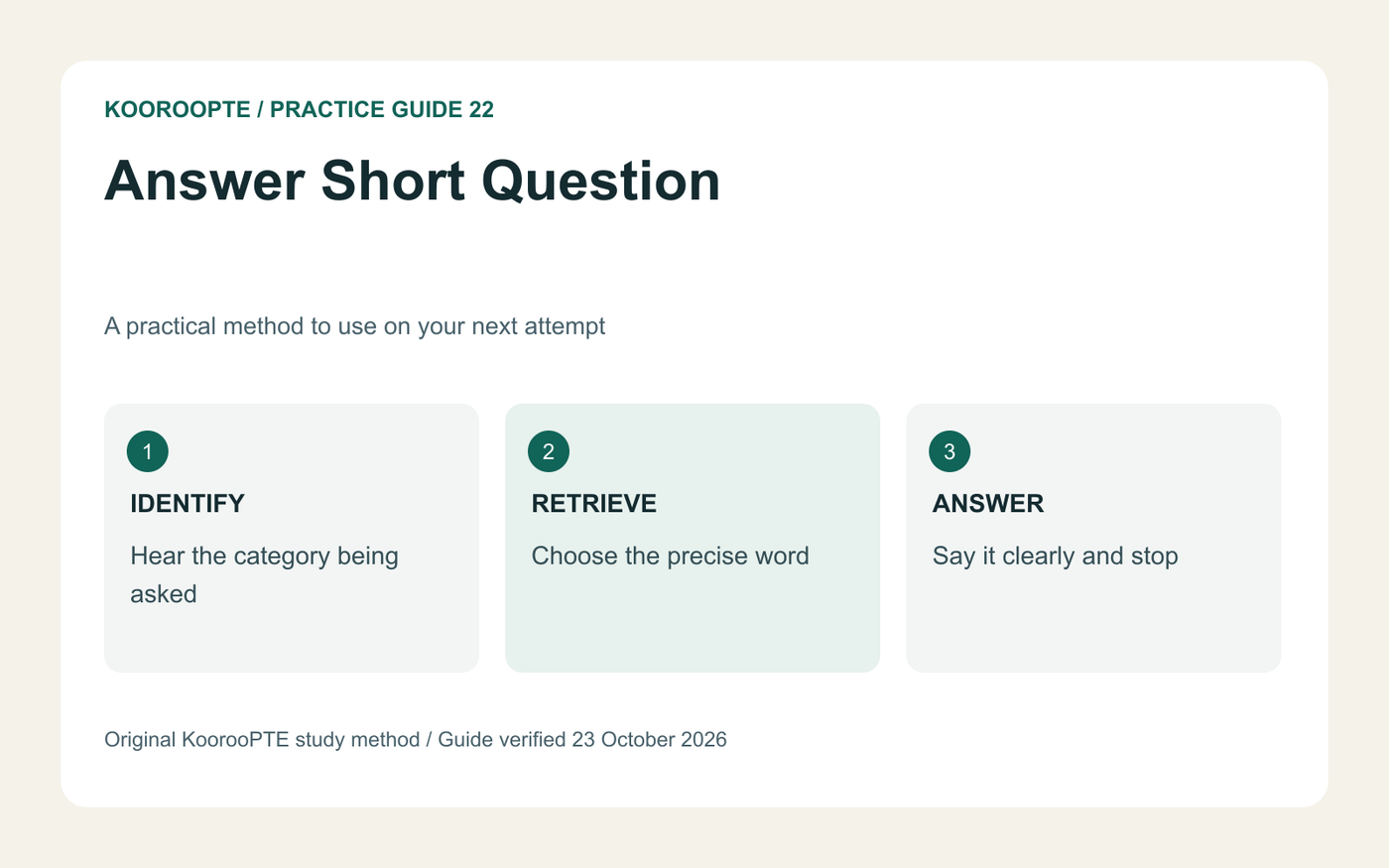
PTE Answer Short Question rewards a brief answer that matches the question you hear. Identify the category being requested, retrieve the most precise familiar word and say it clearly. This guide explains the current scoring distinction and provides original questions plus a review method for separating vocabulary gaps from listening mistakes.
Written by the KoorooPTE editorial team. Last updated and fact-checked: 23 October 2026.
What is PTE Answer Short Question?
Answer Short Question asks you to respond to a spoken question with one word or a few words. Pearson lists a 3-9-second prompt and a ten-second response window. A question may also include an image. The goal is an accurate answer, not an extended explanation.
The microphone opens when the question finishes, without the short tone used in several other speaking tasks. Watch the recording status and respond promptly when it is ready. Do not spend the available time waiting for a cue that this task does not provide.
Does this task currently assess Speaking or Listening?
The current score guide lists Listening as the assessed communicative skill. That can surprise learners because the response is spoken and the task appears in the Speaking and Writing section. Answer format, section location and scored skill are different things.
The response is judged correct or incorrect according to the appropriateness of the answer. There is no separate Pronunciation or Oral Fluency trait in this task’s rubric. You still need to say the answer clearly enough to communicate it; a longer response does not create extra credit simply by containing more speech.
Use Read Aloud or other extended speaking tasks for a different kind of delivery practice. Do not treat a short vocabulary-answer drill as a replacement for practising connected speech.
How do you produce a precise answer quickly?
Listen for the category being requested, then retrieve the shortest suitable word or phrase.
- Hear the whole question. Avoid answering from the first familiar noun before the final words narrow its meaning.
- Identify the category. Decide whether the question asks for a person, place, object, action, quantity or relationship.
- Use the defining clue. Connect the clue to the precise concept, rather than to a broad related topic.
- Choose one answer. Avoid speaking a chain of alternatives that leaves your intended response unclear.
- Say the answer naturally. Use ordinary volume and clear word endings rather than exaggerated speech.
- Stop when you have answered. Do not add an explanation merely to fill the response window.
The method becomes easier when you practise retrieval in both directions. Ask what a word means, then ask which word matches a spoken description of that meaning.
What do original practice questions look like?
These questions illustrate short, precise answers. They are original teaching examples, not predictions of live exam questions or a complete representation of possible difficulty.
- Question: What do you call a person who borrows a library book? Answer: A borrower.
- Question: If a container is empty, does it contain something or nothing? Answer: Nothing.
- Question: What instrument is used to measure temperature? Answer: A thermometer.
- Question: What is the opposite direction to east? Answer: West.
- Question: If a meeting happens every week, how often does it happen? Answer: Weekly.
- Question: What do you call the list of sources used in an academic piece of writing? Answer: A bibliography.
- Question: If you divide a whole into quarters, how many equal parts do you get? Answer: Four.
- Question: What do you call the place where trains stop for passengers to board? Answer: A station.
Read the defining clue before reviewing the answer. “Used to measure temperature” asks for an instrument, so “weather” is related but insufficient. “Every week” asks for frequency, so “weekly” is more precise than “often.”
A correct teaching answer does not imply that these are the only acceptable phrasings in every test context. In practice, prefer a direct conventional term and avoid building a list of speculative alternatives.
How do you diagnose a wrong response?
Separate misunderstanding the sound, misunderstanding the question and not retrieving the word. Each problem calls for a different exercise.
Suppose you hear “What instrument measures temperature?” and answer “weather.” If you recognized every word, the problem is probably the category or vocabulary connection. Practise distinguishing the phenomenon from the instrument: temperature versus thermometer. If you heard a different question, replay the audio and locate the sound that caused the mistake.
Suppose you knew “thermometer” but could not say it promptly. That is a retrieval problem. Ask several differently worded questions that lead to the same answer, then practise a different concept before returning to it. Reading the answer repeatedly may feel easy without testing retrieval at all.
Use an error log with four labels: misheard; wrong category; unknown word; slow retrieval. Add a fifth, “unclear delivery,” when your intended answer was correct but difficult to understand in the recording.
What habits should you avoid?
Avoid habits that turn a short response into an uncertain explanation.
- Answering before the question ends: wait for the complete meaning and the recording status.
- Adding several guesses: choose the term that best matches the clue instead of naming a broad set of possibilities.
- Using a long opening: remove phrases such as “I think the answer might possibly be” when the answer itself is straightforward.
- Memorizing only one wording: vary the prompt so you recognize the concept when it is expressed differently.
- Treating every error as pronunciation: check the meaning of the answer before working on how it sounds.
Clear delivery comes from familiar language you can retrieve accurately. There is no need to imitate a particular accent to make a simple answer sound more convincing.
How can you practise without turning it into a prediction list?
Use a small set of concepts and vary how they are asked. For “weekly,” try a definition question, a contrast with “daily,” and a short scenario about a recurring meeting. Then mix those questions with unrelated concepts so the answer is not predictable from the preceding item.
Have a partner read the questions, or use a text-to-speech tool while the answers are hidden. Record your first response. Check meaning first, then whether it was understandable and concise. Revisit difficult concepts the next day with new wording.
Copy this checklist: whole question heard; requested category identified; precise answer chosen; recording status checked; no unnecessary explanation. It gives you a repeatable review standard without claiming to reproduce Pearson’s scoring engine.
Open Answer Short Question practice. Use Repeat Sentence for exact spoken recall and the question-type guide to keep the different response skills distinct.
Which sources were checked for this guide?
The exam facts were checked against Pearson's current Speaking and Writing task descriptions and the Test Taker Score Guide (pages 24) on 23 October 2026. The worked examples, model responses and practice routines are original KoorooPTE teaching material, not official Pearson questions or awarded scores.
Frequently asked questions
Do I need a full sentence for every answer?
No. Choose the shortest response that answers the question clearly and accurately. A word or short phrase often does the job. Practise identifying the requested category before speaking, so you do not spend time building an introduction that adds no useful information to your actual answer.
Should I memorize large prediction lists?
Build reliable understanding of useful everyday and academic vocabulary instead of depending on a list appearing in the test. Turn each unfamiliar word into several different questions and practise recognizing it in spoken context. That checks whether you understand the concept when the wording changes, rather than remembering a fixed prompt.
What should I record after an incorrect practice answer?
Write down whether you misheard the question, misunderstood its category, did not know the word or failed to retrieve a word you knew. Then choose a matching drill. Replaying audio helps a listening problem, while writing more definitions will not necessarily fix a slow spoken response.