
PTE Repeat Sentence 2026: How Scoring Really Works (and How to Fix It)
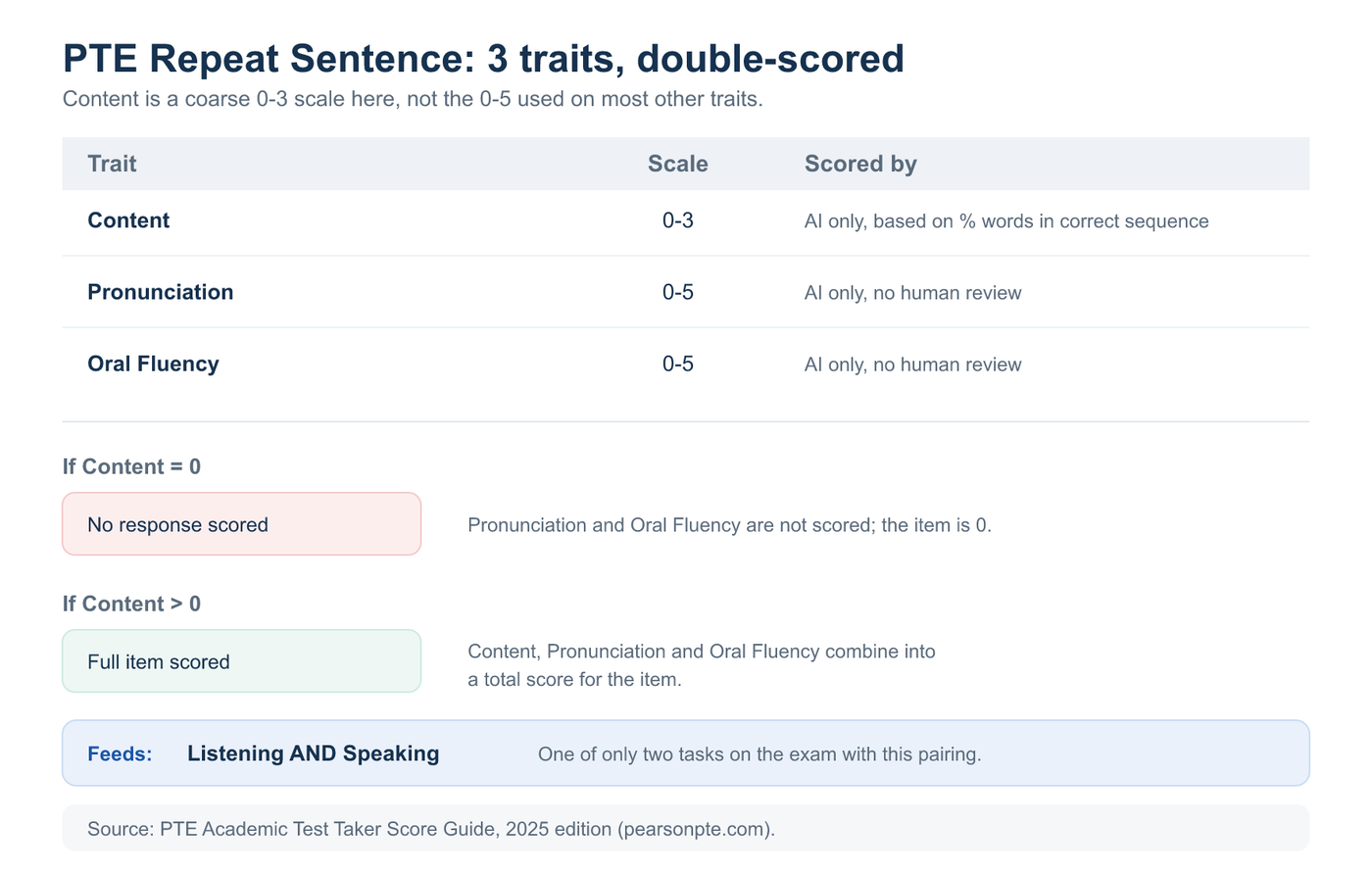
PTE Repeat Sentence plays a sentence once, 3 to 9 seconds long, then gives you 15 seconds to repeat it back exactly. It appears 10 to 12 times per test form, more repetitions than any other speaking task, and it is the only task type on the whole exam, alongside Write from Dictation, whose response feeds two communicative skills from a single answer: Listening and Speaking. This guide covers exactly how the three scored traits work, a memory technique that beats word-for-word memorising, and what to do the moment you forget part of the sentence.
What is PTE Repeat Sentence and why does it matter?
Repeat Sentence is a listen-then-speak task: you hear a single sentence once through your headset, then repeat it as closely to word-for-word as you can. There is no text on screen at any point, so you are working from memory alone, not reading along. Because it appears 10 to 12 times per test, more than double the frequency of Read Aloud, it carries an outsized share of both your Listening and your Speaking score, which makes it one of the highest-value tasks to drill consistently rather than occasionally.
What is the format and timing?
- Sentence audio length: 3-9 seconds
- Audio replays: None, plays once
- Time to respond: 15 seconds
- Attempts allowed: 1, no re-recording
- Items per test form: 10-12
You do not see a transcript at any point, before, during, or after the audio, so every attempt relies on what you actually retained in the moment. Source: Pearson's official PTE Academic and UKVI test format page.
How is PTE Repeat Sentence scored?
Repeat Sentence is scored on three traits, and the Content scale here is coarser than on most speaking tasks: it runs 0 to 3, not 0 to 5.
Content measures how much of the sentence you reproduced in the correct sequence: a 3 means all the words came back in the right order, a 2 means at least half the words were correct and in sequence, a 1 means less than half, and a 0 means almost nothing from the original sentence made it into your response. Per the Score Guide, only replacements, omissions, and insertions count as errors; hesitations, filled or unfilled pauses, and leading or trailing material are explicitly ignored when Content is scored, so a pause while you recall the next word does not directly cost you a Content point, even though it can still cost you on Oral Fluency.
Pronunciation and Oral Fluency use the same 0 to 5 scales as every other AI-scored speaking task, from "highly proficient" pronunciation with correctly placed word and sentence stress, down to "non-English" with more than half the speech unintelligible; and from "highly proficient" fluency with smooth, hesitation-free rhythm, down to "disfluent" speech with multiple long pauses.
All three traits are scored by AI only, with no human review, the same as Read Aloud. Pearson's Score Guide describes the same content-gates-the-rest architecture generally for every Content-scored speaking task: Content is evaluated first, and if it scores 0, the response is treated as containing almost nothing usable, so Pronunciation and Oral Fluency are not scored either and the item totals zero. If Content clears 0, all three traits combine into the item's total score.
That total then contributes to two communicative skill scores at once: Listening and Speaking. Per the Score Guide, Repeat Sentence's communicative skills scored are listed as Listening and Speaking together, making it one of only two task types on the entire exam with this specific double-scoring pairing (the other is Write from Dictation, which pairs Listening with Writing instead).
How do you do PTE Repeat Sentence? (step by step)
- Listen for meaning, not for individual words. Trying to memorise a 15-word sentence letter by letter overloads short-term memory faster than grouping it into 3-4 word chunks by meaning.
- Chunk the sentence as you hear it. A sentence like "the committee will review the proposal again before making a final decision" breaks naturally into "the committee will review," "the proposal again," "before making a final decision," three chunks that are each easy to hold in memory individually.
- Start speaking immediately once the audio ends. The 15-second window is generous relative to a 3-9 second sentence, but hesitating at the start eats into time you could use to speak at a natural pace.
- Reproduce the sentence structure you heard, not a paraphrase. Content is scored on matching the actual words in sequence, so a synonym or a rephrased version scores as errors even if the meaning is preserved.
- If a word is missing, keep the sentence moving rather than stopping to search for it. A confident gap costs less than a long pause that also damages Oral Fluency.
- Say every chunk you retained, in the order you heard them, even if you are not fully confident on one word in the middle; partial credit rewards sequence, not perfection.
- Match the stress and rhythm of natural speech, not a flat, robotic recall voice; Oral Fluency and Pronunciation are scored the same way here as on every other speaking task.
What does a strong Repeat Sentence response look like?
Sentence: "The committee will review the proposal again before making a final decision."
A strong response reproduces all thirteen words in the exact order, at a natural pace, with stress falling on "committee," "review," "proposal," and "decision," the words carrying the sentence's actual meaning. A response that drops "again" but gets everything else exactly right still scores a 3 on Content in practice, since a single omission in an otherwise complete, correctly sequenced response is well within the tolerance the scoring targets; the risk only grows once multiple words are missing or reordered. A response that instead says "the committee is going to look at the proposal one more time before deciding," which is a reasonable paraphrase of the meaning, would score far worse on Content, because almost none of the actual words match, even though a human listener would understand it perfectly.
Should you paraphrase if you forget part of the sentence?
No. This is the single most common mistake test-takers bring over from everyday conversation skills, where paraphrasing is a strength. Repeat Sentence scores Content on exact word sequence, not comprehension, so inventing a plausible-sounding replacement for a forgotten word or clause actively lowers your score compared to simply omitting it and continuing with the words you are sure of. If you retain the first half and the last word of a sentence but lose the middle, say exactly those two parts in their correct positions rather than filling the gap with a guess.
What mistakes cost you marks on Repeat Sentence?
- Paraphrasing instead of repeating. Swapping in synonyms or restructuring the sentence, even when the meaning survives, counts as replacement errors against Content.
- Trying to memorise word-by-word instead of chunking by meaning. Long sentences overload verbatim memory fast; grouping by meaning holds up far better under the 3-9 second exposure.
- Freezing after a missed word. A long pause searching for one lost word costs more on Oral Fluency than skipping it and continuing with the rest of the sentence.
- Guessing at unfamiliar vocabulary in the sentence. An invented word is still an error against Content, so if you genuinely did not catch a word, it is safer to leave a small gap than fabricate one.
- Treating all 10-12 items as equally worth the same effort. Since every item scores independently and contributes to two communicative skills, a rushed or half-attempted response on even one item is more costly here than on most single-skill tasks.
Practise this task with real audio and instant feedback on Repeat Sentence on KoorooPTE, which scores your Content, Pronunciation, and Oral Fluency separately so you know exactly which one needs work.
Where does Repeat Sentence fit in your overall score?
Repeat Sentence is one of the few tasks that moves two communicative skills from a single response, Listening and Speaking, which makes consistent daily practice on it more efficient than most other single-skill tasks on the exam. If either of those scores is lagging, our why is my PTE speaking score low guide covers diagnosing which trait is the actual weak point, and our how PTE Read Aloud is scored guide walks through the closely related three-trait mechanic that Read Aloud shares with this task. Our PTE score chart explains how Listening and Speaking scores convert to IELTS and CEFR terms, and our PTE Superior English 2026 guide covers what it takes to push both toward 79. For the other 20 task types, see our PTE question types hub.
Frequently asked questions
How long is the PTE Repeat Sentence audio?
3 to 9 seconds. It plays once, with no replay, and you get 15 seconds after it finishes to repeat the sentence exactly as you heard it.
How is PTE Repeat Sentence scored?
On three traits: Content, scored 0 to 3 based on how much of the sentence you repeated in the correct sequence; Pronunciation, 0 to 5; and Oral Fluency, 0 to 5. All three are AI-scored, with no human review.
Does PTE Repeat Sentence affect my Listening score?
Yes. Per Pearson's Test Taker Score Guide, Repeat Sentence is one of only two task types on the exam whose communicative skills scored are Listening and Speaking together, so a strong Repeat Sentence habit lifts two scores at once.
Can I replay the PTE Repeat Sentence audio?
No. The audio plays exactly once and you cannot pause, rewind, or request it again, and you are only able to record your response once as well.
What if I forget part of the sentence on Repeat Sentence?
Say the words you are confident about in their correct positions rather than guessing at the missing part or inventing a plausible-sounding replacement. Content is scored on exact sequence match, and partial credit exists: at least half the words in the right sequence still scores 2 out of 3.