
PTE Read Aloud 2026: How Scoring Really Works (and How to Fix It)
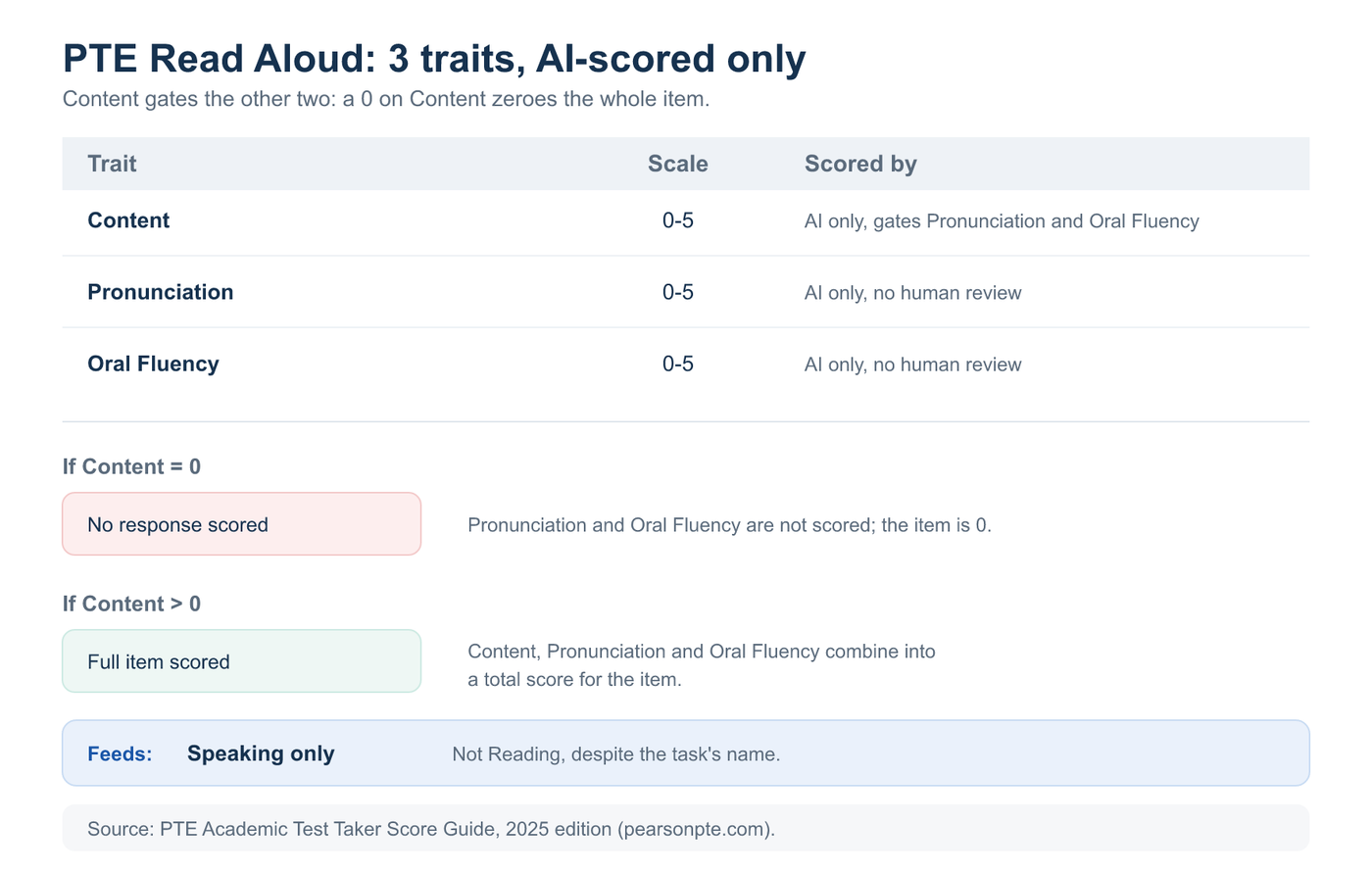
PTE Read Aloud gives you 30 to 40 seconds to prepare a passage of up to 60 words, then one attempt to read it aloud, scored on Content, Pronunciation and Oral Fluency. It is one of the few speaking tasks scored entirely by AI, with no human review at any point, and it appears 6 to 7 times per test form, more than almost any other task. This guide covers exactly how each trait is scored, a worked example annotated for stress and pausing, and a fact that a lot of older PTE guides still get wrong: which score Read Aloud actually feeds.
What is PTE Read Aloud and why does it matter?
Read Aloud is the first scored speaking task in Part 1: a short passage appears on screen, and after a short prep window you read it aloud exactly as written, in one take. It is not a test of comprehension or opinion, since every word you need is already in front of you, which makes it the most mechanically simple task on the exam and also the easiest to underestimate. Because it appears 6 to 7 times per test form, more repetitions than any other single Speaking task, small, consistent scoring gains here compound across the whole Speaking section faster than gains on a task you only see once or twice.
What is the format and timing?
- Passage length: Up to 60 words
- Preparation time: 30-40 seconds
- Time to answer: Varies by item, sized to the passage's length
- Attempts allowed: 1, no re-recording
- Items per test form: 6-7
You do not choose your own pace against a fixed clock the way you do on Describe Image. The system opens the microphone once your prep time ends and gives you roughly as long as the passage requires to read it at a natural pace, then closes it. Source: Pearson's official PTE Academic and UKVI test format page.
How is PTE Read Aloud scored?
Read Aloud is scored on three traits, each rated 0 to 5, and the scoring runs in a strict order: Content first, then the other two traits only if Content clears zero.
Content counts how accurately you reproduced the text. Every replacement, omission, or insertion of a word counts as one error, and the maximum score depends on the passage's length, so a longer passage has more room for a small slip without losing the full point. Per Pearson's Test Taker Score Guide, if you give no response, or a response unrelated to the passage, Content scores 0, and once Content is 0, Pronunciation and Oral Fluency are not scored at all for that item; the whole question scores zero.
Pronunciation measures how clearly a regular speaker of English would understand you, from "highly proficient" (all vowels and consonants produced clearly, correct word and sentence stress) down to "non-English" (pronunciation seems characteristic of another language, more than half the speech unintelligible).
Oral Fluency measures your rhythm and pacing, from "highly proficient" (smooth rhythm and phrasing, no hesitations or false starts) down to "disfluent" (slow, labored speech with multiple hesitations and long pauses).
Both Pronunciation and Oral Fluency are AI-scored only. Read Aloud is not on the list of seven question types (Describe Image, Re-tell Lecture, Respond to a Situation, Summarize Group Discussion, Summarize Written Text, Write Essay, and Summarize Spoken Text) that also get a human expert review of Content, so your Read Aloud score never passes through a second human check the way an essay does.
The total score for the item then contributes to your Speaking communicative skill score, and to your overall score. Per the same Score Guide, Read Aloud's communicative skill scored is Speaking only, not Reading. A number of PTE guides, including some published assumptions in earlier KoorooPTE content, describe Read Aloud as boosting both scores at once. That description was accurate for an older version of the score guide, but the current one lists Speaking only, so treat any claim that Read Aloud lifts your Reading score as outdated.
How do you do PTE Read Aloud? (step by step)
- Skim the whole passage the moment it appears. Do not start silently rehearsing the first line while the rest of the text is still unread; you need the full 30-40 seconds to preview the entire thing.
- Mark natural pause points at commas, full stops, and clause boundaries, even if only in your head. These are where a fluent reader's voice would naturally break.
- Identify 2-3 words that are unfamiliar, long, or easy to mispronounce, and rehearse them silently before the microphone opens.
- Begin promptly once recording starts. The response window is sized to the passage, so a slow, hesitant start eats into time you need for the rest of the sentence.
- Read at the pace you would use to explain the sentence to someone, not rushed to beat an imagined clock and not artificially slowed down.
- Stress the words that carry meaning (nouns, verbs, key adjectives) and let function words (articles, prepositions, conjunctions) fall away naturally, the way native speech actually sounds.
- If you stumble on a word, keep moving forward. A brief recovery costs less on Oral Fluency than a full stop-and-restart, and you cannot re-record regardless.
- Say every word exactly as printed. Do not skip a word you find awkward, add a word that is not there, or substitute a synonym you find easier; each of those counts as a Content error.
What does a strong Read Aloud response look like?
Passage: "Renewable energy sources such as solar and wind power are becoming increasingly important as governments seek to reduce dependence on fossil fuels. While the initial cost of installation can be high, the long-term savings and environmental benefits often outweigh this investment. Many countries now offer subsidies to encourage households to adopt these technologies."
A strong reading treats the three sentences as three separate thoughts, not one continuous stream. The first sentence gets a clear stress on "renewable," "solar," "wind," and "reduce," with a natural pause after "fuels" before moving on. The second sentence slows very slightly on "initial cost" and "long-term savings," since these are the contrast the sentence is built around, with the comma after "high" taken as a real, brief pause rather than skipped. The third sentence keeps a steady pace through "subsidies" and "households," both multisyllabic words worth rehearsing in the prep window, and finishes cleanly on "technologies" without trailing off.
Notice what this reading does not do: it does not read all three sentences at one flat, identical speed, and it does not pause only where the text happens to wrap on screen. Both of those habits score worse on Oral Fluency even when every single word is pronounced correctly.
Can I use a template for PTE Read Aloud?
Not in the way you can attempt one on Write Essay or Describe Image. Read Aloud has no content to template, since the passage is fixed and you cannot change a single word of it. Our do PTE templates still work in 2026 guide covers the mechanism across every task; on Read Aloud specifically, the equivalent risk is not a memorised script but rhythmic monotony. A flat, over-rehearsed delivery, the kind that comes from practising with the same intonation pattern on every passage regardless of what it says, reads to the Oral Fluency scoring as mechanical rather than natural. The fix is the same for both problems: read for meaning, not for habit, and let the specific sentence in front of you decide where you stress and pause.
What mistakes cost you marks on Read Aloud?
- Rushing to beat an imagined clock. The response window is already sized to the passage, so racing through it only produces rushed pronunciation and skipped pauses, not a faster overall time.
- A flat, unchanging rhythm across every sentence. The same pace and stress pattern regardless of the text's actual meaning is exactly what the "disfluent" and "limited" Oral Fluency descriptors call out.
- Skipping or guessing at unfamiliar words instead of attempting them. A mispronounced word still gets more credit for effort on the underlying descriptors than a word left out entirely, which is scored as a Content error.
- Restarting from the beginning after a stumble. You cannot re-record, and a full restart usually costs you the time and rhythm needed to finish the passage cleanly, which is worse than continuing past one dropped word.
- Not using the full prep window. Thirty to forty seconds is enough to preview the whole passage and rehearse the hardest words silently; starting to read before you have actually seen the last sentence increases the odds of a Content error near the end.
Practise this task with real passages and instant feedback on Read Aloud on KoorooPTE, which scores your Content, Pronunciation, and Oral Fluency separately so you know exactly which one to fix first.
Where does Read Aloud fit in your overall score?
Read Aloud feeds only your Speaking score, alongside Repeat Sentence, Describe Image, Re-tell Lecture, Summarize Group Discussion, and Respond to a Situation. If your Speaking score is the one holding you back, our why is my PTE speaking score low guide walks through diagnosing which of the three traits is the actual problem, and our PTE Superior English 2026 guide covers what it takes to push Speaking to 79 and above. Our PTE score chart explains how a Speaking score converts to IELTS and CEFR terms if that is what you need for a visa or university target. For the other 21 task types, see our PTE question types hub.
Frequently asked questions
How long is the PTE Read Aloud passage?
Up to 60 words. You get 30 to 40 seconds to read it silently and prepare before the microphone opens, and the recording window itself is sized to the passage's length rather than being a fixed number of seconds.
How is PTE Read Aloud scored?
On three traits: Content (whether you said all the words in the text and only those words), Pronunciation, and Oral Fluency, each on a 0 to 5 scale. All three are scored by AI only. Read Aloud is not one of the seven question types that also get a human review of Content.
Does PTE Read Aloud affect my Reading score?
No. Per Pearson's own Test Taker Score Guide, Read Aloud's communicative skill scored is Speaking only. It does not contribute to your Reading score, despite what a lot of older PTE guides still claim.
Can I re-record my PTE Read Aloud answer?
No. You are only able to record your response once, per Pearson's own instructions, so there is no retake if you stumble partway through.
Do PTE Read Aloud templates work?
There is no content to template, since the passage is fixed for you and you cannot change a single word of it. The real risk on Read Aloud is a flat, over-rehearsed delivery that scores poorly on Oral Fluency, not a memorised script.