
PTE Highlight Incorrect Words 2026: Listen, Compare, Select
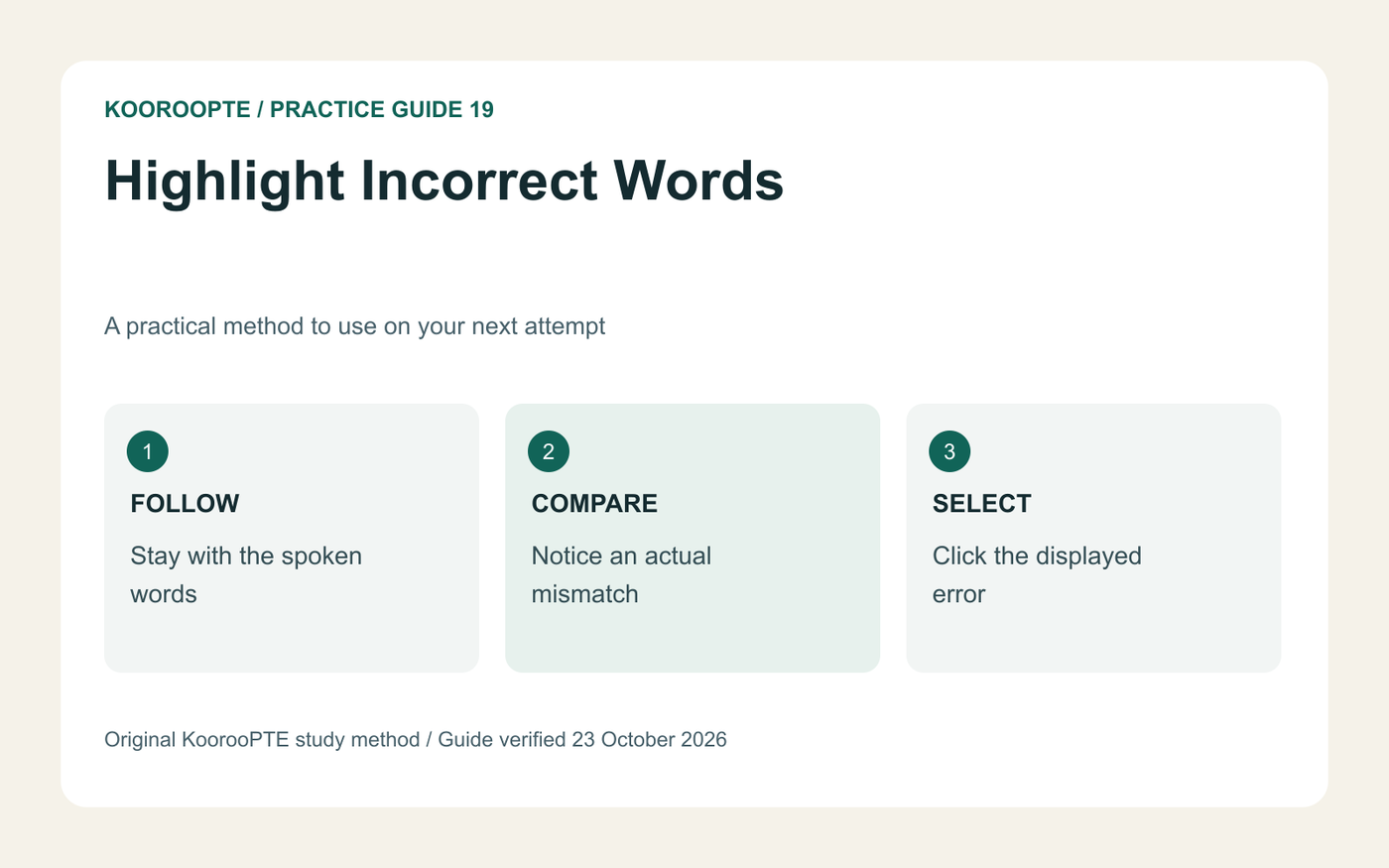
PTE Highlight Incorrect Words requires you to compare the recording with the displayed transcript and select the words that differ. Keep your attention moving with the speaker and select a mismatch only when you hear evidence for it. The examples below show how to avoid costly guesses and recover after losing your place.
Written by the KoorooPTE editorial team. Last updated and fact-checked: 23 October 2026.
What do you select in Highlight Incorrect Words?
You select the words in the displayed transcript that differ from the recording. The word you click is the written mismatch, not the replacement word you hear. Pearson lists recordings of 15-50 seconds and assesses Listening and Reading for this task.
That distinction matters when the text and recording both sound plausible. If the transcript says “increase” while the speaker says “decrease,” you select “increase” on the screen. You do not choose based on which statement sounds more reasonable in the real world.
The response is also different from Write from Dictation. Here the transcript gives you a path to follow. Use it to stay aligned with the recording rather than trying to memorize the whole passage.
How does negative marking work?
The current score guide gives one point for a correct selection and deducts one for an incorrect selection, with a minimum of zero for the item. An uncertain extra click can therefore cancel credit from a correct one. The floor applies to the item, not as a reason to make indiscriminate selections.
For a simple illustration, suppose an item contains three mismatches. Selecting two of them and also selecting one word that actually matches produces one raw point: two correct selections minus one incorrect selection. This is an illustration of the rubric, not a conversion to a reported PTE score.
Track missed mismatches separately when practising. Failing to select a real mismatch loses an opportunity for credit, while selecting a matching word introduces a deduction. Those errors need different corrections.
What method helps you follow the recording?
Keep your eyes and cursor close to the words currently being spoken, and make decisions from sound rather than expectation.
- Skim the transcript before playback. Notice the topic and any names or technical terms that could help you recognize your place.
- Start at the beginning with the speaker. Resist scanning far ahead for words that merely look suspicious.
- Follow short phrases. Move your attention through the sentence as the audio develops instead of jumping between lines.
- Select an actual mismatch. Click the displayed word only when the recording gives you evidence that it differs.
- Keep moving after a decision. Do not let one doubtful word make you miss the next sentence.
- Review an uncertain selection only with evidence. If you realize you clicked the wrong word, deselect it; do not fill uncertainty with additional guesses.
Practise cursor movement as part of the task. If your eyes are in the right place but the pointer is far behind, the delay can create an avoidable wrong click.
What does a complete example look like?
This original short example contains three transcript mismatches. Ask someone to read the audio script while you look only at the displayed version.
Audio script: “The survey found that evening classes attracted more students, although attendance fell during the winter.”
Displayed transcript: “The survey found that morning classes attracted more students, although attendance rose during the summer.”
Select these displayed words: “morning,” “rose,” and “summer.”
“Morning” differs from the heard “evening.” “Rose” differs from “fell.” “Summer” differs from “winter.” Leave “students” and “attendance” unselected because they match, even if you initially expected a different sentence.
The contrast word “although” is useful for following the meaning, but it is not itself an error here. Selecting it because you feel uncertain about the relationship would reduce the result. This is why understanding the passage supports the task without replacing word-level comparison.
How should you recover when you lose your place?
Rejoin at the next recognizable phrase and continue comparing. Spending the rest of the recording reconstructing a missed clause makes the loss larger. During practice, leave the uncertainty visible in your notes instead of pretending that a guess was a confident observation.
Use a second pass after the attempt to find the cause. If the sound was unfamiliar, replay the phrase and compare its connected pronunciation with the written form. If the problem was visual tracking, follow the same line slowly, then retry at normal speed. If a click delayed you, practise selecting without moving your eyes away from the next words.
Change only one part of the method at a time. Otherwise, you will not know whether a better result came from improved listening, a simpler recording or a change in how freely you clicked.
Which common mistakes have a specific fix?
Match each mistake to a concrete correction rather than repeating the instruction to concentrate harder.
- Clicking unfamiliar vocabulary: check whether it actually differs from the audio. Add the word to vocabulary review after the attempt.
- Selecting what seems factually wrong: return to the recording. The task compares two versions of text; it does not ask you to fact-check the speaker.
- Chasing a missed phrase: rejoin the current sentence and mark the missed section for later review.
- Clicking a neighbouring word: keep the pointer aligned with the phrase and check the selected highlight.
- Counting only correct clicks: record false selections and missed mismatches as well, so the review reveals your decision pattern.
What drill can you use this week?
A useful drill alternates accurate comparison with error diagnosis. Prepare a short transcript and change a few words, then have a partner read the unchanged original. Keep the substitutions plausible so you have to listen rather than identify obvious nonsense.
Start with changes to nouns and verbs, then practise smaller differences such as singular and plural forms. Use fresh passages for measuring progress; repeated passages are useful for learning but become easier because you remember their errors.
Copy this checklist: follow the current phrase; select the displayed mismatch; avoid unsupported clicks; rejoin promptly; review false selections. Record a few attempts with all three error categories before deciding that a strategy works.
Open Highlight Incorrect Words practice on KoorooPTE. For another task where selection rules matter, read the listening multiple-choice guide. Use the question-type overview to keep this comparison task distinct from summarizing or dictation.
Which sources were checked for this guide?
The exam facts were checked against Pearson's current listening task descriptions and the Test Taker Score Guide (pages 44) on 23 October 2026. The worked examples, model responses and practice routines are original KoorooPTE teaching material, not official Pearson questions or awarded scores.
Frequently asked questions
Should I click a word just because it sounds unusual?
No. An unfamiliar word is not automatically a mismatch. Compare what was said with what appears in the transcript, using the surrounding phrase to keep your place. In practice, separate words you could not recognize from words you confidently heard differently so you can train the right weakness.
What should I do if I miss part of the recording?
Rejoin the speaker at the next clear phrase instead of staying behind to reconstruct the missing section. During review, replay that part and identify why you lost your place. The useful correction might be recognizing linked speech, moving the cursor more smoothly or resisting an uncertain click.
How can I measure progress on this task?
Track correct selections, incorrect selections and missed mismatches separately. A single total can hide a habit of clicking too freely. Compare several unfamiliar transcripts over time, and check whether fewer false selections come with stable detection rather than simply selecting almost nothing in every attempt.