
PTE Listening Multiple Choice and Select Missing Word: 2026 Guide
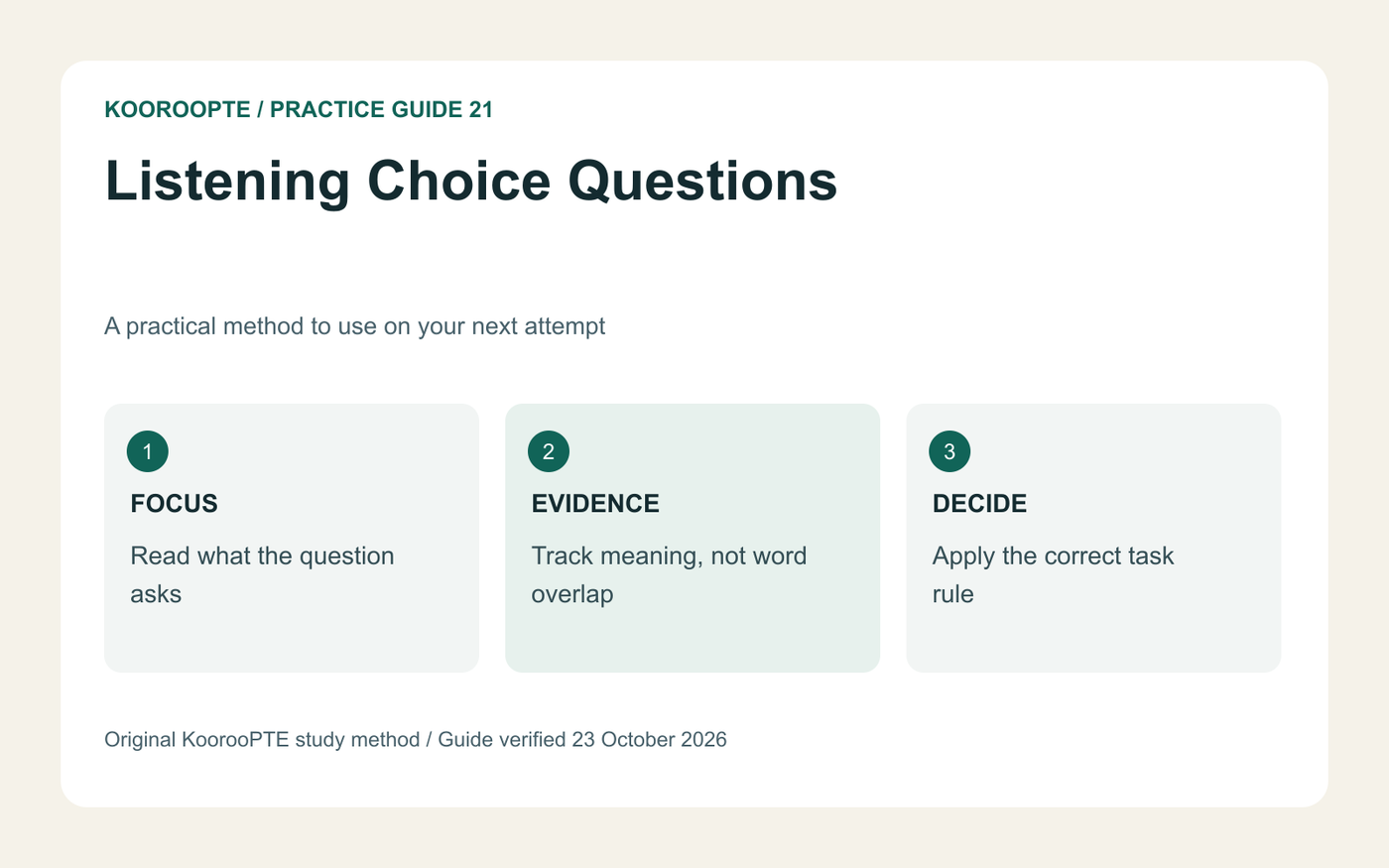
PTE listening multiple choice becomes more manageable when you separate the question types and follow evidence from the recording. Identify what the question asks, track the speaker’s meaning, and evaluate each option against it. Select Missing Word needs the same attention to context, with particular focus on the recording’s unfinished ending.
Written by the KoorooPTE editorial team. Last updated and fact-checked: 23 October 2026.
Which listening choice tasks does this guide cover?
This guide covers Multiple Choice, Single Answer; Multiple Choice, Multiple Answers; and Select Missing Word. All three assess Listening, but they ask for different decisions. Read the task instruction before applying a strategy learned for another question type.
Single-answer questions require one response to a question about a recording. Multiple-answer questions require more than one supported option. Select Missing Word asks you to choose the ending that best completes a recording after its final word or phrase is replaced by a beep.
The shared skill is understanding meaning. Repeated words, familiar topics and plausible real-world statements can all distract you from what the speaker actually communicated.
How do the scoring rules differ?
Single Answer and Select Missing Word are scored correct or incorrect: one point for a correct answer and zero for an incorrect one. Multiple Answers uses partial credit, with one point for each correct selection, a deduction for each incorrect selection and an item minimum of zero.
Apply those rules to your review. In a multiple-answer item, an unsupported additional choice can cancel credit. In a single-answer item, there is no comparable deduction for choosing the wrong option. Do not describe all listening questions as negatively marked or apply the same selection behaviour to every task.
The Highlight Incorrect Words guide covers another task with deductions. Its response method is different, so keep the scoring rule separate from the physical action you perform on screen.
What method should you use before choosing an option?
Turn the question into a listening target, then judge options against the evidence.
- Read the question’s focus. Decide whether it asks for a reason, result, opinion, detail or inference.
- Notice differences between options. Look for contrasts in cause, time, degree or intention rather than reading every option as an unrelated sentence.
- Listen for the relevant claim. Keep following the recording even when you hear a familiar word from one option.
- Record decisive information briefly. Include a contrast or qualification if it changes the answer.
- Evaluate each candidate. Ask what part of the recording supports it and whether it adds or changes anything.
- Apply the task’s selection rule. Choose one option for a single-answer task; assess each proposed selection independently for multiple answers.
If an option is partly correct, check the rest of it. One accurate noun does not rescue a sentence with the wrong reason or an exaggerated conclusion.
What does a single-answer example look like?
The correct answer in this original example follows the speaker’s reason, not the most memorable word.
Practice script: “The museum originally planned to extend its weekend opening hours. However, a visitor survey showed that most requests came from local teachers who wanted to bring classes after school. The museum therefore added a later closing time on Wednesdays instead.”
Question: Why did the museum introduce a later Wednesday closing time?
- A: To accommodate school visits after lessons.
- B: To reduce the number of weekend visitors.
- C: To give staff a shorter working week.
Answer: A. The survey identified demand from teachers for after-school visits. B mentions weekends, which appear in the recording, but invents an aim to reduce attendance. C introduces a staffing reason that the recording never gives.
Explain rejected options in practice. That exposes whether you followed the causal relationship or simply recognized vocabulary.
How do you check a multiple-answer example?
Check every selected statement separately, because one correct choice does not make a neighbouring choice safe.
Original practice script: “The department will keep printed handbooks for students who request them, but most information will move online. The change is intended to make corrections faster and reduce printing costs. It is not expected to reduce the amount of guidance available.”
Question: Which reasons does the speaker give for moving most information online?
- A: Updates can be made more quickly.
- B: Printing costs can be reduced.
- C: Students will receive less guidance.
- D: Printed handbooks will be completely banned.
Answers: A and B. These express the two stated purposes. C reverses an explicit qualification. D exaggerates “most information” into a complete ban, despite the retained request option.
Use a three-way review label for each option: supported, contradicted, or not established. Only “supported” is a reason to select it. A statement can sound sensible without being established by the recording.
How should you approach Select Missing Word?
Follow the final line of reasoning and test the ending against both meaning and grammar. The recording’s general topic may leave several options plausible, while its closing sentence narrows the choice.
Original shortened practice script: “The research team had enough equipment, but it could not begin collecting data until the ethics committee had reviewed the proposal. The remaining obstacle was therefore obtaining [beep].”
Options: additional equipment / ethical approval / a larger sample
Answer: ethical approval. The equipment is explicitly sufficient, and the unfinished sentence points back to the committee’s review. A larger sample could matter in a different study, but it does not complete the reason given here.
This short script demonstrates the reasoning. It is not intended to reproduce the length of an official item. Use full practice recordings separately to train attention across a longer passage.
What should you put in your practice error log?
Record the reasoning error, not only the correct option. Useful categories include missed contrast, unsupported inference, wrong degree, vocabulary confusion and selected-too-many.
- Repeated-word trap: write the option’s actual claim and compare it with the recording.
- Missed negative: replay the phrase containing “not,” “never,” or another limitation and explain its effect.
- Overstatement: compare words such as “some” and “all,” or “may” and “will.”
- Outside knowledge: identify where an assumption came from your own expectations rather than the source.
Use this checklist before moving on: question focus clear; claim understood; limitation retained; each choice supported; correct number-of-answers rule applied. This is a review habit, not a promise of a particular score.
Practise listening multiple-answer questions, single-answer questions, or Select Missing Word. Compare these comprehension decisions with Summarize Spoken Text and the broader question-type guide.
Which sources were checked for this guide?
The exam facts were checked against Pearson's current listening task descriptions and the Test Taker Score Guide (pages 44) on 23 October 2026. The worked examples, model responses and practice routines are original KoorooPTE teaching material, not official Pearson questions or awarded scores.
Frequently asked questions
Should I choose an option because it repeats the recording?
No. Shared vocabulary can appear in an option that changes the speaker’s meaning. Check whether the option preserves the original claim, including any contrast, condition or limitation. During review, explain why each rejected option is wrong instead of recording only the letter of the correct answer.
How should I take notes for multiple-answer questions?
Write short reminders of the points that answer the question, including reasons and contrasts. Avoid transcribing every sentence or selecting options while you are still trying to understand a new point. After listening, compare each option with your notes and identify the specific evidence that supports it.
What if every Select Missing Word option seems plausible?
Return to the speaker’s final line of reasoning and the grammar immediately before the gap. Several endings may be sensible in everyday life, but only one best completes this recording. During practice, test each option aloud in the sentence and explain which earlier detail makes the intended ending strongest.