
PTE Write from Dictation 2026: Accuracy, Spelling and Practice
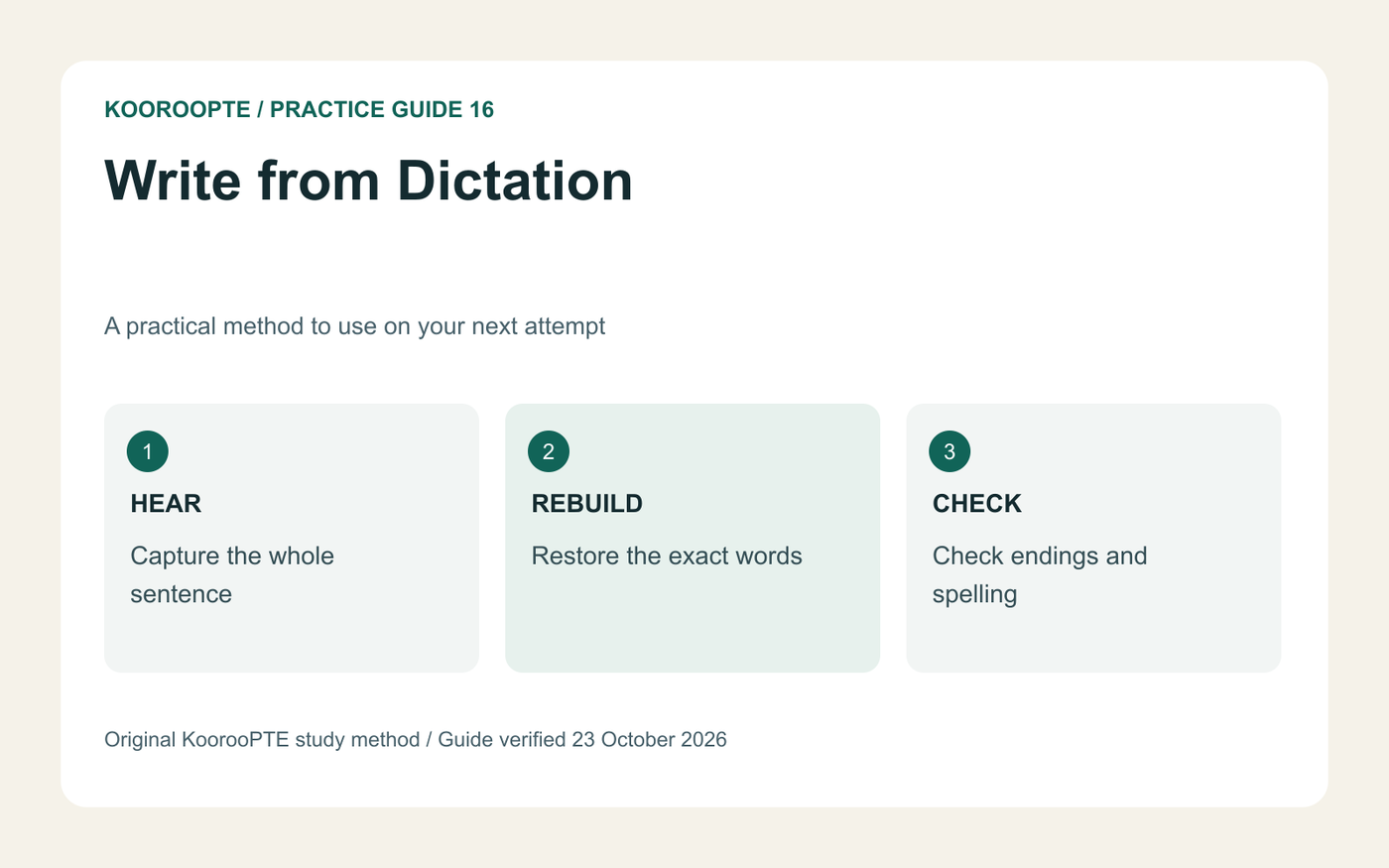
PTE Write from Dictation asks you to reproduce a short spoken sentence accurately. Build your response from the words you heard, then check missing articles, word endings and spelling. This guide gives you an original worked example and a repeatable review routine for turning listening errors into focused practice.
Written by the KoorooPTE editorial team. Last updated and fact-checked: 23 October 2026.
What does PTE Write from Dictation ask you to do?
Write from Dictation asks you to type the sentence you hear, preserving its words and spelling. Pearson lists a recording length of 3-5 seconds and assesses Listening and Writing. You hear the recording once. Notes are permitted, so your task is to choose a way of capturing the sentence that you can use reliably.
The useful distinction is between remembering the message and reproducing the wording. If you hear that a lecture has moved, remembering only “new lecture room” is not enough to reconstruct the sentence. You need the small connecting words as well as the main nouns and verbs.
This is a different response skill from Repeat Sentence. Both involve retaining spoken language, but here you can inspect and edit the written result. Use that opportunity to check what you actually heard instead of turning the sentence into a more elegant paraphrase.
How is Write from Dictation scored?
Pearson awards credit for correct words with correct spelling. Its current rubric does not justify a promise that this task supplies a fixed percentage of your final score. An item result also should not be treated as a direct conversion to a score out of 90.
Use exact wording as your practice target. Replacing a heard word with a synonym may preserve meaning while failing to reproduce the source. Adding a list of alternative words is also a poor learning method: it hides which form you heard and which form you merely hoped would be present.
What method should you use on each attempt?
Use a consistent capture-and-check sequence, then adjust the capture step based on your errors.
- Prepare to hear a whole sentence. Keep your attention on the recording rather than predicting a topic from the previous item.
- Catch the sentence structure. Notice who or what the sentence concerns and what is being said about it.
- Record useful fragments. If you take notes, use short forms you can interpret immediately. Do not let writing the beginning make you miss the ending.
- Rebuild the sentence promptly. Type the words you remember in their original order. Resolve gaps from the recording and grammatical context, without adding new information.
- Check the small words. Look for missing articles, prepositions and auxiliaries such as “the,” “to,” or “has.”
- Check endings and spelling. Read the response once for meaning and once for exact word forms, then move on within the remaining section time.
Choose between direct typing and brief notes through practice, not through an absolute rule. Try each approach on several unfamiliar sentences of similar difficulty. Keep the method that preserves more of the ending and produces fewer unresolved gaps.
What does a worked correction look like?
An effective correction identifies the exact difference and explains how to notice it next time. The following is an original practice script; ask a partner or a text-to-speech tool to read it once while you keep the text hidden.
Source: “The revised timetable will be available on the department website.”
First attempt: “The revised time table will available on department website.”
Correct response: “The revised timetable will be available on the department website.”
Three corrections matter here. “Timetable” is one word in this sentence. “Will be available” needs the auxiliary “be.” The phrase “on the department website” includes an article before “department.” The exercise is not a request to make the first attempt sound better; it is a comparison with the exact source.
An error log should preserve those distinctions. Write “word form: timetable,” “missing auxiliary: be,” and “missing article: the.” If all three are labelled simply “listening,” you lose the information needed to choose tomorrow’s drill.
What mistakes should you correct first?
Correct recurring errors that appear across unfamiliar sentences, rather than repeatedly polishing one sentence you already know.
- You miss sentence endings: shorten your notes and keep listening while writing. Review whether the final clause disappears whenever the opening is long.
- You paraphrase automatically: compare your response word by word with the source and mark substitutions separately from omissions.
- You lose singular or plural endings: practise contrasts inside sentences, then check whether the surrounding grammar supports what you heard.
- You know a word but misspell it: use a listen-write-check cycle with that word in a new sentence the following day.
- You keep changing a correct answer: record the first and final versions during practice. Look for edits driven by evidence versus edits driven by discomfort.
Avoid judging yourself from one difficult recording. A repeated pattern across several items provides a better basis for a useful change.
How can you practise this in fifteen minutes?
A short session should include fresh attempts, error analysis and a delayed retry. The schedule below is a suggested home routine, not an official exam time allocation.
Spend five minutes on a small set of unfamiliar sentences. Use one playback per first attempt, then compare with the source. Spend five minutes sorting mistakes into missing words, substituted words, word endings and spelling. Use the remaining five minutes to practise the most frequent category with new sentences.
Try these original prompts with the text hidden while someone reads them:
- “All laboratory reports must include a clearly labelled diagram.”
- “The researchers compared the results with an earlier study.”
- “Students can borrow additional equipment from the technical office.”
Use this reusable checklist: whole sentence captured; no deliberate paraphrase; small words checked; endings checked; spelling checked. Record the number of fresh sentences attempted as well as the errors, so a shorter session does not create a misleading appearance of improvement.
Open Write from Dictation practice on KoorooPTE, then apply the same error log. For the wider task map, use the PTE question-type guide. If your difficulty is turning understood information into accurate written language, compare this exact-reproduction task with Summarize Written Text, where selecting and paraphrasing ideas is the goal.
Which sources were checked for this guide?
The exam facts were checked against Pearson's current listening task descriptions and the Test Taker Score Guide (pages 44) on 23 October 2026. The worked examples, model responses and practice routines are original KoorooPTE teaching material, not official Pearson questions or awarded scores.
Frequently asked questions
Should I add extra words to Write from Dictation?
Aim to reproduce the sentence you heard, without padding it with alternatives. When you are unsure, use the sound and the sentence structure to choose the most defensible wording. Keeping a record of those uncertainties is more useful for practice than relying on an unsupported extra-word trick.
How should I practise spelling for Write from Dictation?
Build a short list from words you actually miss. Listen to each word in a sentence, write it without looking, compare it with the source and try it again the next day. Include plural and past-tense endings, because knowing the base word does not guarantee an accurate sentence.
Is a good practice result a guaranteed PTE score?
No. Treat a practice result as feedback on that attempt, not a promise about your official score. Compare performance across unfamiliar sentences and record the kinds of errors you make. Improvement is more convincing when you can reproduce it on material you have not memorized.