
PTE Reading Fill in the Blanks 2026: Grammar and Context
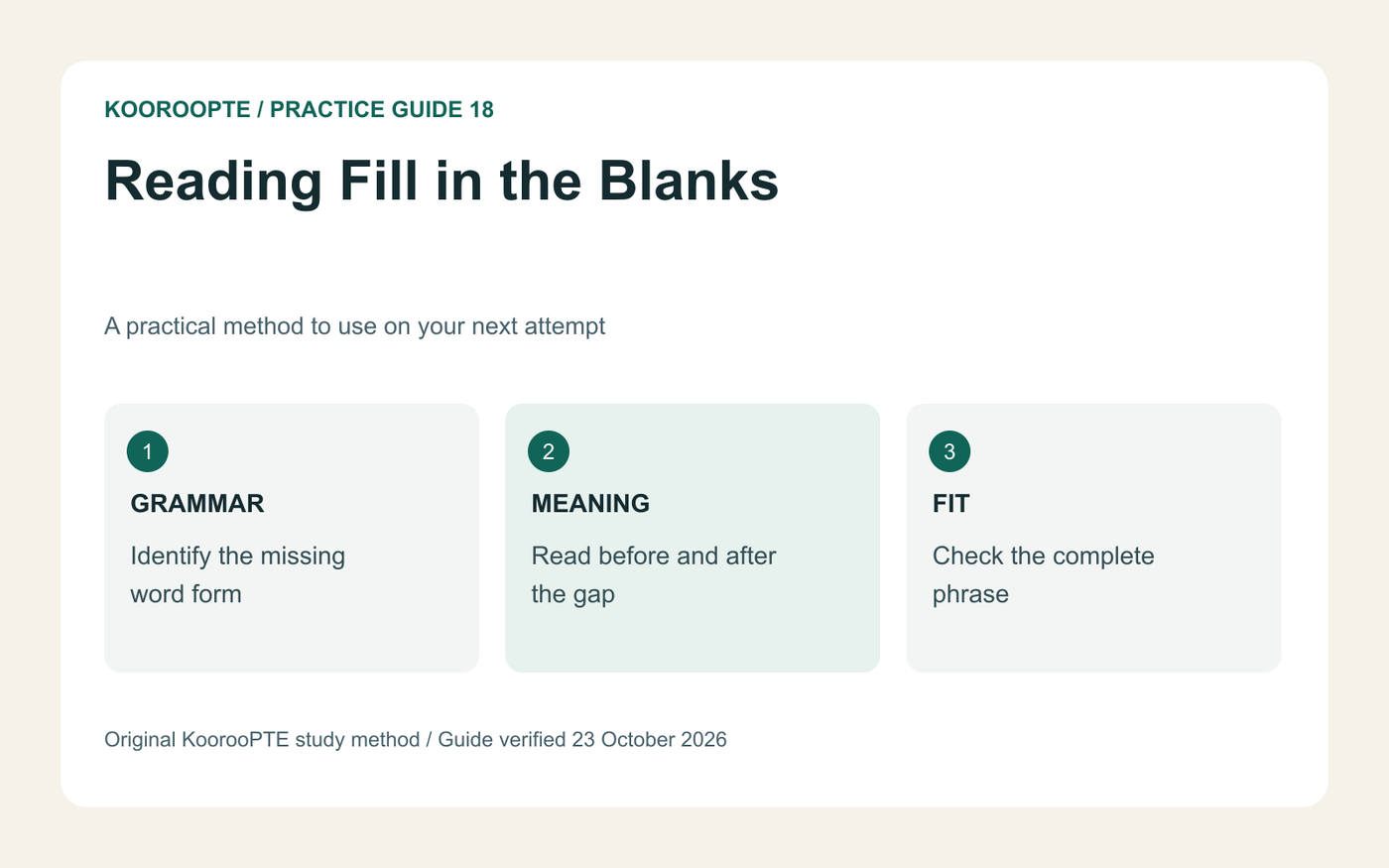
PTE Reading Fill in the Blanks tests how well you combine grammar with meaning. Identify the kind of word a gap needs, compare the available choices, and reread the completed sentence in context. This guide covers both dropdown and drag-and-drop tasks, including the current scoring distinction that older resources can obscure.
Written by the KoorooPTE editorial team. Last updated and fact-checked: 23 October 2026.
Which Reading Fill in the Blanks formats are in PTE Academic?
PTE Academic has two reading gap-fill formats: dropdown choices for individual gaps and drag-and-drop words drawn from a shared bank. Pearson lists passages of up to 200 words for dropdown and up to 80 words for drag and drop. Both require you to restore a passage using its grammar and meaning.
The interface changes how you compare options. In a dropdown question, focus on the alternatives attached to that particular gap. In drag and drop, keep track of how the available words fit across the passage, because an attractive word in one position may belong elsewhere.
Does the dropdown task still contribute to Writing?
The current detailed task description and score-guide table list Reading for both formats. Older resources and some practice menus still use “Reading and Writing: Fill in the Blanks” for dropdown. Pearson’s Reading page also retains that older claim in its introduction, while its detailed dropdown section says Writing is not tested by this task.
Use the current detailed rubric on page 40 of the linked score guide when planning which skill you are practising. Correctly completed gaps earn credit; an incorrect gap earns none. Do not transfer the multiple-answer question’s deduction rule to gap filling.
How should you choose a word for each gap?
Check grammar, meaning and phrase fit in that order, then reread the completed passage.
- Establish the topic. Read quickly through the text before solving individual gaps so you know what the writer is explaining.
- Identify the needed form. Decide whether the gap needs a noun, verb, adjective, adverb or another structure.
- Inspect both sides. A preposition or auxiliary after the gap can matter as much as the word before it.
- Remove incompatible options. Reject choices that cannot fit the grammar or clearly contradict the message.
- Compare the remaining meanings. Explain what each candidate would make the sentence say.
- Check the full phrase. Read the sentence naturally and then check that it connects with the surrounding sentences.
Treat collocation as evidence about how words work together, not as permission to ignore context. A familiar phrase can still express the wrong idea in this particular passage.
What does a dropdown worked example look like?
The correct choice must fit the surrounding structure as well as the topic. These original examples illustrate the decision process rather than reproduce official test questions.
Passage: “The researchers repeated the experiment to ___ that the result was reliable.”
Choices: ensure / assure / insure / secure
Answer: “The researchers repeated the experiment to ensure that the result was reliable.”
“Ensure that” means make certain that something is the case. “Assure” normally requires a person as its object in this kind of construction, as in “assure the team that.” “Insure” concerns insurance, which the passage is not discussing. “Secure that” does not fit the intended construction here.
Second passage: “The new equipment was expensive; ___, the department postponed the purchase.”
Choices: nevertheless / therefore / similarly / otherwise
Answer: “The new equipment was expensive; therefore, the department postponed the purchase.”
The second clause presents a consequence of the cost. “Nevertheless” would announce a contrast, “similarly” would introduce a comparison, and “otherwise” would normally express an alternative condition. The punctuation alone does not choose the answer; the relationship between the ideas does.
How do you handle a shared word bank?
Complete the clearest gaps first and use the whole passage to check the remaining choices. Avoid forcing the first plausible word into the first gap before you have read the rest.
Original passage: “The team collected water samples at regular ___. Each sample was stored in a sealed ___ before being sent to the laboratory.”
Word bank: container / intervals / interval / contain / regularly
Completed passage: “The team collected water samples at regular intervals. Each sample was stored in a sealed container before being sent to the laboratory.”
“At regular intervals” requires a plural noun in this construction. “A sealed container” needs a singular noun after the article and adjective. The rejected words are not interchangeable just because some share a root with the correct choice.
Write a short reason beside each answer in practice. If you cannot explain why an alternative is wrong, keep that gap in your review list even when you happened to choose correctly.
What mistakes should your review catch?
A useful review identifies why a wrong option looked attractive and what evidence rules it out.
- You choose by topic alone: read the completed sentence and check the exact word form and preposition.
- You stop reading at the gap: include the rest of the sentence before deciding.
- You confuse related forms: record a family such as “analyse,” “analysis” and “analytical,” each inside a different sentence.
- You remember the answer but not the reason: write a fresh sentence using the same structure with a different topic.
- You overuse one familiar collocation: compare it with a near alternative and explain the difference in meaning or construction.
Keep a compact vocabulary notebook with four fields: original phrase, meaning in context, reason the tempting option failed, and your own new sentence. This is more useful than copying a large list you never retrieve from memory.
How can you turn this into a repeatable practice session?
Choose a small set of fresh gaps, explain your decisions, and retest the difficult structures later. During the first pass, avoid looking up words. After checking the answers, use a dictionary to resolve a precise uncertainty, such as whether a verb takes a particular preposition.
Use this reusable checklist: topic understood; required form identified; both sides read; meaning checked; full passage reread. Separate vocabulary errors from grammar and attention errors so your next session addresses the actual cause.
Open Reading Fill in the Blanks practice. You can also open the dropdown practice route, which retains the older name in its URL. Connect this work with Reorder Paragraphs, Summarize Written Text and the PTE question-type guide.
Which sources were checked for this guide?
The exam facts were checked against Pearson's current reading task descriptions and the Test Taker Score Guide (pages 40) on 23 October 2026. The worked examples, model responses and practice routines are original KoorooPTE teaching material, not official Pearson questions or awarded scores.
Frequently asked questions
Should I learn vocabulary as isolated word lists?
Use phrases and sentences alongside individual meanings. A word can have the right general meaning and still be wrong next to a particular verb or preposition. Record the full phrase from each mistake and write a fresh sentence that uses the same pattern in a different situation.
What should I do when two options seem grammatically correct?
Read the surrounding sentences and explain the difference in meaning between the remaining choices. Grammar may eliminate some options without deciding the answer. Look for a cause, contrast, quantity or purpose elsewhere in the passage that makes one candidate fit the writer’s message more precisely.
Is the old Reading and Writing Fill in the Blanks name still useful?
It can help you recognize older lessons or a practice menu, but it should not decide your scoring expectations. Check the current task name and rubric first. This article uses Pearson’s detailed dropdown description and current score-guide table to distinguish the task from older explanations.