
PTE Reorder Paragraphs 2026: Build the Right Sentence Links
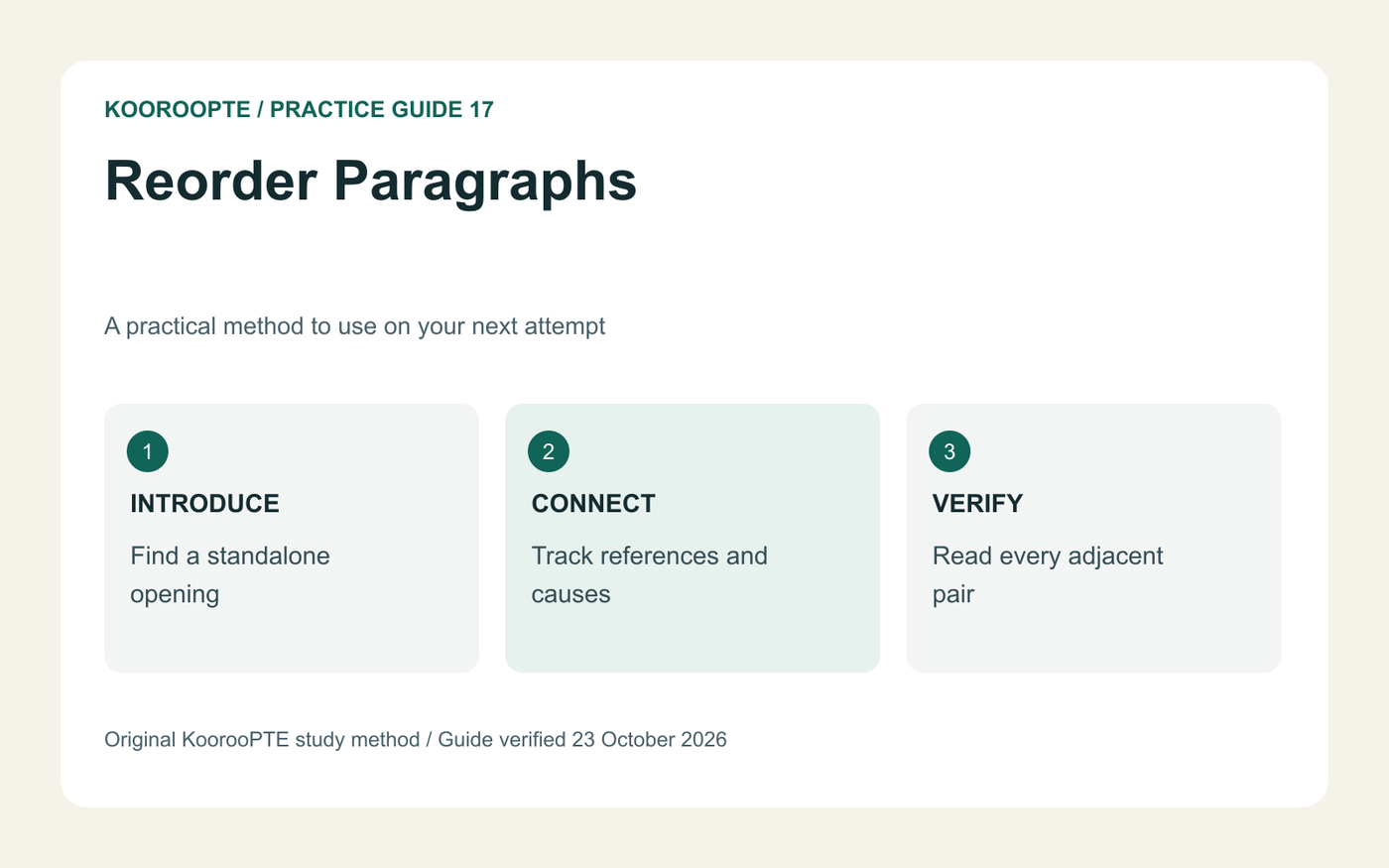
PTE Reorder Paragraphs becomes easier when you justify the link between each pair of sentences. Find a plausible opening, connect references to the ideas they depend on, and check the complete sequence. Use the worked examples below to practise explaining your order rather than guessing from familiar keywords.
Written by the KoorooPTE editorial team. Last updated and fact-checked: 23 October 2026.
What is PTE Reorder Paragraphs?
Reorder Paragraphs asks you to restore the intended order of shuffled text boxes. Pearson calls the task “Reorder Paragraph” in its current format guide and assesses Reading. The text can contain up to 110 words. Your job is to reconstruct the writer’s progression of ideas, not simply to group sentences that mention the same topic.
A convincing order makes each new sentence understandable at the moment the reader reaches it. A reference has something to refer to. An explanation follows the idea it explains. A conclusion follows enough information to support it. These connections give you a way to test an answer rather than rely on how familiar it sounds.
How does adjacent-pair scoring change your approach?
The score guide awards credit for correctly ordered adjacent pairs. That makes checking the connection between neighbouring boxes useful, even when you are uncertain about the whole passage. It does not mean that any two logically related sentences earn credit: the pair must match the intended order and be adjacent.
Consider an intended sequence of A-B-C-D. A response of A-C-D-B preserves the C-D pair, but it breaks A-B and B-C. This simplified illustration explains the scoring unit; it is not a prediction of your final Reading score.
Build the strongest pairs first when they are clear, then test where those pairs belong. Do not sacrifice a well-supported pair merely because another sentence looks like a familiar introduction.
How do you find the right order step by step?
Read for dependencies: information that a sentence needs before it can make sense.
- Read every box once. Identify the subject and the general event or argument before moving anything.
- Find a plausible opening. Prefer a sentence that introduces its subject without needing an earlier reference. Treat this as evidence, not an inflexible rule about particular words.
- Resolve references. Connect phrases such as “this change,” “these findings” or “the equipment” to the specific information they depend on.
- Trace relationships. Look for a cause and consequence, a proposal and response, or a claim and example.
- Join strong pairs. Keep the connection visible while you consider where the remaining boxes belong.
- Read the full sequence. Check every boundary, including the transition between two pairs that each looked correct on their own.
Use grammatical clues with meaning. “However” signals a contrast, but you still need to find what is being contrasted. Two sentences mentioning the same building are not necessarily adjacent if another sentence introduces the event that connects them.
What does an original worked example look like?
The correct order in this example is C-A-D-B, because each sentence creates the context required by the next one.
A. The library addressed this shortage by converting an unused office into a quiet study room.
B. Following that increase, it introduced a booking system to distribute access more fairly.
C. During the examination period, students at a college struggled to find quiet places to study.
D. Demand for the new room then rose sharply, especially in the evenings.
Start with C: it establishes the shortage of suitable study spaces. A responds to “this shortage” and introduces the new room. D depends on that introduction when it discusses demand for “the new room.” B follows the increase in demand and describes the library’s response.
The complete paragraph reads: “During the examination period, students at a college struggled to find quiet places to study. The library addressed this shortage by converting an unused office into a quiet study room. Demand for the new room then rose sharply, especially in the evenings. Following that increase, it introduced a booking system to distribute access more fairly.”
A useful review explains all three boundaries. Saying “C feels like the beginning” explains only the first choice and leaves the rest of the reasoning unchecked.
What should you do when the obvious clue is misleading?
Test the reference against its actual meaning instead of matching a repeated word mechanically. A passage can mention several studies, proposals or groups; “this result” must refer to the right result, not merely the closest noun.
- Mistake: choosing the longest sentence as the opening. Fix: check whether it introduces its own subject and whether its references are already understandable.
- Mistake: pairing every “however” with the preceding positive statement. Fix: state the exact contrast in plain language before accepting the pair.
- Mistake: using chronology alone. Fix: check whether the writer introduces an event and then explains its earlier cause.
- Mistake: changing many boxes at once. Fix: identify the specific broken link, propose one alternative and reread the affected boundaries.
Keep your decision proportionate to the evidence. If a pair is supported only by a repeated word, treat it as provisional. A reference plus a clear causal link is a stronger explanation.
What practice exercise can you try now?
Use a second short passage to practise explaining the order before revealing the answer.
A. That comparison showed that the shaded section retained more moisture.
B. Researchers planted the same seedlings in a shaded bed and a sunny bed.
C. They then compared soil moisture in the two beds each morning.
D. The result suggested that shade could reduce watering needs under those conditions.
The answer is B-C-A-D. B introduces the experiment and its researchers. C describes their comparison. A reports the comparison’s result. D interprets that result while keeping its conclusion limited to the conditions described.
Use this checklist on your next five items: opening justified; every reference resolved; each adjacent pair explained; whole paragraph coherent. Keep a short note of the clue you missed, such as reference, cause, contrast or scope. Review those categories rather than memorizing the final letter sequence.
Practise Reorder Paragraphs on KoorooPTE. Use Reading Fill in the Blanks to work on sentence-level context, Summarize Written Text to practise identifying main ideas, and the question-type guide to place this task within your preparation.
Which sources were checked for this guide?
The exam facts were checked against Pearson's current reading task descriptions and the Test Taker Score Guide (pages 40) on 23 October 2026. The worked examples, model responses and practice routines are original KoorooPTE teaching material, not official Pearson questions or awarded scores.
Frequently asked questions
Should I always put the shortest sentence first?
No. Sentence length does not tell you whether a sentence introduces the topic. Look for a statement that makes sense without information from another box. A short sentence beginning with a reference such as this result may belong much later because the result needs to be introduced first.
How can I decide between two possible orders?
Compare the links that change between the two orders. Ask which sentence supplies the person, event or finding referred to next, and whether a cause appears before its consequence. If both orders still seem possible, reread all boxes for a detail you have not yet used.
Should I memorize paragraph patterns?
Learn common relationships such as problem and response, claim and evidence, or event and consequence. Do not treat one pattern as a compulsory answer. The text itself decides the order, and a good practice explanation identifies the particular words and ideas that make each connection work.