
PTE Reading Multiple Choice 2026: Single and Multiple Answers
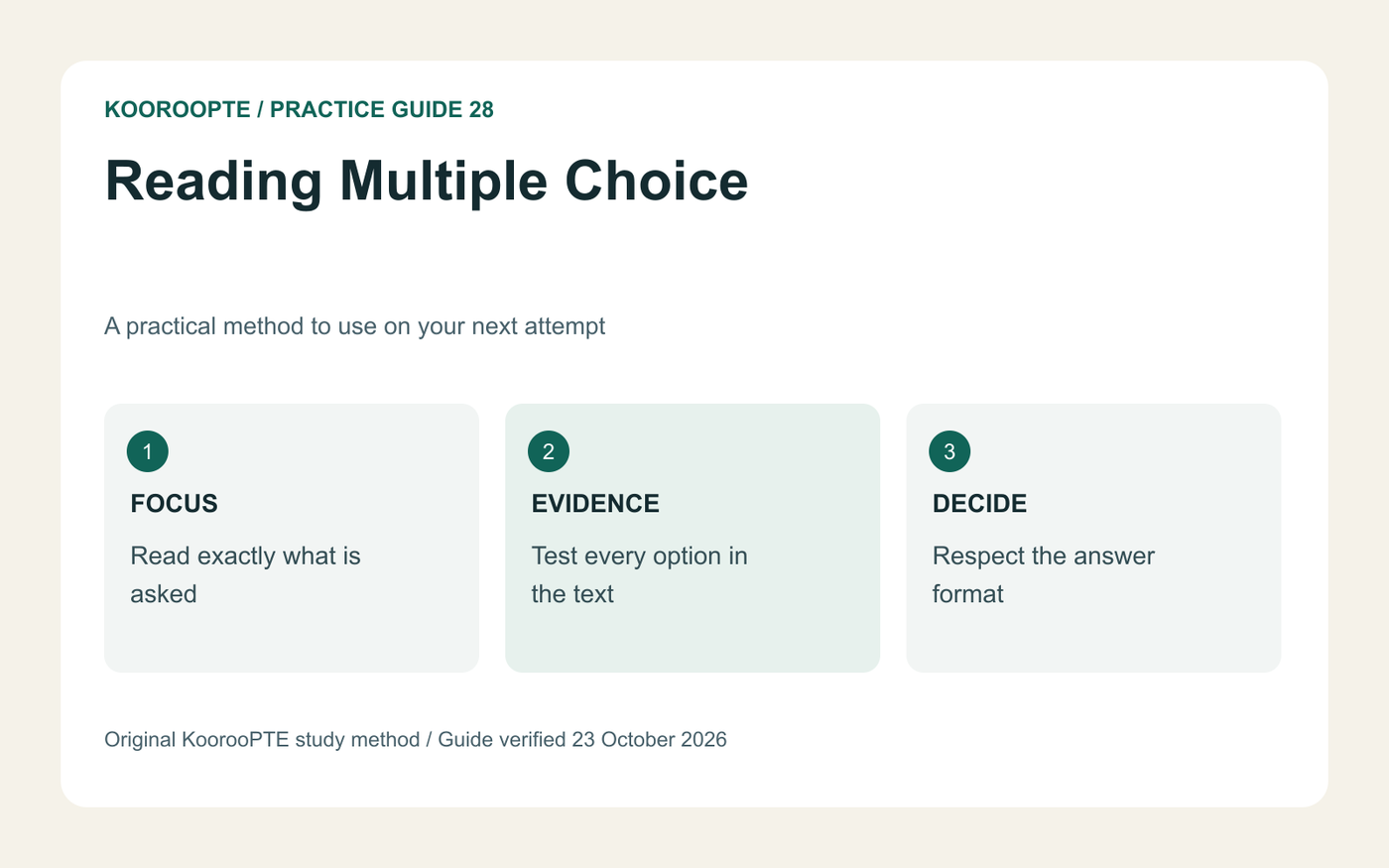
PTE Reading Multiple Choice requires evidence from the passage, not a statement that merely sounds reasonable. First identify whether the task needs one answer or several. Then test each option against the question and text. The examples below explain both formats, their different marking rules and a practical review method.
Written by the KoorooPTE editorial team. Last updated and fact-checked: 23 October 2026.
How do the two Reading Multiple Choice formats differ?
Single-answer questions require one selection, while multiple-answer questions require all supported selections. Both assess Reading, but their raw-point rules differ. Check the instruction before you start comparing options.
Pearson describes passages of up to 110 words for single-answer items and up to 350 words for multiple-answer items. The current Score Guide gives a single-answer item one point if correct and zero otherwise. Multiple-answer items award one point per correct selection, subtract one per incorrect selection and have a minimum item score of zero.
The score table is especially useful here because Pearson's Reading page currently contains a copied dropdown explanation under the multiple-answer scoring heading. This guide uses the task's actual row on page 40 of the Score Guide. Raw item points are not a direct conversion to your final Reading score.
What method works for both formats?
Make the question and passage decide each selection. Outside knowledge can help you understand a topic, but it cannot supply evidence that the text does not contain.
- Read the instruction. Establish whether one answer or several are required. Do not infer the format from how many options look plausible.
- Identify the question's focus. Decide whether it asks for a main idea, a reason, an inference or a detail. Underline a limiting word such as primarily in your practice notes.
- Read for structure. Notice the claim, supporting evidence and conclusion. Locate contrast words that signal a qualification or change of direction.
- Test each option. Find the supporting wording or explain the inference. Mark an unsupported claim separately from a claim the passage directly contradicts.
- Match the strength. Check quantities, time periods, certainty and cause. “Associated with” does not automatically mean “caused by.”
- Apply the answer format. For a single answer, choose the best supported response to the exact question. For multiple answers, evaluate every selection independently and remove those without sufficient evidence.
Do not impose a compulsory number such as “always select two.” The instruction says there is more than one correct response in the multiple-answer format; the passage and options determine which ones deserve selection.
What does a single-answer example show?
The correct answer addresses the writer's purpose rather than repeating any true detail. This passage and all options are original practice material.
Passage: “A college introduced recorded versions of its introductory lectures. Students who missed a session valued the recordings, and many others used them for revision. Attendance at live lectures remained stable during the first term. The college therefore continued the scheme, while asking teachers to keep discussion activities in the classroom. Recordings were intended to extend access to explanations, rather than replace opportunities to question and discuss them.”
Question: What is the main purpose of the scheme described?
- A. To remove the need for classroom teaching.
- B. To provide access to lecture explanations while retaining live discussion.
- C. To reduce attendance at introductory lectures.
- D. To assess students through recorded presentations.
Answer: B. It combines access and the retained role of discussion. A contradicts the final sentence. C confuses a possible fear with the actual stable attendance. D introduces an assessment method that is never mentioned.
Notice that B uses different wording from parts of the passage without changing their meaning. Matching an entire phrase is not necessary. The relevant question is whether the option preserves what the text actually says.
What does a multiple-answer example show?
Correct selections can express different parts of the same argument, while an attractive distractor may exaggerate one of them. This fictional example concerns a workplace trial.
Passage: “A company tested a four-day office week in one department for three months. Employees completed their usual weekly hours across four longer days. Most participants preferred the arrangement because they travelled to work less often. Managers found that routine output remained similar, but arranging meetings with teams on five-day schedules became harder. The company decided to extend the trial to another department before considering a wider policy. It did not claim that every role could use the same arrangement.”
Question: Which statements are supported by the passage?
- A. Participants worked fewer days but kept their usual weekly hours.
- B. Routine output fell sharply during the trial.
- C. Coordinating some meetings became more difficult.
- D. The company immediately adopted the arrangement for every role.
- E. All employees preferred the arrangement because their working hours decreased.
Answers: A and C. A restates how the schedule was organized, while C reports the meeting difficulty. B reverses the output finding. D replaces further testing with a final universal policy. E changes most to all and invents reduced weekly hours.
Selecting A, C and E earns two correct-selection points minus one incorrect-selection point: one raw point for this illustrative item. Selecting A and C earns two. If incorrect selections outweigh correct ones, the item floor is zero; do not interpret that floor as a reason to click indiscriminately.
How should you handle uncertainty and timing?
Use uncertainty to trigger a targeted reread rather than restarting the entire passage. If an option changes a quantity, find the quantity. If it makes a causal claim, inspect the explanation and its limits. This gives your second reading a purpose.
Reading uses a shared section allowance, currently described as 23-30 minutes. There is no official fixed number of seconds for every multiple-choice question. During practice, record where time goes: understanding vocabulary, locating evidence or repeatedly reconsidering an already-supported answer.
Build your own timing checkpoints from several attempts. A longer passage may deserve more reading time, but repeated rereading without a new question is a different problem. Use the Reorder Paragraphs guide to practise recognizing relationships, and Reading Fill in the Blanks for grammar and local context.
What should your next practice review produce?
Produce one explanation for the correct choice and one for your strongest rejected alternative. That comparison shows whether you understood the distinction or simply remembered the answer letter.
Use a reusable checklist: correct format identified; question answered; evidence located; strength of claim preserved; every selected option justified. Record a recurring error in plain language, such as “I accept statements that are possible but not supported.”
Try Reading multiple-answer practice, followed by single-answer practice. Keep the rule differences visible in your notes. For the broader map of where these tasks belong, use the PTE Question Types guide.
Which sources were checked for this guide?
Exam facts were checked against Pearson's current reading guidance and the Test Taker Score Guide (pages 40) on 23 October 2026. The examples, schedules and review methods are original KoorooPTE teaching material, not official test questions, scored Pearson responses or promises of improvement.
Frequently asked questions
Should I select every plausible option in multiple-answer questions?
No. Separate an option that the passage supports from one that could be true in the wider world. Incorrect selections reduce the item's raw points, so broad plausibility is not enough. During practice, write the sentence or inference that supports each choice before checking the answer key.
Is there a fixed time limit for every reading question?
Pearson gives a Reading section time range rather than a separate official allowance for each multiple-choice item. Set practice checkpoints according to passage length and your own performance. Treat those checkpoints as training choices, and revise them when rushing causes you to misread the question or evidence.
How can I improve inference questions?
State what the passage directly tells you, then identify the smallest conclusion that follows from it. Avoid adding motives, future results or universal claims without support. In your error log, compare the accepted inference with your choice and name the extra assumption that made your answer too strong.