
PTE Retell Lecture 2026: Turn Notes into a Connected Response
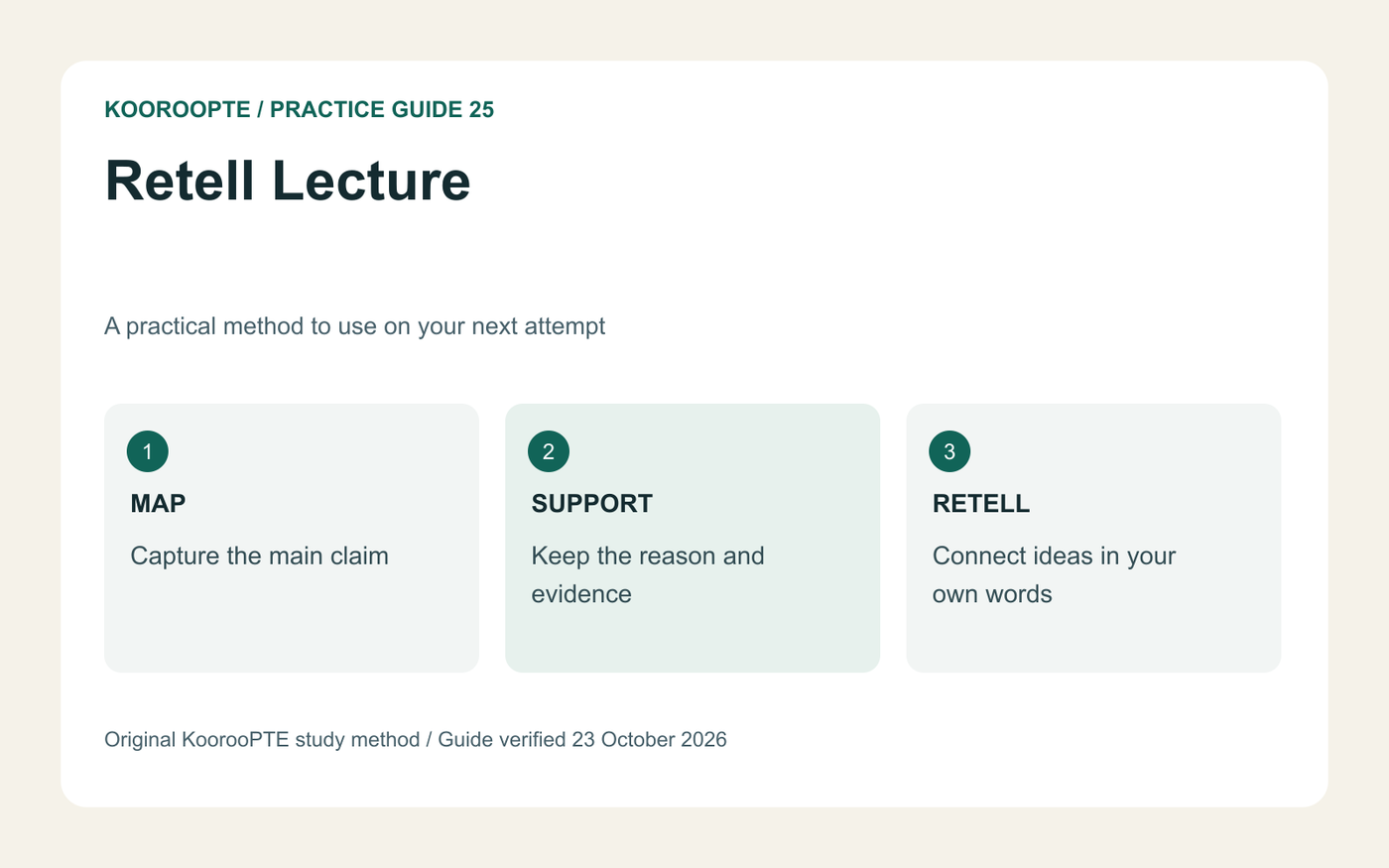
PTE Retell Lecture asks you to explain a short lecture in your own words. Note the main claim, its supporting evidence and any important qualification, then use those relationships to organize your response. The example below shows how to build a connected explanation instead of reading a list of remembered keywords.
Written by the KoorooPTE editorial team. Last updated and fact-checked: 23 October 2026.
What is PTE Retell Lecture?
Retell Lecture asks you to explain a short lecture in your own words after listening to or watching it. Pearson lists a prompt of up to 90 seconds, ten seconds to prepare after the recording and 40 seconds to speak. The task assesses Listening and Speaking, and an image may accompany the source.
The response should preserve the speaker’s main ideas and the relationships between them. Remembering several nouns is only a starting point. Your listener needs to understand what the lecture says about those nouns and why the information belongs together.
What does the current rubric assess?
The task uses Content, Pronunciation and Oral Fluency, with human review of Content alongside AI scoring. Accuracy and coherence matter alongside delivery. A smooth response that changes the lecture’s argument does not become strong merely because it contains relevant vocabulary.
Keep the source’s level of certainty. If the lecture describes a possible explanation, do not retell it as a proven cause. If it compares two approaches, preserve the difference instead of merging them into a vague statement that both are important.
How can you take notes that support a connected answer?
Use a compact argument map: topic, claim, support, qualification or conclusion. This keeps the meaning visible when the recording ends.
- Establish the subject. Use any opening information or accompanying image to recognize the topic, without inventing details from the image alone.
- Capture the central claim. Write what the speaker is explaining, arguing or demonstrating.
- Add the important support. Record the reason, process or example that makes the claim understandable.
- Mark contrasts and limits. A short symbol or phrase can preserve a distinction you might otherwise forget.
- Plan the response order. Use the preparation interval to choose the main claim and its most useful support.
- Explain the connections aloud. Produce sentences that show cause, contrast or development rather than reading a list of notes.
Do not write full sentences if doing so makes you miss the next point. Notes are successful when they help you recover meaning, not when they look like a complete transcript.
What does an original lecture example look like?
This fictional teaching script explains a university archive project. It is an original practice example, not a report about a real institution. Have someone read it while you take notes, then hide the script before responding.
Practice lecture:
“A university archive began digitizing its collection of local newspapers because the paper copies were fragile and difficult for researchers to access. At first, the project team concentrated on producing clear images of every page. That solved part of the preservation problem, but it did not make the collection easy to search. Researchers still needed to know which issue might contain a relevant article. The team therefore began adding information about publication dates, subjects and names to the digital records. This descriptive information allowed users to locate material without opening every page. The project also kept backup copies in a separate location to reduce the risk of losing the digital collection. The archive’s experience shows that digitization involves several related tasks. Capturing an image preserves a representation of the page, descriptive records help people find it, and backups support its continued availability. A successful project needs all of these functions, rather than treating the production of scanned images as the final step.”
Useful notes: fragile newspapers; scans preserve pages; search still difficult; dates/topics/names help discovery; separate backups; digitization includes preservation, finding and availability.
What would a connected model response sound like?
The model below preserves the lecture’s distinction between capturing material, finding it and protecting access to it.
“The lecture explains why digitizing an archive involves more than scanning documents. A university first created clear images of fragile newspapers, but researchers still found the collection difficult to search. The team added descriptive information, including dates, subjects and names, so users could locate relevant material. It also stored separate backup copies. The main point is that a digital archive needs to preserve the pages, make their contents discoverable and protect the collection’s continued availability.”
The response connects the initial problem to the later actions. “But” introduces the limitation of scanning alone, and “so” explains the purpose of the descriptive records. The final sentence synthesizes the lecture’s main point without adding an unrelated opinion.
Read the response at your natural pace and check it against the response window. If you need to shorten it, remove a secondary example before removing a relationship that makes the argument understandable. Do not speed up so much that the words become difficult to follow.
How do you repair a keyword-heavy answer?
Turn the remembered words into claims and connect those claims using the lecture’s logic.
Weak response: “The lecture is about newspapers, images, researchers, dates, names and backups. It is very important and gives useful information about archives.”
That answer recognizes the topic but does not explain the problem or solution. Ask three questions: Why were the newspapers digitized? Why were images insufficient for searching? What did the team add? Use the answers to replace the generic final sentence with a source-based explanation.
A stronger response need not use difficult vocabulary. “The scans preserved the pages, but extra descriptive information was needed to help researchers find articles” communicates more than a long string of technical terms with no relationship between them.
Which mistakes should you check after speaking?
Check whether your response preserves the argument before focusing on small delivery problems.
- Missing the central claim: state it in one sentence before attempting another full response.
- Listing examples without their purpose: add what the example demonstrates.
- Changing a possibility into certainty: restore the source’s limitation or degree of confidence.
- Adding an opinion to create an ending: replace it with the speaker’s actual conclusion or implication.
- Restarting after every minor slip: practise completing the current idea clearly, then continue with the next one.
- Reading notes word for word: reduce the notes to meaning cues and form fresh sentences from them.
Use a recording of your attempt to check what a listener actually hears. A response may feel complete because you remember the source, while omitting a connection that the listener needs.
What routine can you use for your next practice session?
Complete one fresh attempt, compare it with the source and change one specific habit. Mark the main ideas you included accurately, the ideas you omitted and any claim you added. Then decide whether the largest problem came from listening, notes, organization or delivery.
Copy this checklist: main claim clear; important support retained; relationships explained; limitations preserved; response understandable. Retry the same lecture once to practise the correction, then use a different lecture to see whether the improvement transfers.
Open Retell Lecture practice. Compare this single-lecture method with Summarize Group Discussion, use Summarize Spoken Text to practise written synthesis, and consult the question-type guide when planning your next mixed session.
Which sources were checked for this guide?
The exam facts were checked against Pearson's current Speaking and Writing task descriptions and the Test Taker Score Guide (pages 15, 21-24) on 23 October 2026. The worked examples, model responses and practice routines are original KoorooPTE teaching material, not official Pearson questions or awarded scores.
Frequently asked questions
Should I repeat the lecturer’s exact words?
Keep technical terms when they are needed, but express the ideas in sentences you can produce naturally. Reading isolated phrases from your notes can make relationships disappear. During review, check whether a listener could understand the argument from your response without seeing the notes or hearing the original lecture.
What if I cannot remember a technical term?
Use an accurate explanation of the concept if you can do so without changing its meaning. Do not replace it with a confident but incorrect term. In practice, record which concepts repeatedly cause difficulty and learn them in short spoken explanations, rather than memorizing a definition you cannot say fluently.
Should I finish with my own opinion?
Keep the response focused on the lecture. If the speaker offers a conclusion or implication, report it accurately; do not add your own opinion to make the ending sound complete. Before practising again, underline every claim in your response and identify where the original lecture supports it.