
PTE Summarize Group Discussion 2026: Connect All Three Views
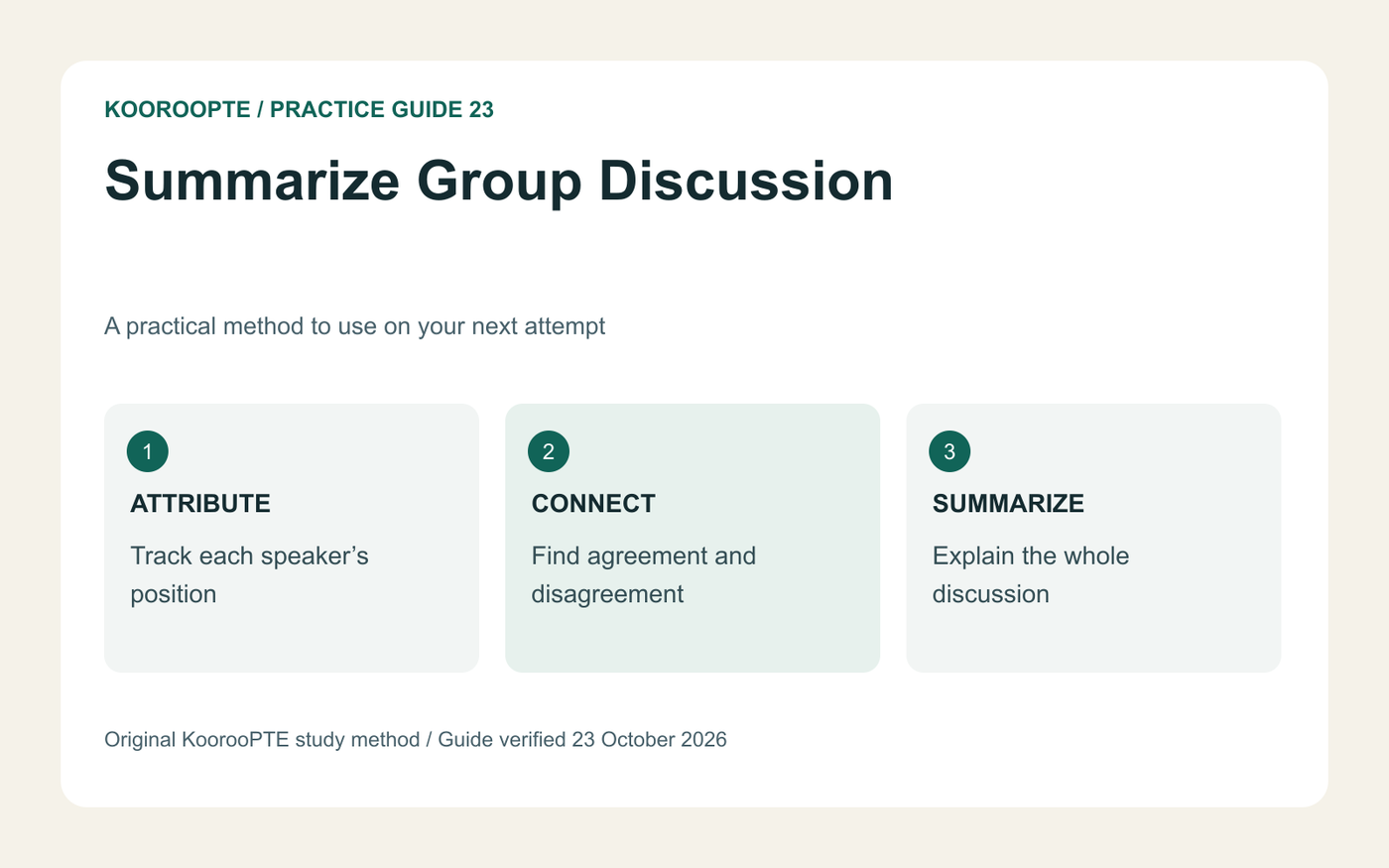
PTE Summarize Group Discussion requires you to explain a discussion rather than recite disconnected notes. Record each speaker’s main position and supporting reason, then identify where their ideas agree, differ or develop. The worked example below shows how to turn that map into a coherent response without inventing a shared conclusion.
Written by the KoorooPTE editorial team. Last updated and fact-checked: 23 October 2026.
What is PTE Summarize Group Discussion?
Summarize Group Discussion asks you to summarize a recording of three people in your own words. Pearson allows a prompt of up to three minutes, ten seconds of preparation after it finishes, and two minutes to respond. It assesses Listening and Speaking. The task was introduced in the August 2025 update; the 2026 date of this guide does not mark a separate new format.
The challenge is representing several viewpoints accurately. A response that repeats one speaker’s strongest point while barely mentioning the others leaves the discussion incomplete. A response that lists all three views without explaining their relationship also misses useful meaning.
What does the scoring reward?
The rubric considers Content, Pronunciation and Oral Fluency, with human review of Content alongside AI scoring. Build your response around accurate contributions, supporting details and the relationships between viewpoints. Speaking continuously is not enough if the content is vague or incorrectly attributed.
A useful personal review question is: could someone who missed the recording understand what each person proposed and how the discussion developed? This is a coaching check, not an unofficial formula for converting your response into a PTE score.
How should you organize notes for three speakers?
Give each speaker a small space for a position, a reason and any later change. Then add a separate line for agreement, disagreement or an unresolved issue.
- Write the shared topic. Use a few words that identify the decision or problem under discussion.
- Assign consistent speaker labels. Use names if clear, or simple first/second/third labels.
- Capture each main position. Record what the person proposes or believes, not only their topic vocabulary.
- Add the important reason. Include a constraint or example that explains why the person holds that view.
- Track responses between speakers. Notice when someone accepts a point, challenges it or offers a compromise.
- Plan a coherent route through the discussion. Use the preparation interval to identify your opening, main contrast and ending.
This structure reduces the temptation to treat every turn as a separate mini-lecture. One speaker may return later and qualify an earlier view, so keep space to update the same label.
What does an original discussion example look like?
The following fictional discussion concerns a university library. It is original practice material and can be read aloud by three people. The example demonstrates attribution and development rather than supplying a memorized answer for other prompts.
Speaker 1: “I think the library should stay open later during exams. Last week I finished work at seven, and by the time I arrived there were only two hours left. My shared flat is noisy, so I cannot always study there. I am not asking for longer hours throughout the year, just during the busiest examination weeks.”
Speaker 2: “I understand the problem, but opening the entire building later could be expensive. We would need staff and security, and some sections might have very few users. Before changing the hours, I would like to know how many students would actually stay. A short survey could help us estimate demand.”
Speaker 3: “Could we open only the ground-floor study area? It already has desks, power sockets and toilets nearby. That would give students a quiet place without keeping all the book collections accessible. We could try it for two weeks and count how many people use it at different times.”
Speaker 1: “That would meet my main need. I can collect books earlier, and I usually work from my laptop in the evening. I would support a limited trial, provided students know which entrance to use and when the area closes.”
Speaker 2: “A trial sounds more manageable. I would still want an estimate of staffing costs, and we should compare usage with those costs afterward. The survey could also ask whether students need quiet individual desks or space for group work.”
Speaker 3: “Then the next step could be to propose the ground-floor trial, collect the survey responses and ask the library about staffing. We have a possible approach, but the details need checking before anything is approved.”
How can you turn those notes into a connected response?
The model below identifies the problem, preserves each contribution and distinguishes a proposed trial from an approved decision.
“The speakers discuss whether the university library should extend its opening hours during the examination period. The first speaker supports later access because work commitments and a noisy shared flat make evening study difficult. They want a temporary extension during exams rather than longer hours throughout the year.
The second speaker is concerned about staffing and security costs, especially if parts of the building attract few users. They suggest collecting evidence of demand through a survey. The third speaker offers a more limited option: opening only the ground-floor study area for a two-week trial and recording how many students use it.
The first speaker accepts this compromise because access to desks matters more than late access to the book collections. The second also considers a trial manageable, but wants its costs and usage reviewed. The discussion ends with a proposal to gather survey responses and consult the library about staffing. The speakers move towards a possible trial, although the practical details and approval remain unresolved.”
The response uses relationships such as “concerned,” “offers a more limited option” and “accepts this compromise” to explain the interaction. It does not add a claim that the library has agreed to open later. Read it aloud naturally and adapt your length to the content; do not pad an accurate summary merely to fill time.
What mistakes should you check after recording?
Check attribution and meaning before polishing delivery.
- One speaker dominates your summary: compare your notes with the recording and identify the missing contribution.
- You report agreement too early: distinguish acceptance of a possible idea from approval of a final plan.
- You give your own opinion: remove claims that are not part of the discussion.
- You list disconnected points: add the accurate relationship between them, such as cause, objection or compromise.
- You misattribute a reason: correct the speaker label and practise recalling the viewpoint with its supporting detail.
How should you practise the method?
Use fresh discussions and review whether your summary represents all three people. First listen once and take notes. Record your response within the task’s response window. Then replay the source and mark each claim in your summary as accurate, incomplete, misattributed or invented.
Copy this checklist: shared topic clear; three views represented; reasons included; relationships explained; ending faithful. On a second attempt, correct the largest content problem before trying to sound more polished.
Open Summarize Group Discussion practice. Compare this multi-speaker method with Retell Lecture, use Respond to a Situation for a different speaking purpose, and consult the question-type guide for the wider format.
Which sources were checked for this guide?
The exam facts were checked against Pearson's current Speaking and Writing task descriptions and the Test Taker Score Guide (pages 15, 25-28) on 23 October 2026. The worked examples, model responses and practice routines are original KoorooPTE teaching material, not official Pearson questions or awarded scores.
Frequently asked questions
Do I need to remember the speakers’ names?
Accurate attribution matters more than inventing or struggling over names you did not catch. You can use clear labels such as the first speaker when appropriate. During practice, check that your labels stay consistent and that you have not assigned one person’s concern or proposed solution to someone else.
What if the speakers do not reach agreement?
Say that their views remain different and explain the important difference accurately. A summary does not need a happy ending or a shared decision. Before recording, check whether the discussion actually contains an agreement, a tentative suggestion or only separate opinions, then choose wording that preserves that distinction.
Can I use a fixed introduction and conclusion?
A short opening can help you establish the topic, but the response must be built around the actual discussion. Avoid a memorized conclusion that claims agreement or importance regardless of what happened. Use your notes to decide what the ending should communicate and remove any sentence that adds only repetition.