
PTE Respond to a Situation 2026: Say What the Situation Needs
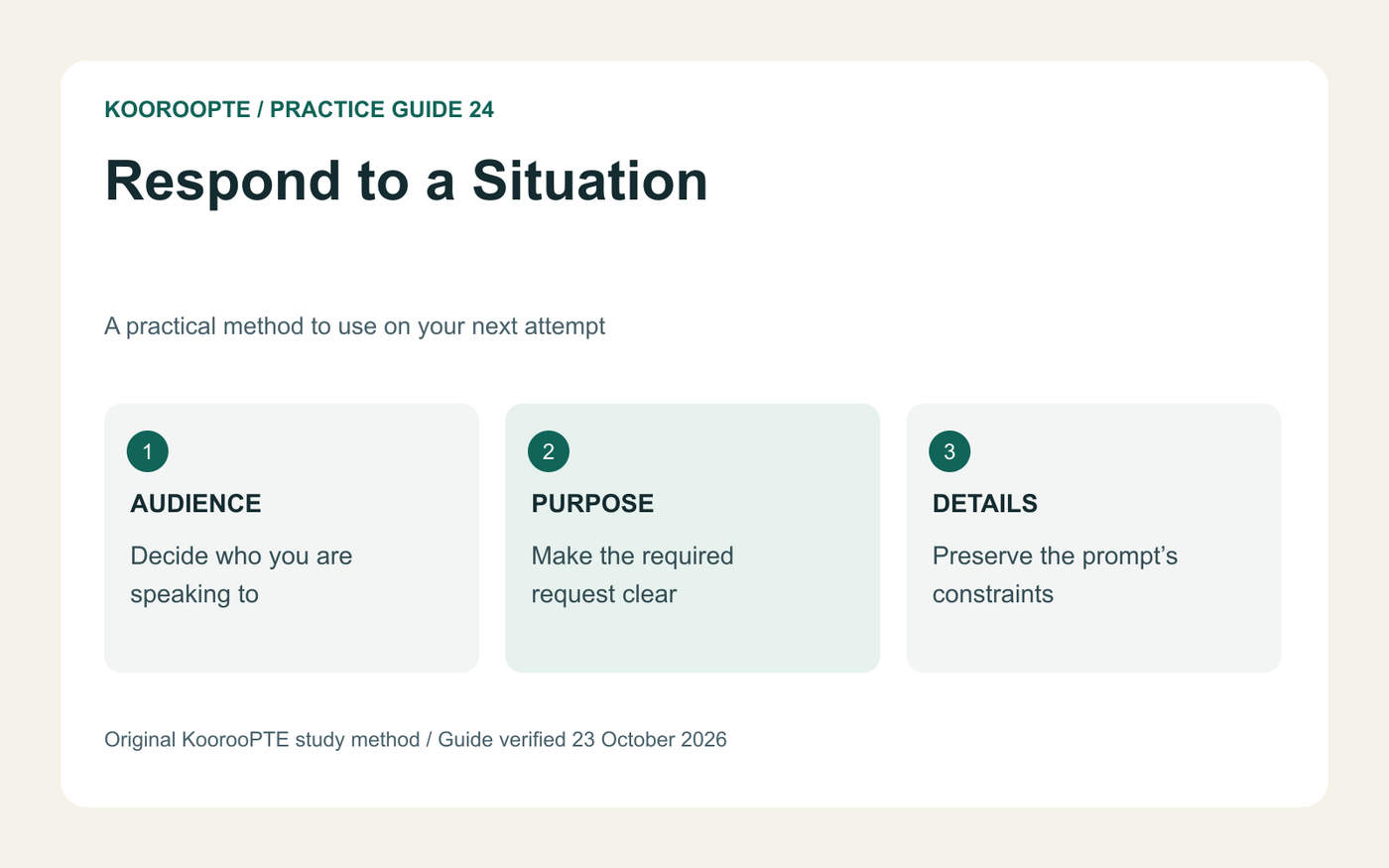
PTE Respond to a Situation asks you to say what you would communicate in a specific everyday situation. Identify your listener, your purpose and the details that must remain accurate. Then give a direct, appropriately polite response. This guide includes two original examples and a checklist for checking whether your message actually solves the prompt.
Written by the KoorooPTE editorial team. Last updated and fact-checked: 23 October 2026.
What does PTE Respond to a Situation ask for?
Respond to a Situation asks you to read and hear a short everyday scenario, then give the response you would make in that situation. Pearson lists a prompt of up to 60 words, ten seconds to prepare and 40 seconds to speak. The assessed communicative skill is Speaking.
The task belongs to the August 2025 PTE Academic update. It is not a miniature essay or a summary of a discussion. You need to communicate with an imagined listener: make a request, explain a problem, apologize, negotiate or perform the action the prompt requires.
What makes an answer relevant and effective?
An effective response achieves the communication goal while preserving the prompt’s important details. Identify who you are speaking to, what you need from them and which constraints cannot change. A polite answer that requests the wrong date is still inaccurate.
Pearson evaluates Content, Pronunciation and Oral Fluency, and a human expert reviews Content alongside AI scoring. Your practical aim is therefore a clear, appropriate message delivered understandably. A fixed speech that sounds fluent but avoids the actual request is a weak fit for the task.
How should you use the preparation time?
Reduce the prompt to three notes: listener, purpose, details. Add a tone reminder if the relationship is unfamiliar.
- Identify your listener. A friend, tutor and service employee may call for different wording.
- Name the communication goal. Decide whether you are requesting, explaining, apologizing or proposing a solution.
- Mark non-negotiable details. Preserve the date, time, reason, responsibility and any requested alternative.
- Choose a direct opening. Establish the purpose early so the listener does not have to infer what you want.
- Explain only what supports the purpose. Use the relevant reason without retelling every word of the prompt.
- Close with a clear next step. Ask the question, confirm the request or offer the practical option required by the situation.
Use these notes to organize speech, not to write a full script during the short preparation interval. Your response should sound like communication addressed to the person, rather than commentary about what you might tell them.
What does a polite request look like?
This original example requires a specific extension request and an accurate explanation.
Practice prompt: “Your group assignment is due at 3 p.m. today. Your home internet has failed, but you can reach the library and upload the finished file by 4 p.m. Speak to your tutor, explain the problem and ask for a one-hour extension.”
Model response: “Hello, I’m contacting you about our group assignment, which is due at three this afternoon. The file is finished, but my home internet has stopped working, so I cannot upload it from here. I can get to the library and submit it by four. Could you please allow us a one-hour extension? I’m sorry for the inconvenience. We are asking for extra time to upload the completed work, rather than to finish writing it.”
The response states the deadline, the technical problem, the available solution and the exact request. It does not invent a medical emergency or imply that an extension has already been granted. The closing clarification reinforces a distinction already present in the prompt.
Read the response aloud and check its pace. The model demonstrates coverage; it is not a script to reproduce for unrelated scenarios or a certified full-mark answer.
How would the response change for a friend?
A response to a friend can use more relaxed language while keeping the same attention to purpose and constraints.
Original practice prompt: “You promised to help a friend move on Saturday at 10 a.m., but your employer has scheduled you to work until noon. You can arrive at 1 p.m. Apologize, explain the change and ask whether helping from 1 p.m. would still be useful.”
Model response: “Hi, I’m sorry, but I need to change our plan for Saturday. I know I said I would help you move at ten, but I’ve been scheduled to work until noon. I can get to your place by one. Would it still help if I came then? I’m sorry for changing things after we had already agreed, and I wanted to let you know so you can plan the morning.”
The answer accepts the earlier commitment instead of pretending the change does not matter. It asks whether the alternative works, rather than assuming the friend must accept it. The tone is friendly without losing the practical details.
Which mistakes should you remove from a draft?
Remove language that hides the purpose, changes the facts or makes the relationship inappropriate.
- Narrating instead of responding: replace “I would tell my tutor that...” with the message addressed to the tutor.
- Missing the actual request: include a direct question or proposal, not only an explanation of the problem.
- Changing a deadline: check every time and date against the prompt before speaking.
- Inventing a commitment: offer an option as a possibility when the prompt does not establish that it is guaranteed.
- Overformal language with a friend: replace ceremonial phrases with clear ordinary wording.
- Excessive apology: acknowledge the inconvenience, then explain the situation and proposed next step.
An answer can be polite without being indirect. If the listener reaches the end without knowing what you need, revise the purpose sentence first.
What reusable structure is safe to practise?
Practise a flexible sequence of purpose, relevant reason and requested next step. Treat it as a planning aid rather than a paragraph to memorize. The amount of explanation changes with the scenario, and some prompts require several specific points.
Use this checklist: listener addressed; goal explicit; all required details accurate; tone appropriate; next step clear. Check the recording for intelligibility and flow only after confirming that those content conditions are met.
Try changing one feature of a practice prompt, such as the listener or available alternative, and record a fresh response. This tests whether you can adapt the language instead of reproducing the previous answer automatically.
Open Respond to a Situation practice. Compare it with Summarize Group Discussion, where you report other people’s views, and Retell Lecture, where you explain a source argument. The template guide gives further context for using structures without relying on memorized content.
Which sources were checked for this guide?
The exam facts were checked against Pearson's current Speaking and Writing task descriptions and the Test Taker Score Guide (pages 15, 29-31) on 23 October 2026. The worked examples, model responses and practice routines are original KoorooPTE teaching material, not official Pearson questions or awarded scores.
Frequently asked questions
Should I describe what I would say or actually say it?
Give the response you would address to the person in the situation. Practise speaking directly to that listener instead of narrating a plan about yourself. This makes it easier to state the request, explanation or apology clearly and to choose a level of politeness that fits the relationship.
Can I add details that are not in the prompt?
Use simple connecting language, but avoid inventing facts that change the situation or create commitments you were not asked to make. If a practical alternative is useful, present it as a request or possibility. Check dates, responsibilities and reasons against the prompt before you begin speaking.
How can I avoid sounding overformal?
Match the listener and the purpose. A polite request to a tutor needs clarity and respect, while a conversation with a friend can sound more relaxed. Read your practice answer aloud and replace stiff stock phrases with ordinary wording that still communicates the same request, explanation or proposed next step.