
PTE Write Essay 2026: The 200-300 Word Structure That Scores
PTE Write Essay gives you 20 minutes to write 200 to 300 words on a given topic, and it carries the highest template risk of any task on the exam. It is scored across 7 traits worth 26 raw points, more scoring dimensions than any other PTE task, and a human reviewer checks the content alongside the AI. This guide covers exactly how it is scored, a structure that satisfies that scoring without relying on a memorised script, and the word count mechanics most guides get vague about.
What is PTE Write Essay?
Write Essay is the single writing task in Part 1 that asks you to argue a position, not summarise one. You are given a topic and 20 minutes to plan, write and revise a 200 to 300 word response, and there is 1 essay item per test form. Pearson's own on-screen instruction states the task plainly: you will be judged on how well you develop a position, organise your ideas, present supporting details, and control the elements of standard written English.
That instruction is worth reading closely, because it names exactly what the scoring rewards: a clear position, organisation, real supporting detail, and control of English. Nothing in it rewards a fixed opening sentence or a memorised transition phrase, which is why the highest scoring essays and the most template-damaged essays can look similar on a first skim and score very differently underneath.
How is PTE Write Essay scored?
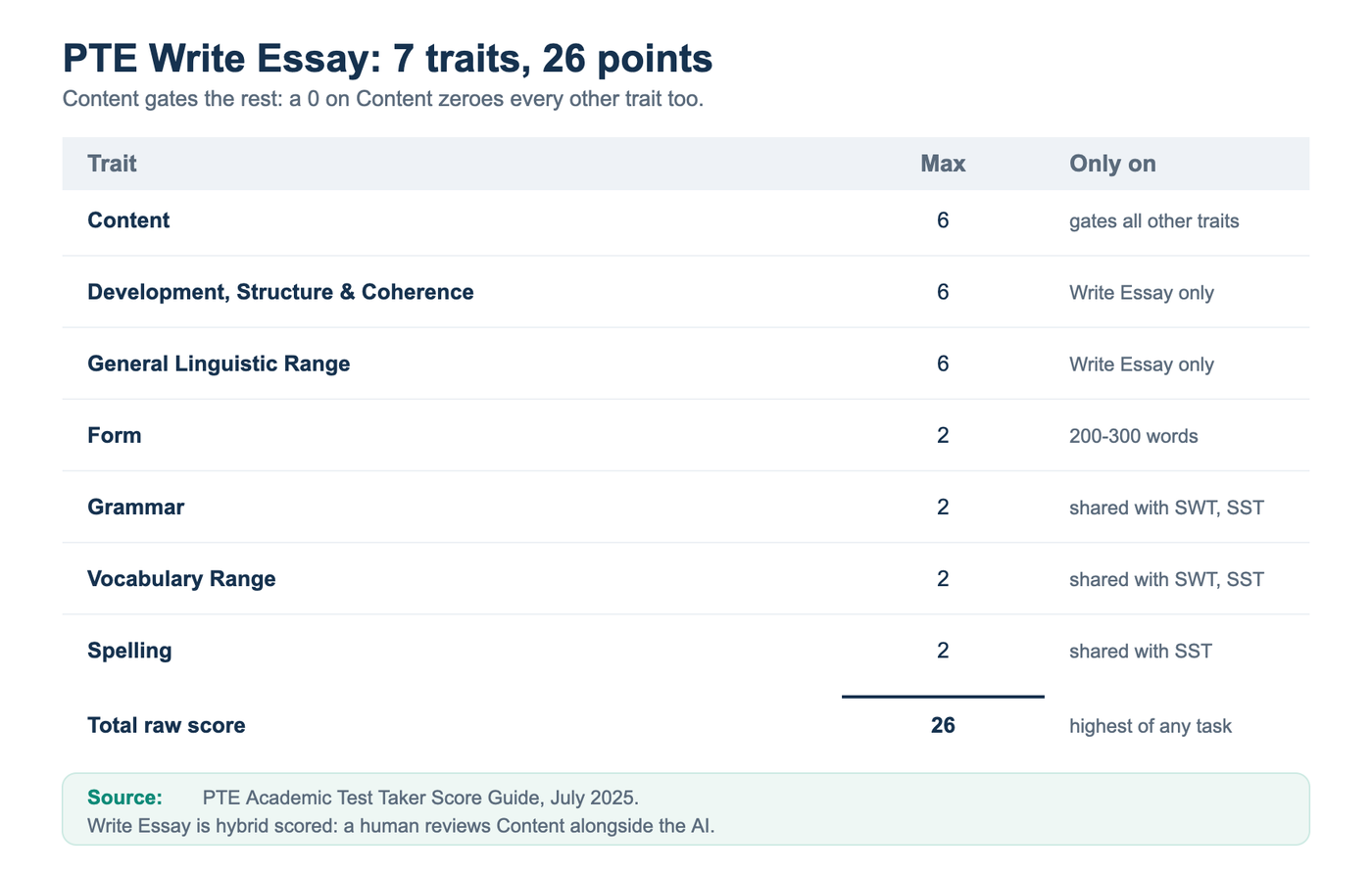
Write Essay is scored across 7 traits worth 26 raw points, the most scoring dimensions of any task on the exam, and it is the only task scored on Development, Structure and Coherence and General Linguistic Range:
- Content: 6 · Gates every other trait on this task
- Development, Structure and Coherence: 6 · Write Essay only
- General Linguistic Range: 6 · Write Essay only
- Form: 2 · Reflects the 200-300 word requirement
- Grammar: 2 · Summarize Written Text, Summarize Spoken Text
- Vocabulary Range: 2 · Summarize Written Text, Summarize Spoken Text
- Spelling: 2 · Summarize Spoken Text
Since the August 2025 refresh, Write Essay is hybrid scored: a human reviewer checks Content alongside the AI, with a second human resolving disagreement. Content is also the gate. Per Pearson's own Score Guide, a response built from pre-prepared or memorised material is classified as an irrelevant response and scores Content 0, and once Content is 0, none of the other six traits are scored either. Source: PTE Academic Test Taker Score Guide, July 2025.
Do PTE essay templates still work in 2026?
Not the kind built from memorised sentences. Write Essay carries the highest template risk of any task on the current exam, because the post-2025 scoring change specifically targets templated essay structure. Our do PTE templates still work in 2026 guide covers the mechanics across every task; on Write Essay specifically, the pattern to avoid is a fixed opening line, a stock set of transition phrases, or a five paragraph shape you pour every topic into without actually engaging with it.
The distinction that matters is structure versus script. A structure, introduction, two developed body paragraphs, conclusion, is a shape you can reuse safely, because you fill it with a genuinely new position and new supporting details every time. A script is the same sentences, word for word, regardless of the topic. The next section builds the structure without the script.
What structure should a PTE essay follow?
A genuine four part structure satisfies Pearson's stated criteria (develop a position, organise ideas, present supporting details, control standard written English) without needing a single memorised sentence:
- Introduction (2-3 sentences). State the topic in your own words, then state your position clearly. Do not restate the prompt verbatim; paraphrase it, and commit to a side rather than hedging.
- Body paragraph one (60-90 words). One reason, developed with a specific example, a statistic, a real scenario, or a named consequence. Vague support ("this is important for society") reads as filler; specific support reads as content.
- Body paragraph two (60-90 words). A second, distinct reason, developed the same way. Repeating the first reason in different words does not count as a second point.
- Conclusion (1-2 sentences). Restate your position in different words than your introduction used, without introducing a new argument.
That shape maps directly onto Development, Structure and Coherence (the paragraphing itself) and Content (the position and its support), while leaving every sentence open for you to write fresh against whatever topic you actually get.
A worked example
Topic: "Some people believe universities should focus only on academic subjects, while others believe they should also teach practical life skills. Discuss both views and give your opinion."
A genuine response, not a script, might open by paraphrasing the debate ("Universities face a real choice between staying purely academic and adding practical skills training") before stating a position ("but a blended approach serves students better"). The first body paragraph could develop the academic-focus view with a specific example (a physics graduate who needed deep theory, not budgeting classes, to succeed in research). The second could develop the practical-skills view with a different concrete example (a graduate who understood their field but struggled to manage a budget or write a formal email in their first job). The conclusion restates the blended position without repeating the introduction's exact wording.
Notice what makes this a structure, not a script: the examples, the specific field, the specific skill gap, only exist because this specific topic came up. Swap the topic and the sentences change, even though the shape stays the same.
How should you manage the 20 minutes?
Word count and time both matter, and treating either as an afterthought is the most common way strong ideas score below their potential. A workable split for the 20 minutes: 2-3 minutes to read the topic and plan your position and two reasons, 13-15 minutes to write, and 2-3 minutes to reread for grammar, spelling, and word count.
Word count is not a suggestion. Form is a scored trait, and it reflects whether your response sits inside 200 to 300 words, so an essay that runs to 120 words or balloons past 350 costs marks on Form even when Content, Development and Grammar are all strong. If you tend to run long, cut supporting detail from your weaker reason rather than trimming both paragraphs evenly; if you tend to run short, that is usually a sign your examples need to be more specific, not that you need filler sentences.
What are the most common mistakes on Write Essay?
- Restating the prompt as the introduction. Paraphrase the topic, do not copy its wording; this is exactly the kind of pre-prepared pattern the Content-zero rule is built to catch.
- One reason repeated twice. Two paragraphs that make the same point in different words score as underdeveloped, not as two points.
- Vague support with no specifics. "This benefits society" is not evidence. Name a field, a scenario, a consequence.
- Ignoring the word count. Both under 200 and over 300 cost you on Form, regardless of how strong the argument is.
- A memorised opener or closer. Even one recognisably rehearsed sentence at the start or end of an otherwise genuine essay is a template signal worth cutting.
Practise this task with real prompts and instant feedback on Write Essay on KoorooPTE, which flags the phrases that would read as pre-prepared before test day does.
Where Write Essay fits in your overall score
Write Essay feeds only your Writing score, but it carries more scoring weight per item than any other Writing task, since Summarize Written Text and Write from Dictation split their marks across fewer traits each. If Writing is your target skill, our PTE Superior English 2026 guide covers why Write Essay is the highest leverage task for reaching 85, and our PTE score chart explains how your Writing score converts to IELTS and CEFR if you need a target in those terms. For the other 21 task types, our PTE question types hub covers the full exam.
Frequently asked questions
How many words should a PTE essay be?
Between 200 and 300 words. This is one of the seven scored traits, Form, so writing noticeably fewer than 200 or more than 300 words costs marks on that trait even if the content itself is strong.
How is PTE Write Essay scored?
Across seven traits worth 26 raw points: Content (0-6), Development, Structure and Coherence (0-6), General Linguistic Range (0-6), Form (0-2), Grammar (0-2), Vocabulary Range (0-2), and Spelling (0-2). A human reviewer also checks Content alongside the AI, and a Content score of 0 cancels every other trait on the task.
How long do you get for PTE Write Essay?
20 minutes to plan, write and revise a single essay, per Pearson's own on-screen instruction. There is 1 essay item per test form.
Do PTE essay templates still work in 2026?
Not the memorised kind. Write Essay carries the exam's highest template risk: Pearson's post-2025 scoring explicitly targets templated essay structure, and a response built from pre-prepared material scores Content 0, which cancels every other trait too. A reusable four part structure you fill in fresh each time is different from a memorised script, and only the second one is penalised.
What structure should a PTE essay follow?
A genuine introduction that states your position, two body paragraphs that each develop one reason with a specific supporting example, and a conclusion that restates your position. This structure satisfies Pearson's own stated criteria, developing a position, organising ideas, and presenting supporting details, without relying on memorised sentences.