
PTE Collocations 2026: Learn Useful Phrases in Context
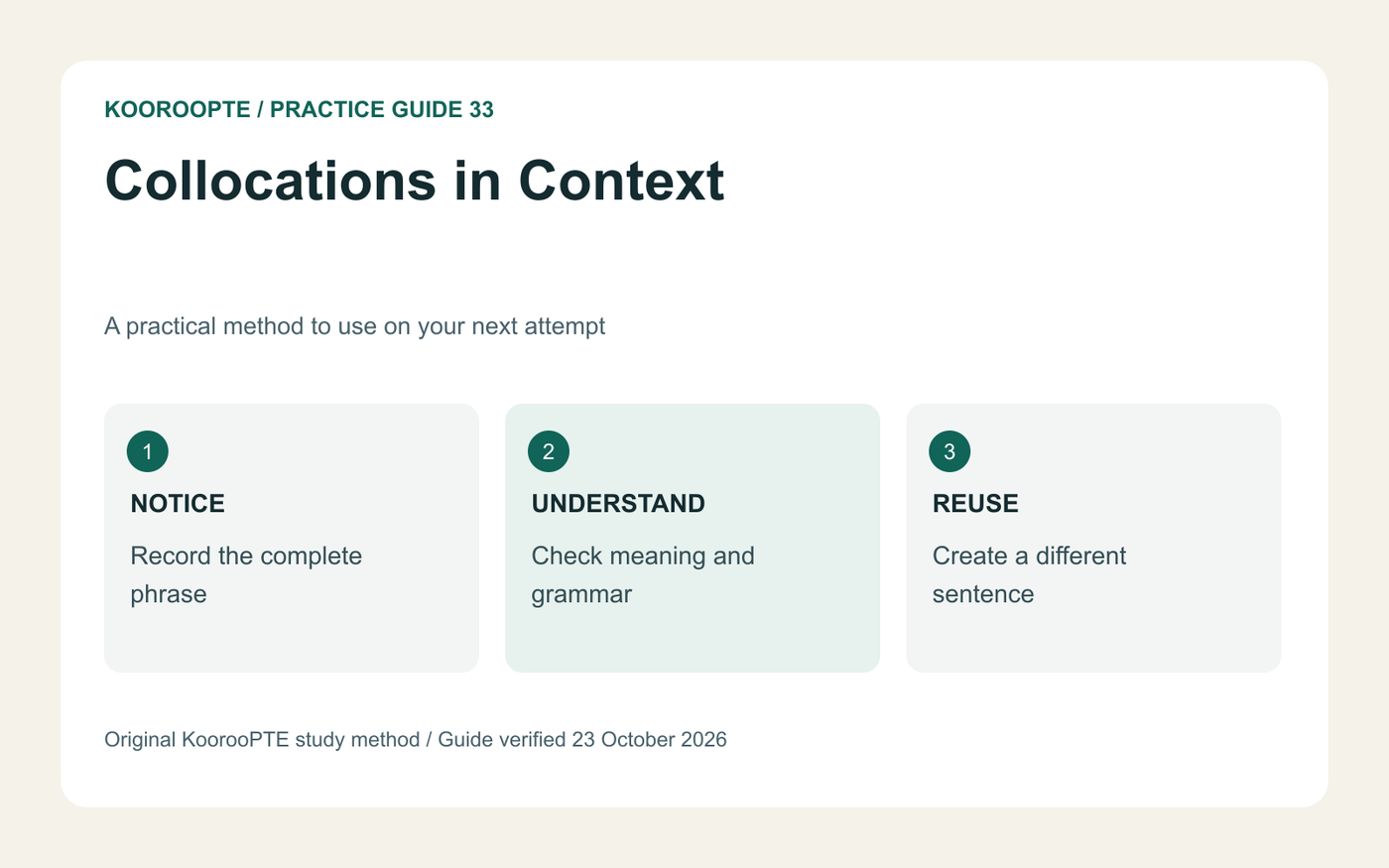
PTE collocations are easier to use when you learn words in meaningful combinations rather than as disconnected translations. Record a phrase, understand the situation it describes and reuse it in a fresh sentence. This guide includes original examples and exercises for testing whether a choice fits grammar, meaning and context.
Written by the KoorooPTE editorial team. Last updated and fact-checked: 23 October 2026.
What is a collocation, and why practise it for PTE?
A collocation is a combination of words that commonly occurs together in a particular meaning or use. Learning the combination helps you recognize an expression as a unit, instead of translating each word separately and hoping the result sounds natural.
For PTE, phrase knowledge can support reading decisions and clearer writing, but it does not replace grammar or understanding the passage. A familiar phrase may still be wrong if the surrounding sentence expresses a different idea. The Reading Fill in the Blanks guide shows how those checks work together.
This article's examples are original teaching material. They are not a Pearson frequency list, predictions of future questions or a claim that memorizing a particular number of phrases produces a particular score. The aim is a reliable learning process that you can apply to vocabulary you actually encounter.
How should you learn a useful phrase?
Learn the phrase with its meaning, grammatical pattern and a sentence you understand. A notebook entry that contains only an English expression and a translation does not show when you can use it accurately.
- Notice a phrase in context. Choose an expression from reliable reading or a mistake you have just reviewed. Keep enough of the sentence to understand its purpose.
- Identify its core words. For “conduct a survey,” record the verb and noun together rather than storing conduct alone.
- Check meaning and form. Use a reliable dictionary when uncertain. Notice articles, number and any preposition needed in the full pattern.
- Write a fresh sentence. Change the topic while preserving the expression's meaning. This tests whether you can use the phrase beyond its first example.
- Retrieve it later. Cover the phrase and complete your own sentence from a meaning cue. Record whether you recalled it independently or recognized it only after looking.
- Recheck in a new passage. Use context to decide whether the phrase fits. Do not select it automatically just because you studied it yesterday.
Keep competing expressions when they are genuinely possible. “Conduct a survey” and “carry out a survey” can both be natural; a practice explanation should not pretend there is only one English expression for an idea. A particular multiple-choice item may still offer only one suitable option.
What should a small phrase notebook look like?
A useful entry connects a phrase to an action or relationship. Here are five original examples you can adapt; they are a manageable starter set, not a ranked list of the most common PTE phrases.
- Conduct a survey: “The transport team conducted a survey of evening passengers.” Use it for systematically collecting responses.
- Draw a conclusion: “We cannot draw a firm conclusion from such a small sample.” The sentence connects evidence with what can reasonably be inferred.
- Pose a challenge: “Unreliable internet access poses a challenge for remote teaching.” The phrase identifies a difficulty rather than a benefit.
- Allocate resources: “The council allocated resources to repairing local footpaths.” Notice the destination introduced by to.
- Reach an agreement: “The two departments reached an agreement on shared laboratory hours.” The article belongs to the noun phrase.
Add your own sentence beside each example. If your sentence changes the meaning, revise it instead of treating the phrase as a decorative substitute for a simple word. “Draw a conclusion” does not mean “collect the data,” even though both may occur in the same research process.
Use a short meaning cue for later recall: “give money or staff to a purpose” can prompt allocate resources. A cue based only on the first letter tests a narrower memory trick and may not show whether you understand the expression.
How do grammar and collocation work together in a gap?
Grammar identifies what kind of expression can fit, while meaning and ordinary usage help choose among grammatically possible alternatives. Work through the complete sentence before looking at the explanation.
Exercise one: “The university plans to ___ a survey of students' travel habits.” Options: conduct, conduction, conductive, conducting. Answer: conduct. The infinitive pattern after plans to needs the base verb, and conduct a survey is an appropriate phrase for the intended action.
Exercise two: “The limited evidence does not support a ___ conclusion.” Options: firm, heavy, loud, crowded. Answer: firm. The sentence concerns confidence in an inference. The other adjectives do not express that relationship naturally in this context.
Exercise three: “The project may ___ a challenge for small organizations.” Options: pose, reach, allocate, draw. Answer: pose. A challenge is a difficulty that a project can present. The other verbs belong to different relationships in the starter set above.
These exercises deliberately isolate different decisions. The first uses a clear grammatical cue; the second asks for an appropriate modifier; the third tests the verb-noun relationship. In a complete reading passage, you may need all those checks at once.
Which vocabulary habits waste useful review time?
Collecting more expressions than you can explain often produces recognition without usable control. Reduce the new set when you cannot recall yesterday's phrases or when your fresh sentences repeatedly distort their meaning.
Avoid replacing every ordinary word with a more formal one. “Use” may be clearer than a complicated alternative that does not fit the noun or context. In Write Essay, vocabulary should express the argument accurately rather than make each sentence sound impressive in isolation.
Do not learn a phrase without its grammatical surroundings. Recording “depend” alone leaves out depend on; recording an uncountable noun with an invented plural builds an error into your notebook. When a correction changes the pattern, update the whole entry rather than only the highlighted word.
How can you check whether learning has transferred?
Check transfer by using the phrase accurately in a different context after a delay. A correct repetition immediately after reading the answer shows short-term recall, but it does not establish that you can recognize or use the expression during an unfamiliar task.
Try an original mini-paragraph: “A local museum conducted a survey of visitors. It used the responses to allocate resources to evening events. Staff will collect more evidence before drawing a conclusion about the change.” Explain the role of each phrase, then rewrite the paragraph about a different organization without changing those relationships.
Use this reusable checklist: meaning understood; complete pattern recorded; fresh sentence accurate; delayed retrieval attempted; new context checked. Start with Reading Fill in the Blanks practice, and connect vocabulary work with the sentence checks in PTE Grammar Practice. Five well-understood entries can support a useful session, without claiming that five is a universal daily target.
Which sources were checked for this guide?
Exam facts were checked against Pearson's current reading guidance and the Test Taker Score Guide (pages 40) on 23 October 2026. Additional references: collocation. The examples, schedules and review methods are original KoorooPTE teaching material, not official test questions, scored Pearson responses or promises of improvement.
Frequently asked questions
Is there an official list of collocations that will appear in PTE?
This guide does not claim to predict exam vocabulary or provide an official Pearson phrase list. Its examples teach a method for learning combinations in context. Build your own notebook from reliable reading and mistakes, then test whether you can understand and use each phrase when the surrounding topic changes.
How many new collocations should I learn each day?
Choose a small set you can explain and retrieve later rather than collecting a large list you only recognize on the page. This guide uses five phrases as a manageable practice example, not a research-based optimum. Adjust the number according to your delayed recall and the accuracy of your new sentences.
Can a grammatically correct phrase still be the wrong answer?
Yes. Grammar can narrow the choices without deciding which expression fits the writer's meaning or ordinary usage. Read the complete sentence and its context before selecting an option. During review, explain whether your mistake concerned word form, the phrase itself or the relationship between the surrounding ideas.