
PTE Grammar Practice 2026: Fix Errors That Change Meaning
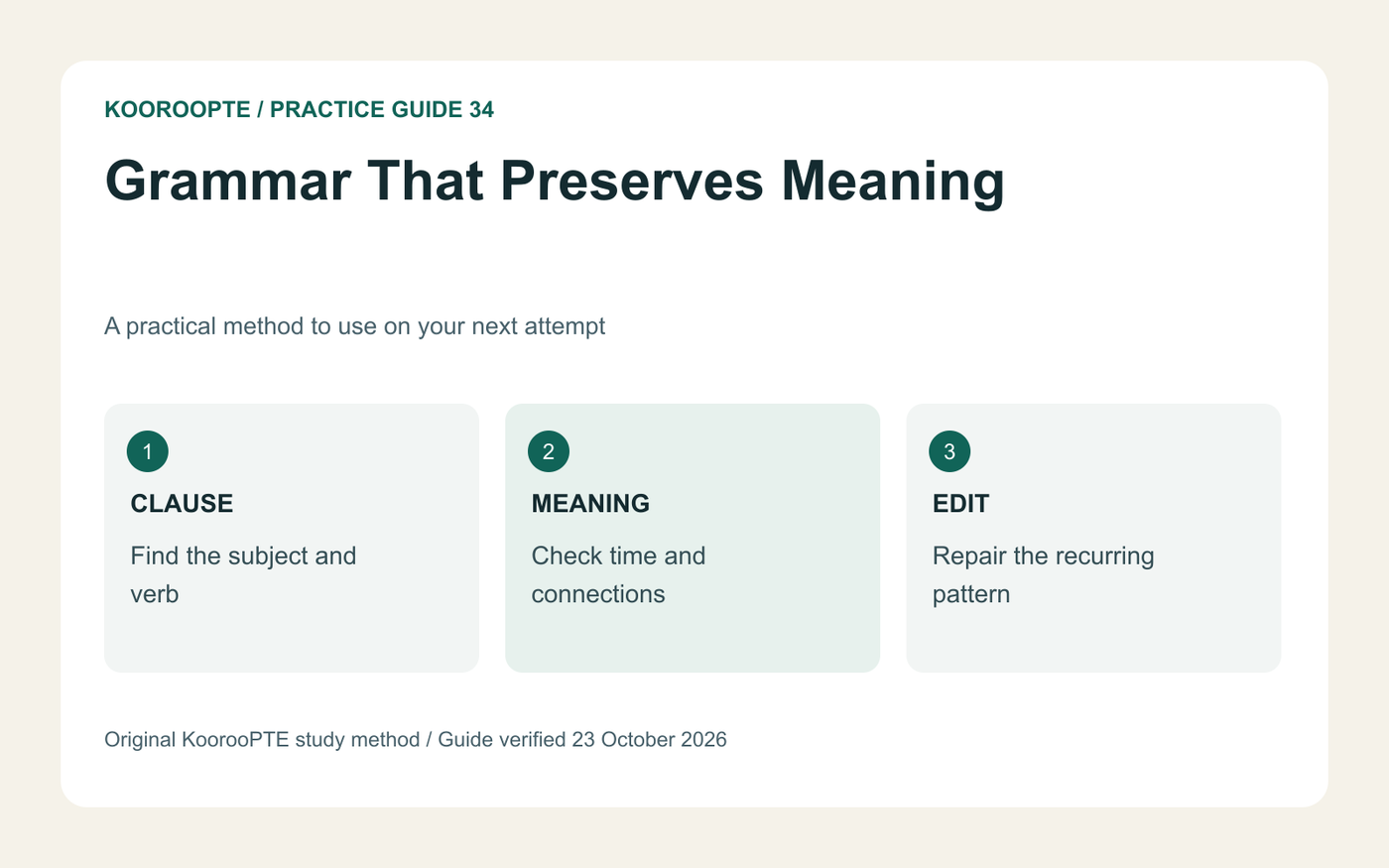
PTE grammar practice is most useful when it fixes errors in sentences you actually need to write. Find the subject and verb, check how clauses connect, and preserve the intended meaning while editing. The original exercises below cover agreement, countability, tense and sentence boundaries, with explanations you can reuse in your own work.
Written by the KoorooPTE editorial team. Last updated and fact-checked: 23 October 2026.
Which grammar should you practise first?
Start with recurring errors that make your own responses incomplete, unclear or inaccurate. A practical priority is controlling the sentence's subject, verb and connections before adding more elaborate structures. You need to express the intended meaning reliably, not simply make a sentence longer.
Grammar appears within task-specific scoring criteria, so keep the response instructions visible while editing. Summarize Written Text has a single-sentence requirement; an essay needs developed organization, and a spoken-text summary follows different instructions. A grammar method can support all three without making their formats identical.
The examples below are original exercises. They isolate common sentence problems so you can explain the correction, then apply it in your own work. They are not official test questions or a prediction of which structures will appear in your exam.
How can you inspect a sentence systematically?
Inspect meaning and clause structure before making cosmetic substitutions. A sentence can contain sophisticated vocabulary while missing the verb that makes its claim complete.
- State the intended message. Explain in plain language what the sentence should communicate. This prevents an edit from silently changing the claim.
- Find the subject and verb. Identify who or what the clause concerns and what is being said about it. Check that the clause is complete in its context.
- Check agreement. Match the verb to the grammatical subject rather than the nearest noun. A phrase between them can distract you.
- Check time and reference. Use verb forms and pronouns that preserve when events occurred and what each reference means.
- Check clause connections. Decide whether you need coordination, subordination or separate sentences. Use the relationship between the ideas to choose.
- Read for meaning again. Confirm that the corrected version still says what you intended and follows the task's response instructions.
During practice, underline the subject once and the verb twice if that helps you see the structure. In a timed response, use a shorter mental check. The marking exercise is a learning aid, not a requirement to spend equal time analysing every sentence.
How do you fix subject-verb agreement errors?
Make the verb agree with the head of the subject phrase. An intervening plural noun does not automatically make the whole subject plural.
Original exercise: “The list of recommended books are on the course website.” Correction: “The list of recommended books is on the course website.” The subject is the singular list; books is inside a phrase describing that list.
Original exercise: “The results of the survey shows a preference for evening classes.” Correction: “The results of the survey show a preference for evening classes.” The subject results is plural, even though survey is singular.
Practise the distinction by changing the head noun: “The recommendation is clear” becomes “The recommendations are clear.” Then add a modifying phrase without changing the agreement. This makes the relevant relationship visible instead of teaching you to match the verb to the nearest word.
How do countability and articles change a sentence?
Countability affects whether a noun can take a plural form and how it works with determiners. Learn a troublesome noun in a complete phrase rather than trying to repair it with a universal rule about adding s.
Original exercise: “The tutor gave several useful advices.” Correction: “The tutor gave some useful advice.” Another suitable version is “The tutor gave several useful pieces of advice.” Advice is normally uncountable in this meaning, while pieces provides a countable unit.
Original exercise: “The students conducted survey about public transport.” Correction: “The students conducted a survey about public transport.” Here survey is a singular countable noun referring to one survey, so the noun phrase needs an appropriate determiner.
Do not assume every noun connected with research is uncountable. A study, two surveys and three recommendations are ordinary countable uses. Record the noun's pattern with the meaning you need, and use a dictionary when a different meaning changes how it behaves.
How do you repair sentence boundaries without changing the argument?
Choose a connection that expresses the relationship between the clauses. Two complete clauses joined only by a comma often need a conjunction, a semicolon or separate sentences in formal writing.
Original exercise: “The trial was short, the findings remain uncertain.” One correction is: “The trial was short, so the findings remain uncertain.” This states a causal relationship. Another is: “The trial was short; the findings remain uncertain.” That links the related statements without adding the same explicit connector.
Select the version supported by your source or argument. Adding because or therefore is a meaning decision, not merely a punctuation repair. If the source says two events occurred together, you should not automatically turn that observation into a causal explanation.
Use Summarize Spoken Text to practise preserving the source while connecting ideas. For a single-sentence task, choose a grammatical structure that fits the actual relationship rather than joining unrelated fragments until the word count looks right.
What does editing a complete short paragraph look like?
An effective edit repairs the sentence problems while preserving the original claims. Consider this fictional practice paragraph: “A group of students were surveyed last month. The survey collect information about travel habits. Many students preferred buses, the service was cheaper than driving. The results provides useful informations for the transport team.”
One clear revision is: “A group of students was surveyed last month. The survey collected information about travel habits. Many students preferred buses because the service was cheaper than driving. The results provide useful information for the transport team.”
The revision uses singular agreement for group treated as one unit, past tense for the completed survey, plural agreement for results and the uncountable information. The because connection is appropriate only if the lower cost is the reason intended by the original writer. If that causal relationship is unsupported, keep the statements separate.
Collective nouns can allow different agreement choices in different varieties and contexts, so do not label every plural use of group automatically wrong. The useful lesson is to make your grammatical perspective consistent and your meaning clear. The unambiguous list/results exercises above are better for isolating basic agreement.
What should you practise after correcting these examples?
Use one recurring error from your own response to create a short set of new sentences. If you often write incomplete clauses, practise supplying the missing subject or verb. If agreement is the problem, vary the head noun and add a distracting phrase between the subject and verb.
Use this reusable editing checklist: message accurate; clauses complete; agreement checked; time references consistent; noun phrases appropriate; connections justified. Then complete a fresh paragraph without looking at the corrected model and see whether the same pattern returns.
Try Write Essay practice to apply the checks in a complete response. Use the Write Essay guide for organization, and PTE Collocations for natural phrase choices. Keep a small error log so that the next grammar session starts with evidence from your writing rather than another unrelated worksheet.
Which sources were checked for this guide?
Exam facts were checked against Pearson's current Speaking and Writing guidance and the Test Taker Score Guide (pages 32-43) on 23 October 2026. Additional references: clauses. The examples, schedules and review methods are original KoorooPTE teaching material, not official test questions, scored Pearson responses or promises of improvement.
Frequently asked questions
Do longer sentences automatically receive better grammar scores?
No. Length alone does not show grammatical control or clear meaning. Use a longer sentence when it expresses a useful relationship accurately, and a shorter one when that is clearer. During review, check whether each clause has a purpose and whether the reader can follow how the ideas connect.
Should I correct every grammar problem at once?
Begin with a recurring pattern that affects your own responses, such as missing verbs or inconsistent agreement. Practise it in several new sentences, then check it again in a complete task. Keep a short record of other errors so you can address them next without losing the focus of the current session.
Can I use the same sentence rule for every PTE writing task?
No. Shared grammar skills support several tasks, but their response instructions differ. Summarize Written Text requires a single sentence, while an essay and Summarize Spoken Text need their own appropriate organization. Check the task instructions first, then apply your grammar checks without forcing every response into the same shape.