
PTE Highlight Correct Summary 2026: Choose the Whole Message
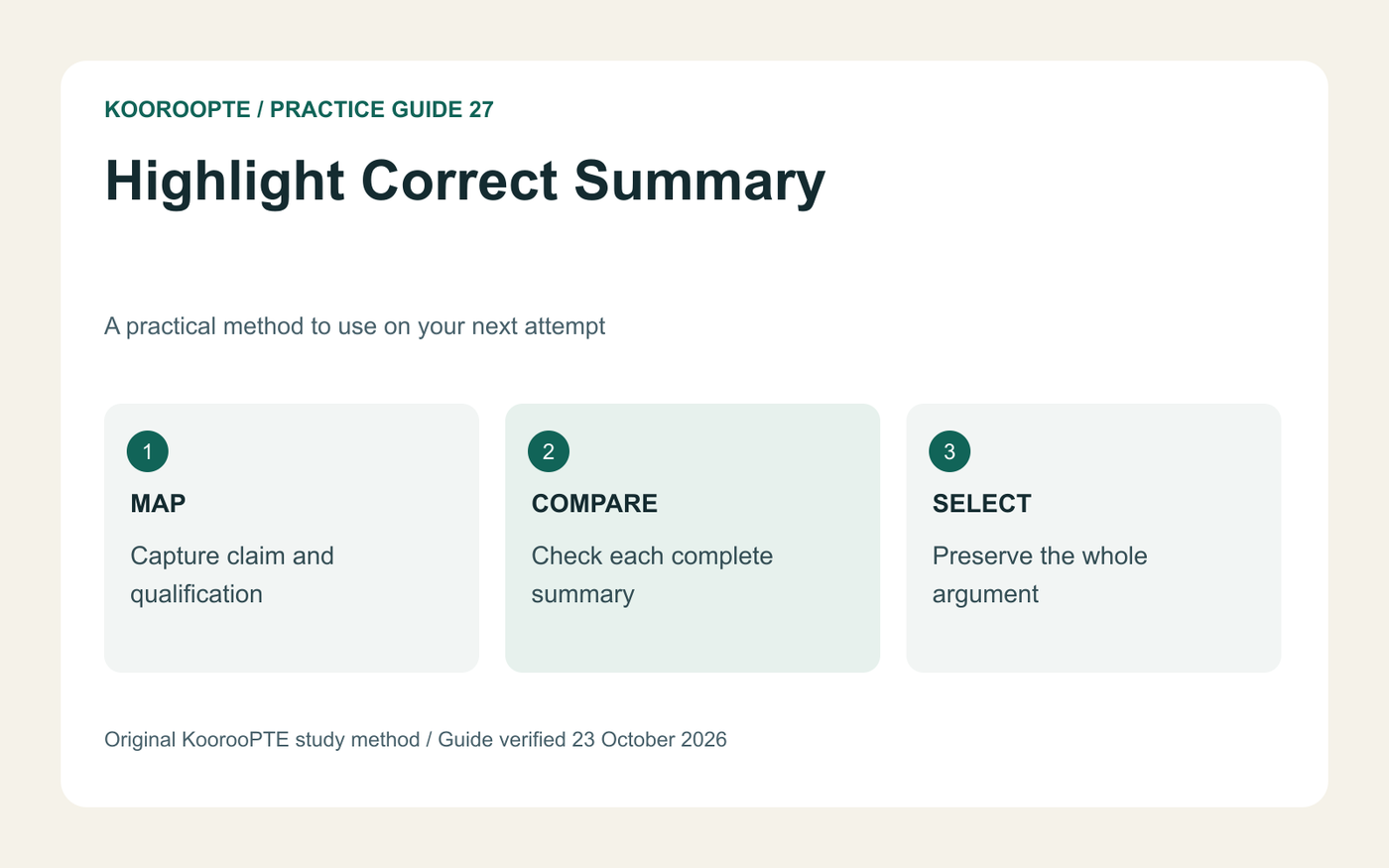
PTE Highlight Correct Summary asks you to choose the paragraph that best represents a recording. Listen for the main claim, its support and any limit on the conclusion. Then compare complete meanings rather than matching familiar words. These original examples show how a plausible option can still distort the message.
Written by the KoorooPTE editorial team. Last updated and fact-checked: 23 October 2026.
What are you selecting in Highlight Correct Summary?
You select one paragraph that best represents a recording's message. Pearson gives an audio length of 30-90 seconds, played once. The task assesses Listening and Reading, and the current score table gives one point for a correct answer and zero for an incorrect or missing answer.
This task tests the relationship between ideas, not your ability to recognize repeated vocabulary. An option may name the same topic, people and examples while changing what the speaker concludes. Your job is to preserve the argument, including any caution or condition that limits it.
Keep this separate from Highlight Incorrect Words. That task asks you to identify transcript mismatches and has a different marking rule. Similar names do not make the response method or scoring interchangeable.
How can you compare summaries systematically?
Build a short account of the recording before letting the options define what you think you heard. A few notes about the claim and its support give you a stable reference when the alternatives look similar.
- Identify the topic. Write a short label such as “library opening hours,” rather than copying the opening sentence.
- Capture the main claim. Note what the speaker says about that topic. “Longer hours helped some users” contains more meaning than “hours.”
- Record essential support. Keep a reason, result or example when it explains the claim. Leave minor details out if recording them makes you miss the next idea.
- Preserve qualifications. Mark words that limit the conclusion, such as only, some, may or unless. These often separate an accurate summary from an exaggerated one.
- Compare each whole option. Check whether its beginning, explanation and ending all fit. One correct sentence does not rescue a false conclusion.
- Choose and justify. Select the closest complete account and name the decisive difference from the strongest alternative. In review, verify that difference against the source.
Use arrows only when you know what they mean. “Hours → visits” can hide whether visits rose, fell or merely shifted to another time. A note such as “later visits, total unchanged” preserves the relationship much more precisely.
What does a fully explained example look like?
The best summary includes both the observed benefit and the limit on what can be concluded. This original script describes a fictional library trial. Have someone read it aloud once before you inspect the options if you want a listening exercise.
Practice script: “A university library extended its weekday opening hours during a six-week trial. More students used the building after nine in the evening, particularly those with daytime laboratory classes. However, the total number of weekly visits remained almost unchanged. Interviews suggested that many students had moved their visits from the afternoon rather than started visiting more often. The library also paid more for staffing and heating. The manager therefore proposed keeping the later hours during examination periods, when students reported the greatest benefit, instead of extending them throughout the year. The trial showed that later access could help particular users, but it did not establish that longer hours increased overall attendance.”
Option A: The trial increased total library attendance and demonstrated that permanent later opening would benefit all students.
Option B: Later opening helped some students change when they visited, but did not increase total visits; the manager proposed using it selectively because of benefits and costs.
Option C: Students stopped visiting in the afternoon because the library had reduced its daytime opening hours.
Option D: Higher operating costs led the manager to reject later opening during examination periods.
The correct answer is B. It preserves the changed timing, unchanged total and selective proposal. A turns a limited benefit into a universal one and invents higher total attendance. C invents a reduction in daytime hours. D reverses the manager's proposal.
The crucial note is “timing changed; total unchanged; exam periods only proposed.” A list of “students, library, costs, examinations” would not protect you against A or D, because those options contain the same topics while changing their relationships.
How can you recognize an attractive but inaccurate option?
Look for a change in scope, cause, certainty or attribution. These four checks expose many plausible distractors without assuming that every question follows the same pattern.
Scope: Does “some students” become “all students”? Cause: Does an observation become proof that one factor caused another? Certainty: Does “may help” become “will solve”? Attribution: Is a critic's view presented as the speaker's conclusion?
Do not reject every strong statement automatically. A recording may make a firm conclusion. The check is whether the strength matches the source, not whether the option contains a word such as always or never. Evidence decides, rather than a shortcut about suspicious vocabulary.
For a related exercise, compare the source-to-summary decisions in Summarize Spoken Text. That task asks you to write a summary, but the need to preserve the speaker's actual meaning is shared.
What should your notes and review sheet contain?
Use a compact frame: topic; main claim; essential support; limitation or final position. This is a listening organizer, not wording to insert into an answer. You are selecting a supplied summary, so a polished written paragraph is unnecessary.
After checking the answer, write why your selected option seemed attractive and which exact phrase made it wrong. “Chose A because attendance was mentioned; ignored total unchanged” identifies a repair. “Need better listening” leaves the next session undefined.
Review omissions as well as inventions. An option can contain no obviously false sentence yet leave out the central conclusion. Ask whether a reader who saw only that option would understand the speaker's main point, not merely one example used to support it.
How can you practise the method on a fresh example?
Test the same skill with a different contrast. Here is an original short training extract: “The new bus route carried many passengers on its first weekend. Tickets were free during the trial, however, so the council will measure demand again when normal fares apply before deciding whether to retain it.”
An accurate summary is: “The free trial attracted passengers, but the council will check paid demand before deciding the route's future.” A misleading summary is: “Strong ticket revenue proved that the route should become permanent.” The second invents revenue, proof and a final decision.
Use this checklist: main claim retained; important limitation retained; no invented cause; no reversed conclusion; one option selected. Try Highlight Correct Summary practice, then compare your reasoning with the distinct selection tasks in the Listening Multiple Choice guide.
Which sources were checked for this guide?
Exam facts were checked against Pearson's current listening guidance and the Test Taker Score Guide (pages 44) on 23 October 2026. The examples, schedules and review methods are original KoorooPTE teaching material, not official test questions, scored Pearson responses or promises of improvement.
Frequently asked questions
Is Highlight Correct Summary negatively marked?
No. The current scoring table gives one point for the correct summary and zero for an incorrect or missing response. Do not confuse it with Highlight Incorrect Words. Use the difference to understand the task, while still selecting the option that best matches the recording's complete message.
Should I select the summary with the most repeated words?
Repeated words can identify the topic, but they do not prove that a summary preserves the argument. Check who did what, why it happened and how strong the conclusion is. A distractor can borrow the recording's vocabulary while reversing a cause or removing an important limitation.
What if I miss a detail in the recording?
Use the ideas you understood to compare the options, without inventing the missing detail. A strong summary must fit the main message as well as its support. In review, find out whether the missed detail was essential or whether you rejected a good answer because of uncertainty elsewhere.