
PTE Listening Fill in the Blanks 2026: Hear and Spell Each Word
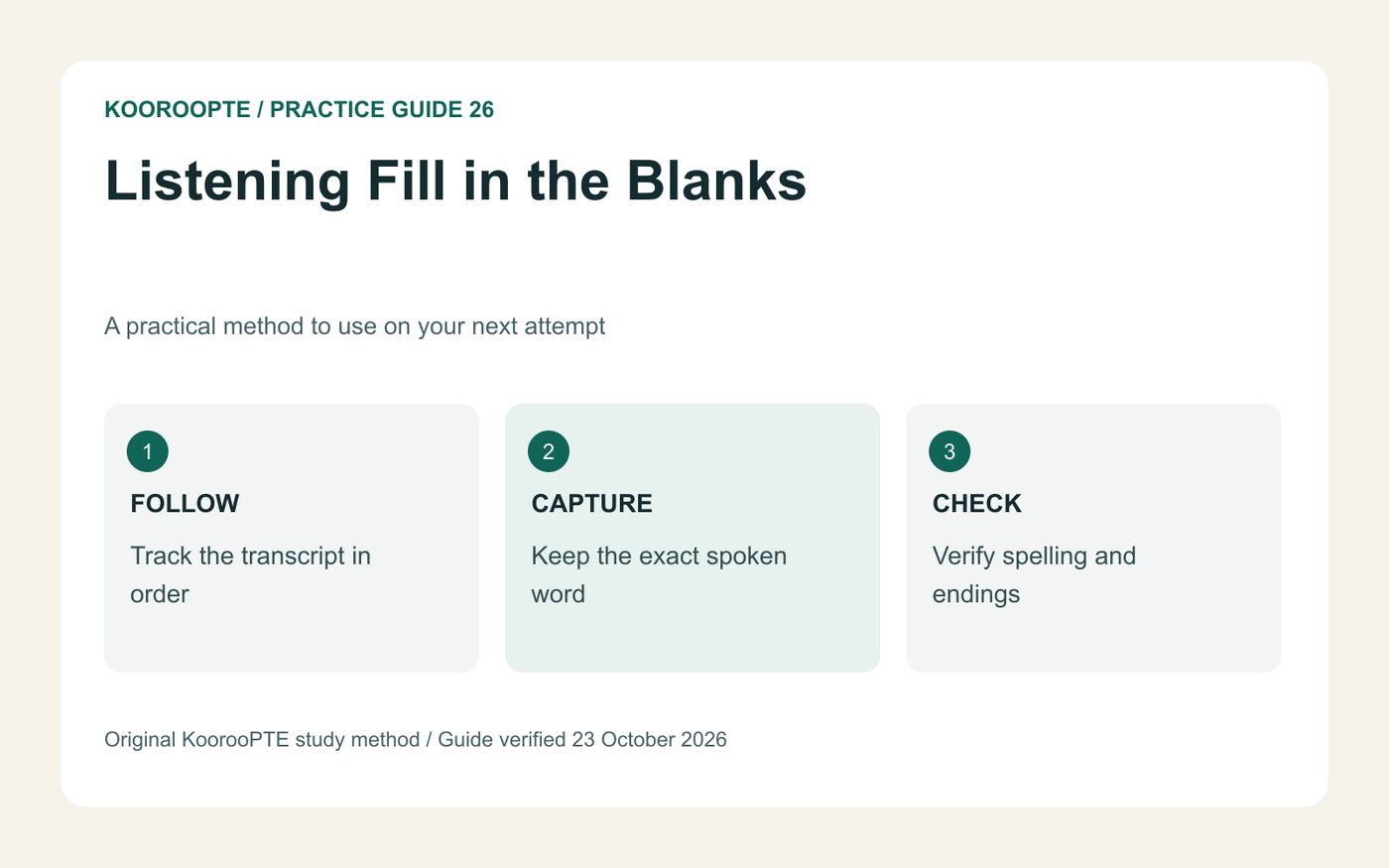
PTE Listening Fill in the Blanks asks you to restore missing words in a transcript while following a recording. Capture the exact word, keep pace with the speaker, and check spelling after listening. Use the original exercises below to separate hearing mistakes from typing and spelling errors in your practice.
Written by the KoorooPTE editorial team. Last updated and fact-checked: 23 October 2026.
What does Listening Fill in the Blanks ask you to do?
You restore the missing words in a displayed transcript by listening to a recording. The surrounding text helps you keep your place, but it does not replace listening: several words might make a grammatical sentence, and only the spoken word restores the transcript accurately.
Pearson gives the recording length as 30-60 seconds and plays it once. Each correctly spelled missing word earns one raw point. Those item points are not the same as points on your final 10-90 score, so do not convert a small practice result into a predicted test score.
The current Score Guide lists Listening as the assessed skill. Pearson's page has a conflicting lower note that still mentions Writing; its main skill label and the guide's current table say Listening. This differs from Write from Dictation, where the task contributes to both Listening and Writing.
How can you follow the recording without losing later gaps?
Keep moving with the speaker and leave detailed spelling repair until you can do it without missing new information. The useful habit is to protect your place in the transcript, especially after an uncertain word.
- Skim for the topic. Notice the subject and repeated nouns before playback. Do not try to solve every blank from context alone.
- Locate the gaps. Read a few words around each one so you recognize the approach to it in the audio.
- Capture the spoken form. Listen for endings as well as the main syllables. A plural or past-tense ending can distinguish the correct word from its base form.
- Keep following the text. If one word is uncertain, retain your best note and rejoin the next clear phrase. Do not mentally replay the missed word over the next gap.
- Enter and inspect your answers. Use your notes if typing while listening divides your attention. Check that each answer went into the intended blank.
- Read the completed phrases. Check spelling, number and grammatical fit before moving on, while respecting the section clock. Context should help you check what you heard, not invent a replacement.
Test typing and note-taking on separate unfamiliar recordings. Choose according to missed words and input mistakes, not typing speed alone. A method that feels quicker may cost more if you repeatedly lose your position.
What does an original worked example look like?
The correct answers preserve the exact words and grammatical forms in the source. This short training extract is original teaching material, not a full official test item or a report of a real study. Have a partner read the complete version once while you view only the gaps.
Transcript with gaps: “The research team compared water use in three university buildings. Before the new equipment was installed, staff recorded a ___ for each building. After six weeks, consumption had fallen, but the researchers warned that warmer weather could affect the ___. They recommended a longer trial before making a final ___.”
Complete source: “The research team compared water use in three university buildings. Before the new equipment was installed, staff recorded a baseline for each building. After six weeks, consumption had fallen, but the researchers warned that warmer weather could affect the results. They recommended a longer trial before making a final recommendation.”
Answers: baseline; results; recommendation. The first answer names the starting measurement. The second is plural in the recording. The third fits “a final” and names what the researchers will eventually make.
“Conclusion” would sound reasonable in the final gap, but it is not what the source says. “Result” is close to the second answer but drops the spoken plural. These are different errors: one substitutes meaning, while the other loses a word ending. Your next drill should reflect that difference.
How do you tell a listening error from a spelling error?
Compare your first answer with what you can recognize on a replay before looking at the written source. If you identify the word correctly when replaying, ask what prevented recognition the first time. If you can say it correctly but cannot write it, spelling needs separate attention.
Use four labels in a simple error log: heard another word, missed an ending, knew the word but misspelled it, or entered it incorrectly. Add the correct phrase and one specific repair. “Recommendation: wrote one m; cover the word and reproduce it tomorrow” is more useful than “improve vocabulary.”
Keep the whole phrase beside the word. Hearing “the results” repeatedly connects the final sound to the plural form; memorizing only a dictionary headword does not practise that connection. For related work on word choice, use the Reading Fill in the Blanks guide.
Which mistakes need a different correction?
Fix the cause of the error rather than repeating the same exercise unchanged. If you select a synonym, practise exact reconstruction. If you lose your place, reduce the number of gaps temporarily and rehearse following the transcript. If spelling fails, retrieve the word from memory after hearing it in a new sentence.
Avoid letting a difficult word interrupt the entire attempt. During review you can replay, slow down or inspect the transcript, but the first attempt should preserve the one-listen condition. Record which stage produced the answer so that supported practice does not look like independent performance.
Use Highlight Incorrect Words for a related comparison skill, while keeping the marking rules separate. Selecting a mismatch is a different action from typing a missing word, and the negative-marking rule from that task should not be imported here.
What should you practise in your next session?
Complete a small set, review each error, then test the same difficulty in a new sentence. One original follow-up sentence is: “The researchers revised their recommendation after checking the results against the baseline.” Ask a partner to omit one of those target words from a written copy while reading the complete sentence aloud.
Use this reusable checklist: follow every gap in order; preserve the spoken word; check endings; check spelling; confirm the answer is in the correct box. Record both correct and missed words, and note whether you needed a replay during review.
Start with Listening Fill in the Blanks practice, then choose one error category for a short repair drill. Finish by attempting unfamiliar material without the transcript answers visible. That final check tells you more than getting a memorized sentence right again.
Which sources were checked for this guide?
Exam facts were checked against Pearson's current listening guidance and the Test Taker Score Guide (pages 44) on 23 October 2026. The examples, schedules and review methods are original KoorooPTE teaching material, not official test questions, scored Pearson responses or promises of improvement.
Frequently asked questions
Does Listening Fill in the Blanks score Writing?
The current Score Guide lists Listening as the scored skill for this task. Pearson's task page also labels it Listening, although a lower note still mentions Writing. Use the current scoring table for planning, and distinguish this task from Write from Dictation, which assesses both skills.
Should I type while the recording is playing?
Use the approach that lets you keep following the recording accurately. If typing makes you miss later gaps, jot down the words and enter them afterward. Compare both approaches during practice, checking missed gaps as well as spelling, rather than choosing solely by how fast you can type.
Can I replace a missing word with a synonym?
Aim for the word actually spoken in the recording. A synonym may make a sensible sentence while failing to restore the transcript accurately. During review, compare the sound, spelling and grammatical form of your answer with the source, especially when a familiar alternative seemed to fit the topic.