
PTE Retake Strategy 2026: Diagnose, Repair and Rebook
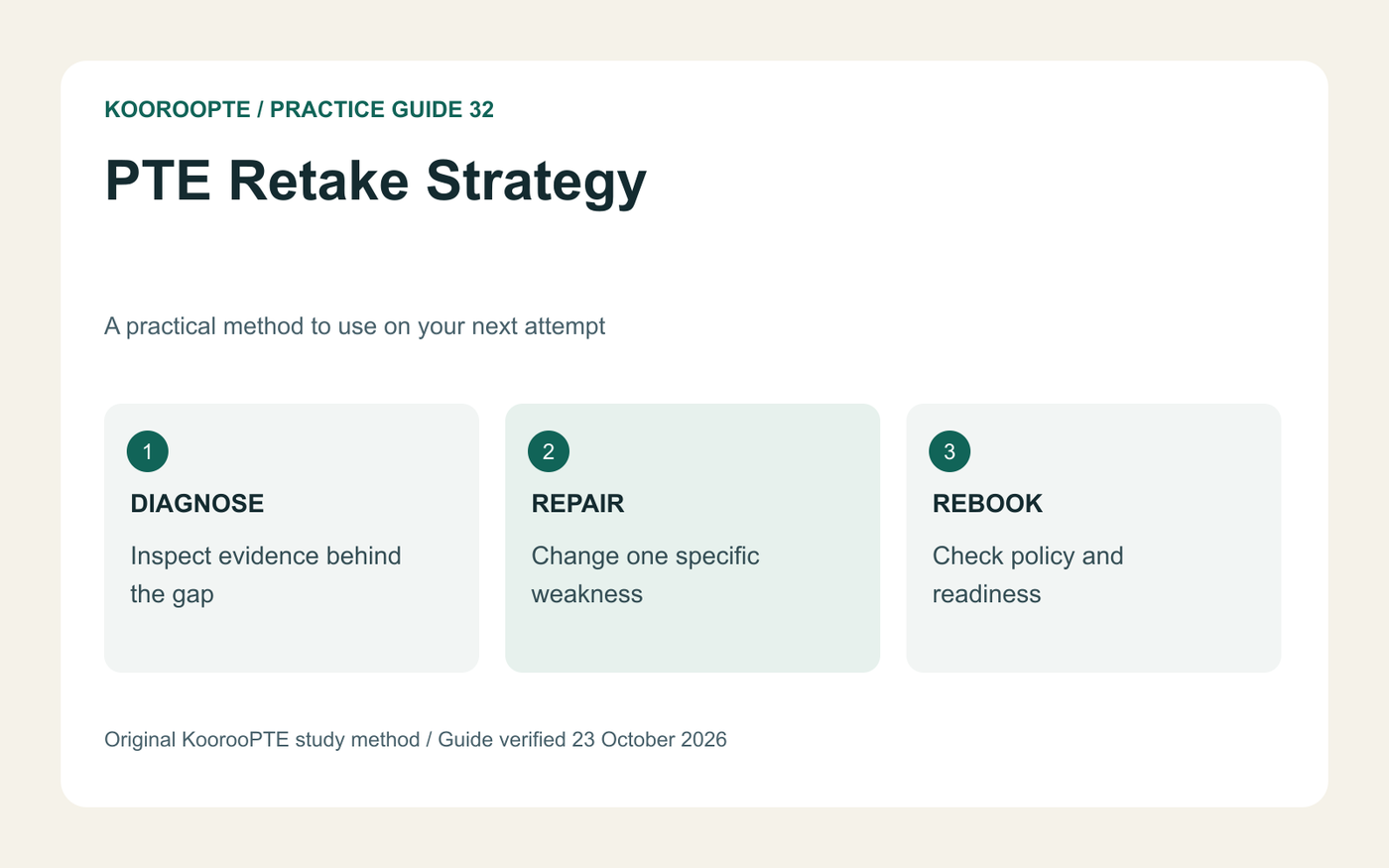
A useful PTE retake strategy changes the preparation that produced your previous result. Compare the score report with your exact requirements, inspect recurring errors and test a specific correction on unfamiliar work. Check Pearson's current booking rules before choosing another date, and separate administrative eligibility from evidence that you are ready.
Written by the KoorooPTE editorial team. Last updated and fact-checked: 23 October 2026.
What should you check before planning a PTE retake?
Check the exact requirement you missed and the booking rules before choosing a new date. A disappointing overall result, an unmet individual skill minimum and a suspected technical problem are different situations; each needs its own next step.
Pearson's current retake policy requires you to receive your previous scores before booking again and permits only one test booking at a time. It allows more than one test in a month, with a limit of twelve attempts within a twelve-month window unless Pearson grants an exception. Do not create another account to bypass those rules.
The policy does not establish a universal seven-day waiting period. Administrative permission to book, however, is different from evidence that your preparation has changed. Use the time before another attempt to identify what you will do differently and how you will check that it helped.
How do you decide what needs to change?
Build the retake plan from the gap between your requirement and your actual work. A score report points to skills to investigate, but it does not reveal every task response or identify a single cause by itself.
- Write the requirement precisely. Record the accepted test version, overall minimum and any individual skill minimums. Confirm unclear wording with the receiving organization.
- Record the previous result. Keep the official report separate from practice estimates and personal impressions of how the test felt.
- Reconstruct relevant observations. Note unfinished tasks, misunderstood instructions or equipment concerns while you remember them. Treat recollection as a clue rather than proof of the scoring cause.
- Collect fresh practice evidence. Attempt relevant unfamiliar tasks and inspect the actual responses. Look for a repeatable pattern that you can explain.
- Change one practice process. Choose a correction that targets that pattern, then test it on different material. Record what improved and what remained difficult.
- Choose a date using both constraints. Combine the current booking policy, available appointments, your deadline and the evidence from your new work. None of those factors substitutes for the others.
Avoid explaining every low result as a microphone problem or an unfair question. Technical concerns deserve the appropriate official process, but ordinary content, comprehension and language errors still need careful inspection. Start with evidence you can actually examine.
What does an illustrative retake diagnosis look like?
A useful diagnosis narrows the problem without claiming to reconstruct Pearson's scoring. Consider a fictional learner who needs at least 65 in every skill and receives Listening 63, Reading 68, Speaking 69 and Writing 64. Those values identify two unmet minimums; no overall score is calculated from them.
The learner remembers finishing every item, but that recollection does not show that the answers were accurate. They complete a fresh practice sample and find that written summaries often contain the topic and examples while omitting the main conclusion. Several dictation responses also miss small words.
Their retake plan now targets two observable processes: recording the conclusion before writing a summary, and reconstructing complete phrases in dictation. They maintain speaking and reading with smaller mixed sets. This is an illustrative response to observed errors, not a universal allocation for everyone with similar skill scores.
Use the Summarize Spoken Text guide and Write from Dictation guide to practise those methods. If your own errors are different, choose different tasks rather than copying the example schedule blindly.
How can a short repair cycle be organized?
Organize the repair cycle around an error, a deliberate correction and an unfamiliar check. The following five-session example is an editorial study method, not a minimum waiting period or a promise of a higher result.
Session one: gather a baseline of fresh responses and classify the errors. Session two: practise the first recurring weakness with feedback and explanation. Session three: practise the second weakness while briefly recalling the first correction. Session four: attempt mixed unfamiliar material without help. Session five: compare the evidence and decide what still needs attention.
Save one before-and-after example for each priority. For summary content, highlight the source conclusion and show where the new response represents it. For dictation, mark missing words separately from misspellings. That comparison makes the change reviewable instead of reducing it to “I studied harder.”
Repeat or extend the cycle when the correction does not transfer. If success depends on seeing the transcript first, you have useful supported practice but not yet evidence of independent listening. If the issue is broad comprehension, a longer one-month preparation plan may fit better than repeated short retakes.
How is a retake different from a rescore or technical review?
A retake is a new test attempt, while a rescore or technical review concerns the previous attempt. Do not treat the three as interchangeable ways to request a higher number.
If you suspect an issue with the previous test, read Pearson's current scoring help and follow the linked process appropriate to your concern. Check its current conditions before paying or making another booking; this article does not assume that every review request is eligible or that a review will change the result.
Keep factual notes when reporting a concern. Record the date, test center, task stage, what you observed and whether you told staff. Avoid inventing a cause you could not see. A precise account of an observed interruption is more useful than claiming that a low score proves a recording failure.
When is another attempt a reasonable next step?
Another attempt is easier to justify when your preparation has addressed a specific gap and fresh work shows more reliable execution. That is a decision principle, not a numerical readiness threshold validated by Pearson.
For example, the fictional learner might now preserve the conclusion across several unfamiliar summaries but still miss short words in rapid speech. The next step could be further listening work rather than declaring both skills ready because one response improved. Inspect the remaining weakness honestly, especially when your requirement has separate minimums.
A deadline can constrain your options without changing the evidence. If you must choose a date before the ideal amount of preparation, record that tradeoff explicitly and focus the remaining time on the most actionable errors. Do not reinterpret urgency as proof that the gap is small.
What belongs on your final retake checklist?
Your checklist should cover eligibility, preparation and practical arrangements separately. Confirm that the previous result is available and that your booking complies with Pearson's policy. Verify the exact requirement again if your application circumstances have changed.
For preparation, write the two main errors you addressed, the method you changed and the unfamiliar work used to check it. Keep a short maintenance plan for the skills that already meet your target. For practical arrangements, follow the current instructions associated with the new booking.
Start with Summarize Spoken Text practice if summary content is one of your observed gaps. Finish the session with a concrete note: “The next attempt needs this correction because this fresh response still shows this error.” A retake plan becomes useful when it changes a process you can observe, not merely the date on your calendar.
Which sources were checked for this guide?
Exam facts were checked against Pearson's current scoring guidance and the Test Taker Score Guide (pages 6-8) on 23 October 2026. Additional references: retake policy. The examples, schedules and review methods are original KoorooPTE teaching material, not official test questions, scored Pearson responses or promises of improvement.
Frequently asked questions
Can I book another PTE test before my results arrive?
Pearson's current retake policy says you must receive the scores from your previous test before booking another, and you can hold only one test booking at a time. Use the waiting period to organize your notes and requirements, then check available dates through your existing account once eligible.
Is there a compulsory seven-day waiting period between PTE tests?
The current published retake policy does not impose a universal seven-day gap. It requires your previous results before a new booking and allows more than one test in a month, subject to its attempt limit. Available appointments and your actual readiness still determine whether a particular date is sensible.
Will repeating the same preparation produce a higher score?
A new attempt does not itself prove that a weakness has improved. Keep the parts of your routine that work, but change the practice connected to recurring errors. Compare unfamiliar responses before and after the change, and record what became more accurate rather than relying only on increased study hours.