
PTE One-Month Preparation: A 30-Day Schedule You Can Adjust
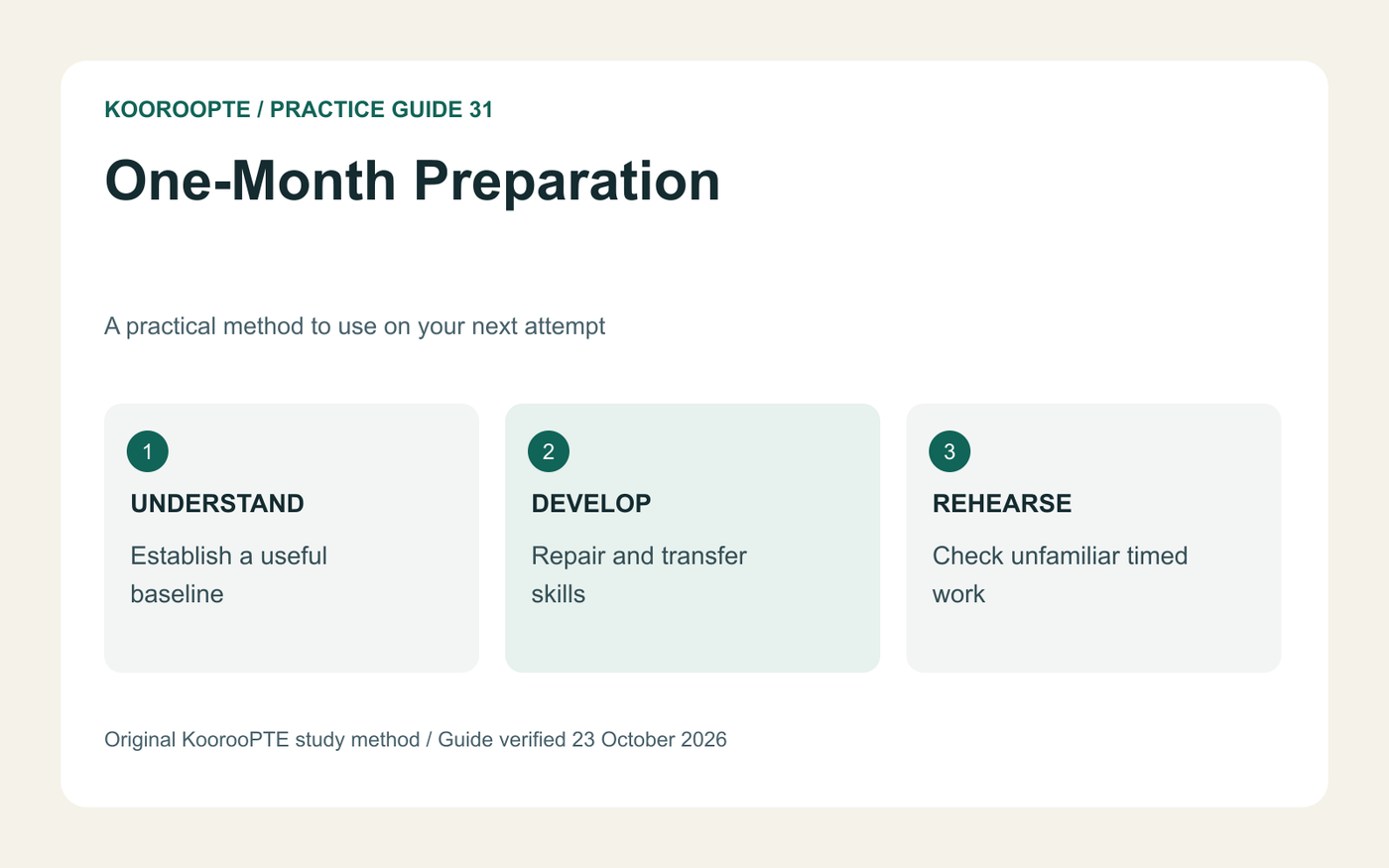
PTE one-month preparation should move from diagnosis to targeted practice and then realistic rehearsal. Build your schedule around the requirements you actually need and the errors your work reveals. This adjustable thirty-day plan explains what to produce each week, when to reassess and how to respond when progress is slower than expected.
Written by the KoorooPTE editorial team. Last updated and fact-checked: 23 October 2026.
What should a month of PTE preparation achieve?
A month should give you a clearer diagnosis, repeated practice of the right skills and evidence of how those skills hold up on unfamiliar work. It is a useful planning period, not a promise that every learner will reach a particular score within thirty days.
Start with your exact requirements and the accepted test version. If your target includes individual skill minimums, track them separately. Pearson's overall score is not calculated by simply averaging Listening, Reading, Speaking and Writing, so a homemade average should not decide your readiness.
Use the PTE score guide article to orient yourself, then verify the requirement itself with the receiving organization. The schedule below concerns preparation for PTE Academic; it should not be applied unchanged to a different test just because the name includes PTE.
How do you build an adjustable thirty-day schedule?
Divide the month into diagnosis, development, transfer and rehearsal, with a concrete output at each stage. That structure lets you change the workload without losing the reason for each week.
- Define your target. Record the exact score combination, accepted test and relevant deadline, with a source for each requirement.
- Set your available time. Choose a normal study block and separate longer slots for any full mocks. Do not hide an unrealistic workload inside a calendar.
- Collect a baseline. Use recent results and unfamiliar responses, recording which evidence is official and which comes from practice.
- Choose two initial priorities. Identify recurring errors that you can describe and practise. Keep short maintenance work for the other skills.
- Schedule fresh checks. Decide when you will attempt different material without help to see whether the correction transfers.
- Revise the next week. Use the evidence you collected, not the number of boxes already ticked, to choose the next priorities.
An example normal day contains fifteen minutes of recall, thirty-five minutes of focused attempts, twenty-five minutes of review, ten minutes of mixed maintenance and five minutes of planning. The total is ninety minutes. These are suggested study allocations rather than official test timings.
What should happen in the first week?
Week one should establish how the test works and where your current work breaks down. On day one, write your requirement card and inspect a recent score report if you have one. On day two, sample speaking and listening tasks; on day three, sample reading and writing. Save the responses you will review.
Use day four to classify the mistakes. Separate a misunderstood instruction from a language gap and from an execution problem such as entering an answer in the wrong place. Those categories lead to different corrections, even when they all produce an incorrect response.
Use days five and six for focused repair sessions on your two strongest recurring patterns. Day seven is a lighter review and planning day: attempt a small fresh check, summarize what you learned and set the next week's workload. A lighter day still produces a useful decision.
For example, a fictional learner might discover that they recognize vocabulary on paper but miss endings in connected speech. Their first repair should target listening discrimination and reconstruction, rather than adding hundreds of isolated words to a vocabulary list.
What should happen in the second week?
Week two should build more reliable control of the chosen weaknesses. Use days eight and nine for the first priority, days ten and eleven for the second, and day twelve for maintenance of the remaining skills. Each session should end with different material that tests the same correction.
Use day thirteen to combine tasks without losing the method you practised separately. On day fourteen, review the evidence and decide whether to keep or change each priority. Moving on should reflect improved fresh work, not boredom with a task you still find difficult.
A worked example makes that decision concrete. Suppose a learner's initial summaries repeatedly omitted the speaker's conclusion. After practising claim-and-support notes, three new summaries retain the conclusion but two introduce an unsupported reason. The next priority becomes distinguishing source evidence from plausible additions, rather than simply writing longer notes.
Use Summarize Spoken Text for that task-specific method. Record the prompt and your reasoning alongside the correction, so you can explain what changed rather than relying on a general impression of improvement.
What should happen in the third week?
Week three should test transfer across topics and under more realistic conditions. Use days fifteen and sixteen for unfamiliar material in your priority skills, and days seventeen and eighteen for mixed practice that includes stronger areas. Keep the first attempt independent before opening explanations.
Use day nineteen for a broader timed rehearsal. A full mock needs its own uninterrupted slot; a partial rehearsal should be labelled partial in your record. On day twenty, review the work carefully. Use day twenty-one to repair the most important recurring issue and prepare the final week's priorities.
Record conditions as well as outcomes. If a result improves after extra replays, it shows useful supported learning but does not yet demonstrate one-listen performance. If a lower result follows repeated interruptions, inspect the responses before deciding that your language ability has declined.
Bring context and grammar together through Reading Fill in the Blanks practice. Explain why the chosen word fits the whole passage, and use a different passage to test whether the reasoning survives a topic change.
What should happen in the final nine days?
Days twenty-two through twenty-four should address the weaknesses revealed by rehearsal. Keep the number of priorities small enough to review thoroughly. Day twenty-five is a mixed check, and day twenty-six is for analysing that check and choosing any final correction.
Use day twenty-seven for another broad rehearsal if the preceding review justifies it and you have appropriate fresh material. Day twenty-eight is for review. Day twenty-nine should be lighter, with short retrieval exercises and practical preparation. Day thirty is your readiness decision and next-step plan, rather than an automatic claim that preparation is complete.
If your appointment is earlier, move the rehearsal and review sequence accordingly. If day thirty is the test day, complete the decision and administrative checks beforehand. The sequence matters more than matching an arbitrary calendar label.
Avoid filling the final days with memorized responses. A useful checklist reminds you what to listen for or check; it does not supply content regardless of the prompt. The template guide explains why that distinction matters.
How can you tell whether the month worked?
Judge the month by changes in unfamiliar performance and the clarity of your remaining priorities. Compare errors under similar conditions, inspect whether improvements appear across several attempts and keep estimated practice scores distinct from official results.
Use this reusable weekly checklist: target still accurate; available time realistic; priorities based on responses; maintenance included; fresh checks completed; next change justified. If you miss sessions, revise the remaining workload rather than doubling every task and removing recovery or review.
Extend the plan when important gaps remain. You can reuse its structure with new priorities instead of restarting from zero. If you are already near your requirement and need a focused final review, the seven-day plan provides a shorter structure. In both cases, readiness comes from the evidence, not the length of the calendar.
Which sources were checked for this guide?
Exam facts were checked against Pearson's current scoring guidance and the Test Taker Score Guide (pages 6-8) on 23 October 2026. The examples, schedules and review methods are original KoorooPTE teaching material, not official test questions, scored Pearson responses or promises of improvement.
Frequently asked questions
Is one month enough to reach my target?
One month is a planning period, not a readiness guarantee. Compare your starting performance with your exact requirements and inspect whether your main difficulties concern language, task understanding or execution. Use the weekly checks to decide whether the schedule is working or whether you need a longer preparation period.
What should I do if I miss several study days?
Resume with the highest-priority unresolved skill and a short check of what you remember. Do not double every task simply to restore the calendar. Reduce lower-priority volume, preserve review time and move the next reassessment if needed, so the revised plan remains realistic and useful rather than punitive.
When should I move from individual tasks to full mocks?
Start combining tasks once you understand their instructions and can apply your method without constant help. Use a full mock when you want to inspect pacing and sustained performance across the test. Keep targeted practice between mocks, because a broad score report alone does not repair the errors it reveals.