
PTE Seven-Day Study Plan: A Focused Week Before Your Test
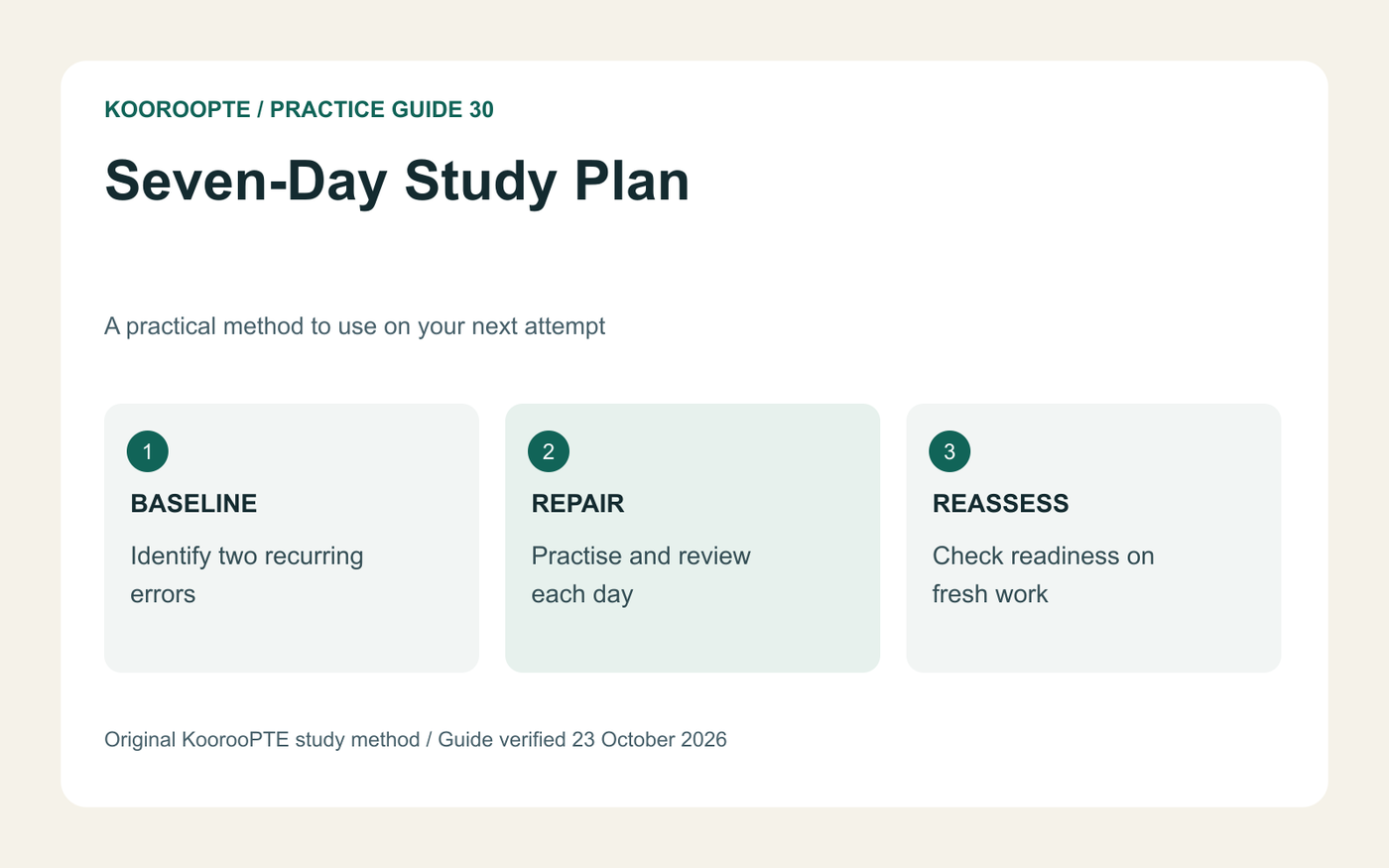
A PTE seven-day study plan works best as a focused review week, not a promise to learn English from scratch. Establish your baseline, repair two recurring weaknesses and rehearse the current test format. The daily schedule below includes clear outputs and a final readiness check so you can judge progress honestly.
Written by the KoorooPTE editorial team. Last updated and fact-checked: 23 October 2026.
Who is a seven-day plan useful for?
A seven-day plan is useful for organizing a final review week when you already have relevant English skills and some familiarity with the test. It can also expose what a beginner needs to learn, but it cannot promise that a week will bridge an unknown proficiency gap.
Begin by writing your exact score requirements and reviewing the current question types. Include Summarize Group Discussion and Respond to a Situation in your preparation; the speaking additions belong to the August 2025 update, not a newly invented 2026 change.
Set aside a daily block you can complete attentively. The plan below uses ninety minutes for a normal study day. If you use a full mock, reserve a separate uninterrupted slot for its advertised duration and review it afterward; do not squeeze a full test into the ninety-minute framework.
How should each study block be organized?
Use the same review cycle each day while changing the task and the error you target. The cycle keeps practice from becoming a list of completed questions with no explanation of what improved.
- Name today's correction. Choose a visible problem, such as skipping plural endings or failing to state a speaker's conclusion.
- Recall yesterday's lesson. Reproduce a corrected phrase or explain a task rule without looking at your notes.
- Attempt unfamiliar material. Preserve the relevant first-attempt conditions, and record any help or extra time you use.
- Explain the errors. Compare meaning, form and execution separately. Write why the answer failed rather than copying the answer key.
- Try a fresh example. Apply the correction to different material so that memory of the first answer does not decide the result.
- Choose tomorrow's adjustment. Keep the same priority if the error persists, or move on when the new work supports a change.
An example ninety-minute split is ten minutes of recall, thirty minutes of attempts, thirty minutes of review, fifteen minutes of fresh checks and five minutes of planning. Those allocations add to ninety minutes; they are an editorial study framework, not a Pearson requirement.
What should you do on days one and two?
Day one should produce a baseline and two priorities. Review a recent result if available, sample unfamiliar tasks and inspect actual responses. Record whether each difficulty concerns understanding the task, understanding the language or executing an answer under time pressure.
Choose priorities from repeated evidence. For example, a fictional learner notices missing small words in dictation and summaries that omit a contrasting view. “Listen more” is too broad; “retain short function words” and “record the contrast before summarizing” give the next days a purpose.
Day two should repair one speaking or listening process. Attempt a small set using the Repeat Sentence method or another relevant task guide, then review what was omitted or changed. For a longer spoken response, check whether your explanation communicates the actual source rather than a list of topic words.
Keep a short recording as evidence of the first attempt and another from fresh material after review. Compare the selected weakness, not whether one recording simply sounds more confident. Confidence is useful, but it does not establish accurate content.
What should you do on days three and four?
Day three should connect reading decisions to evidence. Use an unfamiliar passage, answer the questions and justify each selection. For a wrong answer, identify whether you missed a grammatical cue, changed the strength of a claim or selected something the passage never said.
Apply that correction to a new passage. The Reading Fill in the Blanks guide helps with local grammar and context, while multiple-choice practice checks how you justify a statement from the whole passage. Keep these error types distinct in your notes.
Day four should produce a complete writing response and an edited version. Use the correct task instructions, plan the main message and write under the relevant conditions. During review, check content before polishing words: a fluent response that misses the prompt still needs substantive repair.
Annotate three useful changes. One might repair a missing conclusion, another a sentence boundary, and another a repeated phrase. Explain what each change fixes, then write a short fresh paragraph that uses the corrected pattern without copying the original response.
What should you do on days five and six?
Day five should test whether the first four days changed unfamiliar work. Use a mixed set that includes your two priorities and a sample of stronger areas. Keep the first attempt independent, then compare the same error categories with day one.
An honest progress note might say: “I retained small words on three new sentences, but still lost plural endings when the speaker accelerated.” That is more informative than “Listening is fixed.” It names both the improvement and the remaining condition that causes trouble.
Day six should rehearse sustained performance and produce a short review. Use a full mock if it is appropriate and available, or a clearly labelled partial rehearsal if time is limited. A partial set cannot establish how you perform over an entire test.
Record interruptions, equipment problems, fatigue and unfinished work. Then choose only the most actionable findings for the final day. Do not replace the whole week with a completely new strategy because one result was disappointing; first inspect what actually happened.
What belongs on day seven?
Day seven should consolidate reliable habits and confirm practical readiness. Review your short checklist, complete a light unfamiliar set and inspect only the main remaining errors. Avoid using a marathon session as a substitute for evidence that you understand the tasks.
Check your appointment details and the current instructions supplied by Pearson for your booking. Keep those administrative checks separate from this study plan; it is not a replacement for the official identification or test-center requirements.
Write a final learning note with three fields: what became more reliable, what still needs help and how you will respond if that difficulty appears. For example: “If I miss one dictation word, I will preserve the rest of the sentence and review the uncertain position afterward.”
How should you adapt the week if the baseline is weak?
Use the week to establish a longer plan when the baseline shows broad comprehension or expression gaps. A calendar deadline does not make unfamiliar language easier to process. Reduce the task difficulty during learning, then return to realistic conditions to check transfer.
If you have only forty-five minutes a day, reduce the number of attempts rather than deleting review. One compact allocation is five minutes of recall, fifteen of attempts, fifteen of review, five of fresh checking and five of planning. A full mock still needs its own appropriate slot.
Use this reusable checklist: exact target recorded; two priorities identified; daily output saved; fresh work checked; rehearsal conditions recorded; readiness judged honestly. Begin with Read Aloud practice if spoken delivery is one of your priorities, and switch to the one-month schedule when the evidence calls for more time.
Which sources were checked for this guide?
Exam facts were checked against Pearson's current scoring guidance and the Test Taker Score Guide (pages 6-8) on 23 October 2026. The examples, schedules and review methods are original KoorooPTE teaching material, not official test questions, scored Pearson responses or promises of improvement.
Frequently asked questions
Can I prepare for PTE from scratch in seven days?
Seven days can help you understand the format and organize useful practice, but it cannot guarantee the language proficiency your target requires. Begin with a baseline rather than a promise. If unfamiliar tasks reveal persistent comprehension or expression gaps, use the week to identify a longer preparation plan.
How many hours should I study each day?
Use a block you can complete attentively and review properly. This article offers a ninety-minute daily framework as an editorial example, with a separate slot for a full mock when used. Shorten the task set if necessary, but preserve time to inspect mistakes and plan the next session.
Should I take a full mock every day?
Daily full mocks are not required by this plan. A mock is useful when you will analyze it and change your practice afterward. Between broader checks, use smaller unfamiliar task sets to test a specific correction, so your week contains learning as well as repeated measurement of performance.