
PTE vs IELTS 2026: Which Is Easier & Right for You
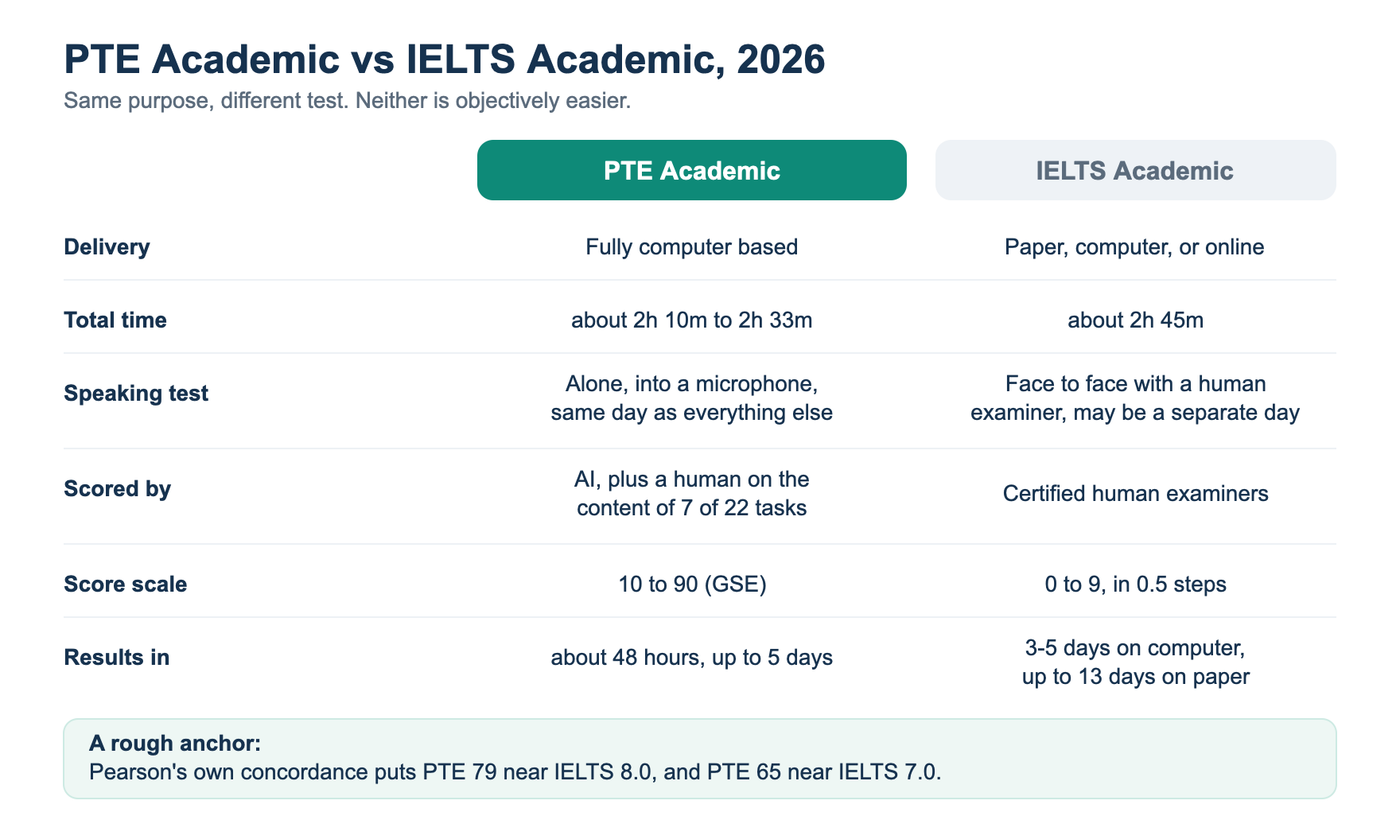
Neither test is objectively easier, but they suit different people. PTE Academic is fully computer based with no face to face component, faster results, and a scoring model that mixes AI with human review on specific tasks. IELTS Academic keeps a live speaking interview with a certified examiner and a longer, four section format. Here is exactly how they compare, and Pearson's own conversion table so you can see where your target score lands on either scale.
What is the actual difference between PTE and IELTS?
The biggest structural difference is delivery. PTE Academic is entirely computer based: you sit at a workstation, speak into a headset microphone, and type or click every answer, with no other person in the room during the test itself. IELTS Academic can be taken on paper, on computer, or online, but the Speaking section is always a live interview, face to face with a certified examiner (or over video call for IELTS Online), and it may even be scheduled on a different day from the rest of the test.
That one difference cascades through everything else. PTE finishes in a single sitting of about 2 hours 10 minutes to 2 hours 33 minutes with no scheduled break. IELTS runs about 2 hours 45 minutes for Listening, Reading and Writing together, with the Speaking test bolted on separately, up to a week before or after. If you want the full breakdown of every PTE section, see our full PTE exam pattern 2026 guide.
How does each test structure its four skills?
Both tests measure Listening, Reading, Writing and Speaking, but PTE integrates them while IELTS keeps them separate.
PTE Academic runs three parts covering all four skills at once: Speaking & Writing (9 scored tasks, 76-84 minutes), Reading (5 tasks, 23-30 minutes), and Listening (8 tasks, 31-39 minutes), 22 scored task types in total. Many tasks feed two skill scores simultaneously. Repeat Sentence, for instance, scores both Listening and Speaking from the same response.
IELTS Academic keeps four distinct sections. Listening runs about 30 minutes. Reading is 60 minutes across 3 passages, roughly 2,150 to 2,750 words total. Writing is 60 minutes across two tasks: Task 1 describes a chart, graph, or diagram in at least 150 words in about 20 minutes, and Task 2 is a 250 word argumentative essay in about 40 minutes. Speaking is a 11 to 14 minute, three part conversation with an examiner. Source: ielts.org.
How is each test scored, and by whom?
This is where the two tests diverge most since the August 2025 PTE refresh. PTE scores you from 10 to 90 on the Global Scale of English. Pronunciation and Oral Fluency are AI scored on every speaking task, no exceptions. But the content of 7 of the 22 PTE Academic task types, Describe Image, Re-tell Lecture, Summarize Written Text, Write Essay, Summarize Spoken Text, and the two newer speaking tasks, is also reviewed by a human, with a second human resolving any disagreement between the AI and the first reviewer.
IELTS scores you from 0 to 9 in half band increments, and every part of it, including Speaking and Writing, is marked by certified human examiners against published assessment criteria: fluency and coherence, lexical resource, grammatical range and accuracy, and pronunciation for Speaking, with comparable criteria for Writing. There is no AI scoring layer in standard IELTS delivery.
One consequence worth knowing before you prepare: PTE's post-2025 algorithm explicitly zeroes the Content score on any response built from pre-prepared or memorised material, and that zero cancels the response's other marks too. Our do PTE templates still work in 2026 guide breaks down exactly which tasks carry that risk and what to practise instead. IELTS examiners can also penalise obviously rehearsed answers under fluency and coherence, but there is no equivalent published all-or-nothing scoring gate.
How fast are results, PTE or IELTS?
PTE is faster on average. Pearson states results are typically available within about 48 hours and almost always within 5 business days, with no separate paper option to slow things down since the whole test is computer delivered.
IELTS results depend on which delivery format you booked: a computer delivered test returns results in 3 to 5 days, while a paper based test can take up to 13 days (7 days in some regions, including India). If your visa or university deadline is tight, this gap alone can decide which test to book. Source: ielts.org.
What PTE score equals what IELTS band?
Pearson publishes its own PTE to IELTS concordance, so you do not need to guess. These are Pearson's published minimum PTE thresholds per IELTS band, expanded into ranges:
- 9.0: 90
- 8.5: 86-89
- 8.0: 79-85
- 7.5: 71-78
- 7.0: 63-70
- 6.5: 55-62
- 6.0: 47-54
- 5.5: 39-46
- 5.0: 31-38
- 4.5: 24-30
A PTE score below 24 is reported as "below IELTS 4.5" rather than assigned a fabricated band. This table is why PTE 79 became the well known Superior English number in Australia: it lines up with IELTS 8.0, the level Home Affairs anchors Superior English to. Source: pearsonpte.com.
Prefer an interactive lookup to a static table? Our PTE to IELTS score converter covers every band both ways, alongside CEFR and TOEFL on the same score converter hub.
Does it matter which one universities and visa authorities accept?
For most study and skilled migration pathways in Australia, the UK and New Zealand, PTE Academic and IELTS Academic are accepted interchangeably at equivalent bands, so the choice comes down to test experience, cost and speed rather than acceptance. Two exceptions are worth knowing before you book.
- UK visas require the SELT version of whichever test you choose: PTE Academic UKVI, not standard PTE Academic, or IELTS for UKVI, not standard IELTS Academic. A regular booking of either test will not satisfy a UK visa route. The PTE for the UK page has the current Skilled Worker and study thresholds.
- Canada does not accept PTE Academic for Express Entry or most PR pathways at all. IRCC accepts PTE Core against IELTS General Training instead, and those are both different products from the Academic versions this guide compares. Our PTE Core vs PTE Academic guide explains the distinction, the PTE for Canada page has the current CLB thresholds, and our PTE Core to CLB converter covers every skill.
So which one should you actually take?
Choose PTE Academic if you want the fastest possible results, prefer speaking into a microphone alone over a live interview, and are comfortable with a scoring model that mixes AI and human review depending on the task. Choose IELTS if you perform better in a real conversation than talking to a screen, want the option of a paper based test, or your specific visa or institution names IELTS by preference. Both are internationally recognised, both map cleanly onto the same CEFR levels through their own published alignments, and neither will cost you a visa outcome if you prepare properly for the one you pick.
Once you have picked a test, the fastest way to close the gap between your current level and your target band is instant, exam accurate feedback on real practice. Start free PTE practice on KoorooPTE to see exactly how your Speaking and Writing responses would score against the 2026 PTE rubric.
Frequently asked questions
Is PTE easier than IELTS?
Neither is objectively easier; they test the same skills differently. PTE is fully computer based with no face to face component, which suits candidates comfortable speaking alone into a microphone. IELTS keeps a live speaking interview, which suits candidates who do better in real conversation than talking to a screen.
What PTE score is the same as IELTS 7.0?
Per Pearson's own published concordance, IELTS 7.0 lines up with PTE Academic 63 to 70. IELTS 8.0 lines up with PTE 79 to 85, which is why PTE 79 became the well known Superior English benchmark in Australia.
Does Canada accept PTE the same way it accepts IELTS?
Not quite. For Express Entry and most Canadian PR pathways, IRCC accepts PTE Core, not PTE Academic, alongside IELTS General Training, not IELTS Academic. If Canada is your goal, compare PTE Core against IELTS General Training, not the Academic versions this guide covers.
Which test gives results faster, PTE or IELTS?
PTE Academic is faster on average: results typically arrive within about 48 hours and almost always within 5 business days. IELTS results take 3 to 5 days for a computer delivered test and up to 13 days for a paper based test.
Is the PTE speaking test scored by AI or a human?
Both. Pronunciation and fluency are scored by AI on every PTE speaking task. Since the August 2025 refresh, the content of 7 of the 22 PTE Academic task types, including several speaking tasks, is also reviewed by a human, with a second human resolving disagreements. IELTS speaking is scored entirely by a certified human examiner.