
How to Get 65 in PTE: Build a Plan Around Your Actual Gaps
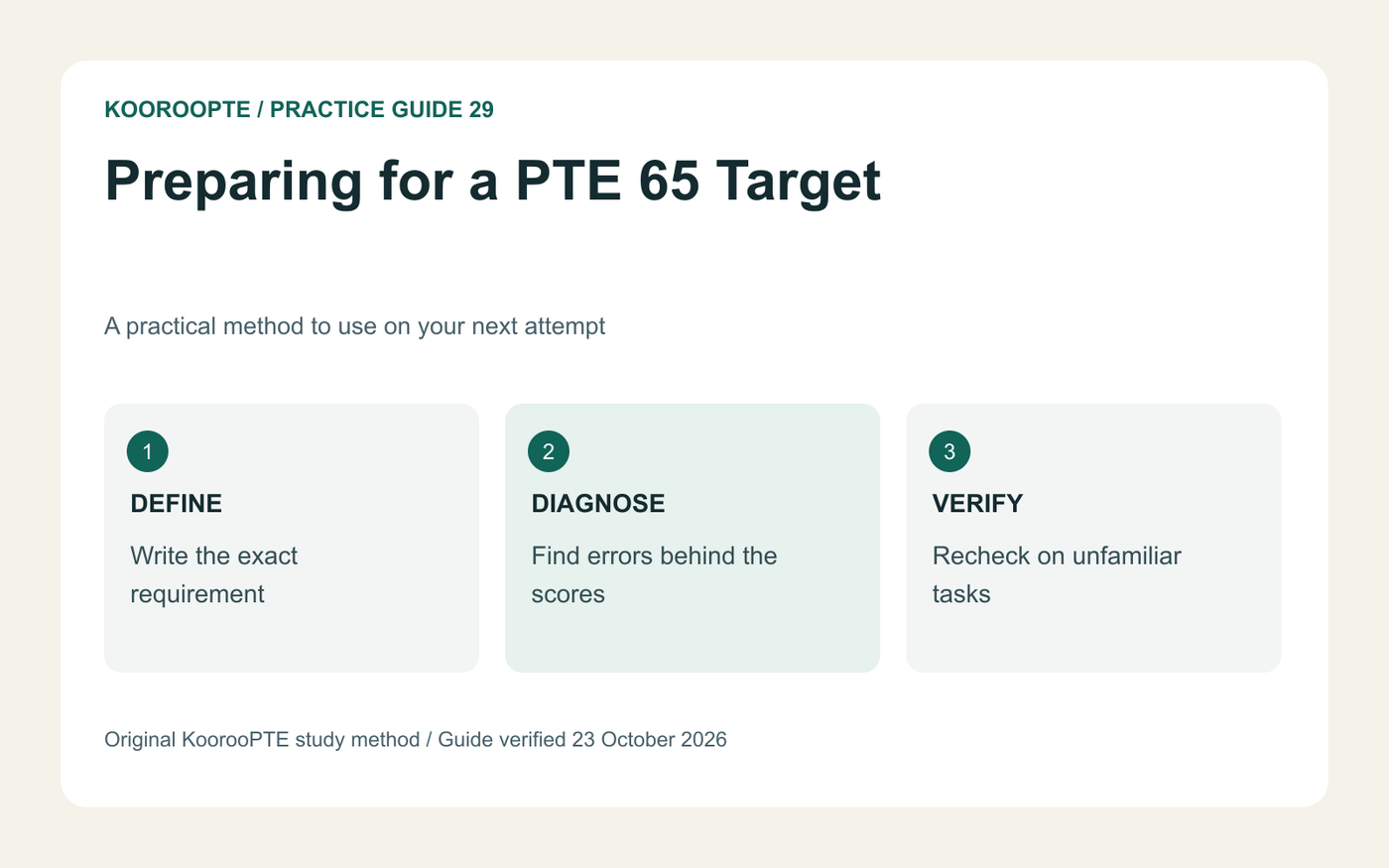
Learning how to get 65 in PTE starts with checking whether you need 65 overall, 65 in each skill, or another combination. Use a recent baseline to identify the specific errors holding you back, then practise and reassess those skills. This guide provides a worked planning example without promising a particular score.
Written by the KoorooPTE editorial team. Last updated and fact-checked: 23 October 2026.
What does a target of 65 actually mean?
A target of 65 means only what your receiving institution or authority says it means. It may require 65 overall, particular minimums in each skill, or both. Copy those requirements before deciding how to prepare; a general internet target is not an admission or visa decision.
Pearson reports an overall score and separate Listening, Reading, Speaking and Writing scores on a 10-90 scale. The overall score is not the arithmetic average of the four skills. A stronger skill therefore does not automatically cancel a lower one when your requirement includes individual minimums.
Write a requirement card with the accepted test version, overall minimum, each skill minimum, source link and date checked. Leave a field marked unresolved if the wording is unclear and confirm it with the receiving organization. Do not silently replace a missing answer with a familiar rule from another application.
How do you turn a score target into a practice plan?
Start with observable errors behind the skill gap, then choose practice that directly addresses them. A score identifies an area to inspect; it does not tell you which sentence, task or habit caused the result.
- Record the exact target. Use your requirement card so that each study decision serves the result you actually need.
- Take a useful baseline. Record the source, date and conditions of a recent test or practice result. Keep an official result distinct from an estimated practice score.
- Compare each skill separately. Identify which requirements are currently unmet. Do not calculate an overall result from the four values.
- Inspect actual responses. Collect examples of missed words, misunderstood passages, incomplete summaries or unclear spoken explanations. Look for a repeated cause.
- Choose one correction per session. Practise a manageable skill, review it and test it in a new context. “Hear plural endings” is more actionable than “raise Listening.”
- Reassess before changing the goal. Check whether the correction transfers to unfamiliar work and whether the broader skill gap remains. Adjust the plan using that evidence.
Keep maintenance practice for stronger skills. Concentrating every session on one weak area can leave you unfamiliar with the rest of the test. A short mixed set helps you detect that drift without giving all skills identical time.
What would an illustrative score-gap analysis look like?
A useful analysis separates the required result, the observed values and the explanation you still need to test. Consider a fictional learner whose chosen program requires at least 65 in each skill. Their example profile is Listening 61, Reading 67, Speaking 70 and Writing 62. No overall score is inferred from those numbers.
Listening and Writing are below that learner's stated requirement; Reading and Speaking need maintenance. The numbers alone do not prove that Write from Dictation is the problem, even though it assesses two skills. The learner must inspect responses before choosing a task priority.
Suppose a small practice review reveals three recurring issues: missing plural endings in dictation, summaries that omit the main conclusion, and essay paragraphs with incomplete sentences. These are illustrative observations, not a claim about how Pearson calculated the example profile.
The next plan now has three concrete actions. Use short dictation drills to hear endings, map a recording's claim and conclusion before summarizing, and edit complete clauses in an essay paragraph. The learner can judge whether each action changes the error it targets, even before taking another broad assessment.
Use Write from Dictation, Summarize Spoken Text and Write Essay for the corresponding task methods. Their value here comes from the observed errors, not an unsupported claim that one task guarantees the largest score gain.
How should a focused practice session work?
A focused session should include an attempt, an explanation of the errors and a fresh check. Here is an original sixty-minute session for the fictional learner; its time allocations are study choices, not official exam timings.
- Ten minutes: attempt unfamiliar dictation sentences and mark uncertain endings without replaying them during the first attempt.
- Fifteen minutes: inspect the transcript, separate hearing from spelling errors and write two new sentences using the troublesome forms.
- Fifteen minutes: take notes from a new short recording and write a concise summary that retains its main conclusion.
- Ten minutes: inspect the summary for missing meaning and sentence errors, explaining each correction.
- Ten minutes: attempt a fresh mini-set and write the next session's priority.
Change the distribution when the evidence changes. If dictation endings become reliable but the learner still misrepresents a speaker's argument, move more practice toward comprehension and summary organization. Repeating a fixed timetable forever would ignore the progress the review is meant to reveal.
Which progress measures are useful before another scored test?
Track the particular error you are trying to reduce and keep the conditions visible. For dictation, separate missed words from spelling errors. For summaries, note omitted main ideas and invented claims. For writing, record recurring sentence problems rather than counting every correction as equally important.
Compare several unfamiliar attempts instead of one excellent response. A repeated prompt can show that you learned that answer, while a fresh prompt tests whether the skill transfers. Record when you used extra time, a replay, a dictionary or feedback during the attempt.
Avoid turning those measures into a homemade PTE score calculator. “Four of five plural endings correct” is a useful observation about that exercise, not proof of a particular Listening score. Use broader assessments for broader evidence and your error log for deciding what to repair.
What should you change if progress stalls?
Change the level or method of practice when the same mistake survives several carefully reviewed attempts. More volume is not automatically the missing ingredient. A learner who cannot understand a spoken phrase may need slower analysis before another timed attempt; a learner who understands it but types inaccurately needs a different drill.
Ask for a focused explanation when you cannot diagnose the error. Provide the prompt, your response, the intended answer and your current reasoning. That gives a teacher or feedback tool something specific to examine, instead of asking it to explain a score without seeing the underlying work.
Reconsider your preparation horizon if the gap concerns broad language proficiency rather than task familiarity. The one-month plan gives a longer structure. Its checkpoints help you make that decision, but the calendar itself does not promise readiness.
What should you do before booking around a score-65 target?
Check both the requirement and the evidence of readiness. Your reusable checklist is: correct test version confirmed; exact minimums recorded; weakest required skills identified; recurring errors practised; fresh work reviewed; practical test arrangements checked.
Start a targeted session with Write from Dictation practice if your own evidence points to listening reconstruction or spelling. If it does not, choose the task your error log supports. The method is to allocate attention deliberately, not to make every learner follow the same supposedly universal route to 65.
Finish each review by writing one sentence: “My next session will address ___ because ___.” Fill the second blank with an observation from your work. That keeps the plan connected to evidence rather than a hoped-for score or the number of hours already spent.
Which sources were checked for this guide?
Exam facts were checked against Pearson's current scoring guidance and the Test Taker Score Guide (pages 6-8, 40-44) on 23 October 2026. The examples, schedules and review methods are original KoorooPTE teaching material, not official test questions, scored Pearson responses or promises of improvement.
Frequently asked questions
Does 65 overall mean I have 65 in every skill?
No. Read the individual Listening, Reading, Speaking and Writing values separately from the overall score. A requirement may specify an overall minimum and additional skill minimums. Copy the exact wording from the receiving institution or authority before deciding whether your result meets it or which skill needs attention.
How long does it take to reach a PTE score of 65?
There is no single preparation period that fits every learner. Your starting proficiency, the size of each skill gap and the quality of your practice all matter. Set a review date, collect evidence from unfamiliar tasks and adjust your schedule instead of assuming a fixed number of days guarantees readiness.
Should I practise only my lowest skill?
Give the weakest required skill extra attention while maintaining the others. A low skill score does not identify one particular task or mistake, so inspect actual responses before allocating time. Keep some mixed practice in your week to check that improvements transfer and that previously stronger areas remain stable.