
PTE Mock Test Review: Turn Your Results into a Better Plan
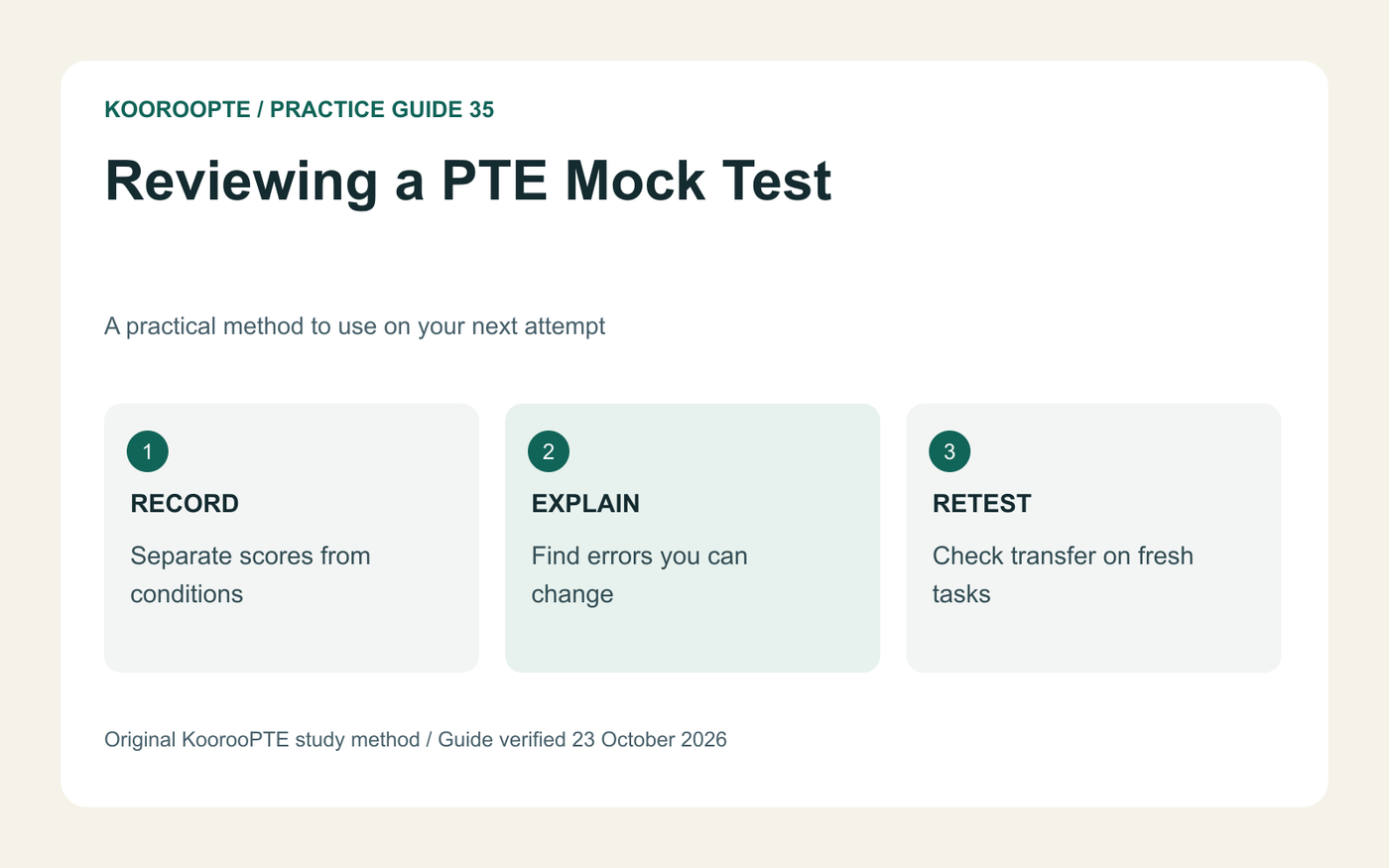
PTE mock test review should explain what to practise next, not stop at the overall score. Record the conditions, inspect errors in actual responses and choose a small number of corrections to test on unfamiliar material. This guide provides a worked review log and distinguishes useful practice evidence from a guaranteed official result.
Written by the KoorooPTE editorial team. Last updated and fact-checked: 23 October 2026.
What should a mock-test review produce?
A mock-test review should produce a short, justified practice plan. The score is one piece of evidence; the most useful output is an explanation of the recurring errors you can change and a way to check whether the correction transfers.
Record where the result came from before interpreting it. An official Pearson Scored Practice Test, a third-party mock and a collection of self-marked exercises are different forms of evidence. Keep their labels attached rather than treating every number as an interchangeable prediction of an official result.
Pearson describes its Scored Practice Test as using its official scoring engine, while stating that the result does not guarantee the same outcome on test day. Its current versions have distinct fixed question sets. Repeating a familiar set can support learning, but familiarity changes what a higher result demonstrates.
How should you review a mock from start to finish?
Review conditions first, then inspect response-level errors before choosing a new practice priority. This order prevents you from building an elaborate explanation around a score without checking the work that produced it.
- Record the context. Note the date, test version, platform, equipment and any interruptions. Mark whether you had seen the questions before.
- Copy the result accurately. Keep the overall score and individual skills separate. Do not invent an overall calculation from the skill values.
- Compare your exact requirements. Identify unmet minimums using the receiving organization's wording, not a generic target you found elsewhere.
- Inspect a useful response sample. Review wrong, weak and uncertain answers, plus some correct answers where your reasoning was unclear. Look for repeated causes.
- Choose a small repair set. Select errors you can describe and practise, such as omitting conclusions, misreading quantities or losing word endings.
- Schedule an unfamiliar check. Decide what new material will test the correction and what observation would show improvement. Complete that check before declaring the weakness resolved.
Use the score-65 preparation guide for an example of comparing skill requirements. Its planning method applies to an exact target; it does not mean that everyone needs 65 or that a practice estimate establishes eligibility.
What does a worked error log look like?
A useful log names the error, its likely cause, the repair and the next check. Here are four fictional entries showing how to turn observations into practice decisions. They are not findings from real KoorooPTE user data.
Entry one: dictation. Observation: the response omitted “has been” but retained the main nouns. Possible cause: attention focused on content words. Repair: reconstruct short clauses including auxiliaries. Fresh check: use different sentences and count omitted function words separately from spelling errors.
Entry two: reading. Observation: the selected option changed “some participants” into “all participants.” Possible cause: topic matching without checking scope. Repair: underline quantity and certainty words while explaining each option. Fresh check: answer a new passage and justify the strength of each selected claim.
Entry three: spoken summary. Observation: the response listed examples but omitted the speaker's conclusion. Possible cause: notes captured nouns without relationships. Repair: use a claim, support and conclusion map. Fresh check: summarize a different recording and trace each main claim back to the source.
Entry four: essay. Observation: one body paragraph did not answer the prompt's central comparison. Possible cause: the plan followed a familiar topic rather than the actual question. Repair: write a one-sentence purpose for each paragraph before drafting. Fresh check: plan a new prompt and explain how each paragraph addresses it.
Keep possible causes provisional until a fresh attempt supports them. One omitted phrase could come from misunderstanding, poor recall or an input mistake. The purpose of the next check is partly to distinguish those explanations, not merely to confirm your first guess.
How should you prioritize the errors you find?
Prioritize repeated, consequential errors that you can act on now. A useful question is: “Does this problem recur, does it affect the required skill, and can I explain the correction?” That is an editorial decision rule, not a published Pearson weighting formula.
Do not infer fixed score percentages from a small mock. The number of sampled items, their difficulty and the scoring system matter. A task you happened to miss in one mock is not automatically the largest contributor to your official score.
Choose two main priorities for the next few sessions and maintain other skills with a smaller mixed set. For the fictional log above, repeated omissions and unsupported reading claims might be the first priorities if those patterns appear across several responses. A single typing slip can still be corrected, but it need not dominate the entire week.
Use the Write from Dictation guide and Reading Multiple Choice guide when those are the observed weaknesses. The link between evidence and practice matters more than choosing the same supposedly high-value task every time.
What should you do with correct answers you cannot explain?
Review them as uncertain evidence rather than treating every correct response as secure understanding. A guess, remembered answer or accidental selection can produce a correct result without showing a repeatable method.
For a reading answer, explain the supporting wording and why the strongest alternative fails. For a summary selection, state the source's main message before rereading the options. For dictation, check whether the phrase was heard accurately or reconstructed through a lucky guess.
Do not punish yourself for a correct answer that involved uncertainty. Use the uncertainty to choose a fresh check. If you can explain and repeat the reasoning on different material, the evidence becomes stronger than the original answer letter alone.
How can you avoid false comparisons between mocks?
Compare results only after recording differences in content and conditions. A familiar question set, extra replays, a quieter room or additional time can change the outcome. Those changes may be useful for learning, but they complicate a claim that language proficiency alone improved.
Keep first attempts separate from supported review. You can replay a recording and inspect a transcript during learning, then attempt new material independently later. Combining both stages into one reported accuracy figure hides how much help was required.
When comparing different platforms, examine observable errors before assuming their overall scales are equivalent. “Two fewer missing main ideas on fresh summaries” is a concrete observation. “This platform's 75 guarantees Pearson 75” is an unsupported conclusion.
What should your next two practice sessions contain?
The next two sessions should repair a specific pattern and test it on unfamiliar work. In the first session, inspect examples, explain the correction and practise it with feedback. In the second, use different material under the relevant independent conditions and compare the same error category.
Use this reusable review checklist: source of score labelled; conditions recorded; exact requirements compared; recurring errors explained; repair chosen; fresh check scheduled. Save a brief before-and-after example so the next review starts with evidence of what changed.
Begin with Write from Dictation practice if omitted words are your priority, or select the task your log supports. Fit the repair sessions into the one-month plan when you need a longer structure. Take another broad mock when it can answer a new readiness question, and preserve time to review its result afterward.
Which sources were checked for this guide?
Exam facts were checked against Pearson's current scoring guidance and the Test Taker Score Guide (pages 6-8) on 23 October 2026. Additional references: scored practice. The examples, schedules and review methods are original KoorooPTE teaching material, not official test questions, scored Pearson responses or promises of improvement.
Frequently asked questions
Does an official practice score guarantee my real PTE result?
No. Pearson describes its Scored Practice Test result as an indicator of proficiency rather than a guaranteed test-day score. Use it alongside evidence from your responses and practice conditions. A result is more useful when you can explain the remaining weaknesses and see whether corrections transfer to unfamiliar tasks.
Can I compare scores from different practice platforms directly?
Treat the comparison cautiously because platforms may use different scoring methods, task samples and feedback scales. Do not assume that an identical number has identical meaning everywhere. Compare observable features such as spelling errors, missing ideas and completion first, and record which source produced each broader practice score.
What if my score rises when I repeat the same mock?
Record the improvement, but separate familiarity with the questions from a transferable skill change. You may remember answers or anticipate difficult sections on a repeat attempt. Use different material for the next readiness check and examine whether the specific errors you targeted remain improved when that memory advantage is removed.